

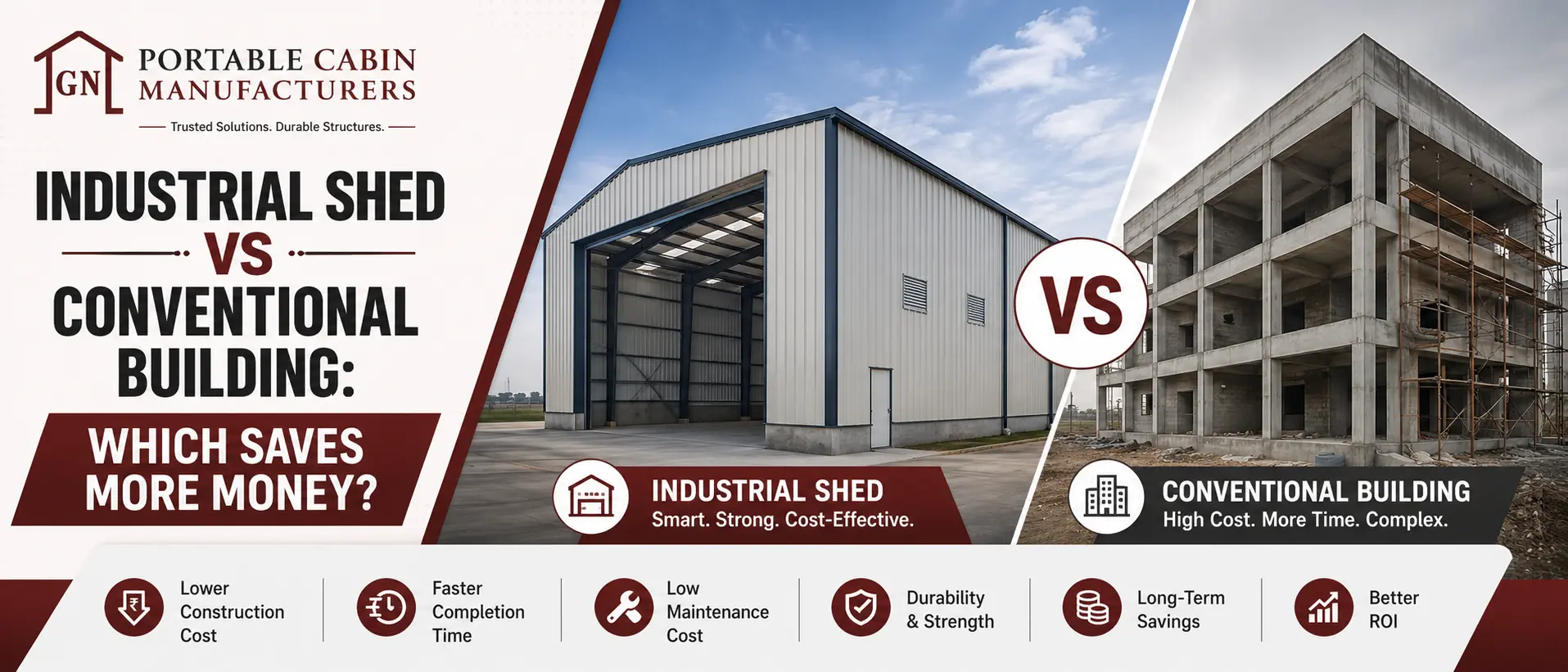
Industrial Shed vs Conventional Building: Which Saves More Money?
01 Jun, 2026
In industrial infrastructure planning, the debate between an industrial shed and a conventional building rarely comes down to construction cost alone. The more important question is how each structure behaves over time during expansion, maintenance, production scaling, and operational usage.
For manufacturing companies, logistics operators, fabrication workshops, and warehouse developers, the decision often affects long-term capital efficiency far more than the initial quotation.
Search intent around “Industrial Shed vs Conventional Building” is typically mid-commercial. Buyers are not simply looking for definitions. They are trying to understand which structure delivers better economic value under real operating conditions before requesting supplier quotations.
In practice, both systems serve different operational goals. The financial outcome depends heavily on production requirements, structural span, material selection, site conditions, and lifecycle expectations.
Industrial Pricing Overview
Industrial shed pricing is generally factor-driven rather than fixed-rate driven. Unlike commodity products, industrial structures involve multiple engineering variables that influence fabrication complexity and installation cost.
Conventional buildings usually involve:
- RCC-intensive civil work
- Longer construction timelines
- Higher wet-work dependency
- Larger foundation requirements
- Sequential construction stages
Industrial sheds, especially prefabricated steel-based systems, often reduce several of these variables through modular fabrication and faster site execution.
However, lower construction time does not automatically mean lower total ownership cost. In many industrial projects, maintenance exposure, future expansion flexibility, and operational downtime become equally important financial considerations.
Industrial sheds often reduce construction timelines, structural dead load, and future expansion costs compared to conventional buildings. Conventional structures may offer longer permanence in certain applications, but industrial sheds generally provide faster deployment and more flexible lifecycle economics for manufacturing and warehousing operations.
Key Factors Influencing Pricing
Several cost drivers determine whether an industrial shed or a conventional structure becomes financially viable.
Major Pricing Variables
- Steel grade and structural thickness
- Cement and aggregate market volatility
- Foundation design complexity
- Clear-span requirements
- Roof insulation specifications
- Wind-load and seismic-zone engineering
- Fabrication precision requirements
- Surface treatment and corrosion protection
- Crane load integration
- Transportation distance
- Installation equipment availability
- Project execution timeline
Industrial projects in sectors like automotive components, warehousing, cold storage, and fabrication workshops often prioritize speed and scalability over architectural permanence.
This changes the pricing logic considerably.
Material & Specification Impact
Material selection is one of the largest differentiators between industrial sheds and conventional buildings.
Conventional buildings rely heavily on:
- Reinforced concrete
- Brickwork
- Wet plaster systems
- On-site curing processes
Industrial sheds typically use:
- Structural steel sections
- PEB components
- Galvanized sheets
- Insulated roofing systems
- Bolted structural assemblies
The advantage of steel structures is not simply weight reduction. Precision fabrication allows controlled manufacturing conditions before site dispatch.
This is one reason why many industrial operators exploring scalable infrastructure also evaluate modern fabrication-led systems through solutions like the industrial structure applications discussed on the national product section.
Still, specification sensitivity matters.
For example:
- Higher bay height increases steel consumption
- Crane-supported sheds require heavier structural members
- Coastal projects demand stronger corrosion resistance
- Thermal insulation layers influence roofing cost significantly
In conventional buildings, concrete grade changes, curing timelines, and civil reinforcement density influence pricing differently.
Neither system is universally cheaper. The application decides the economics.
Production & Process Variables
Manufacturing methodology has a major effect on project cost stability.
Industrial sheds benefit from off-site fabrication. This reduces:
- Weather dependency
- On-site labor variability
- Construction staging delays
- Material wastage
Conventional construction remains more labor-intensive and site-dependent.
In many industrial zones, project delays themselves become hidden cost centers. Delayed commissioning may affect machinery installation schedules, production launches, or warehouse operations.
This is why procurement teams increasingly evaluate construction methodology alongside quotation totals.
At companies handling Pan-India supply operations, including firms like Gururnanak Interiors, execution coordination often becomes as important as fabrication cost itself.
MOQ & Volume Economics
Industrial shed economics improve considerably with scale.
Bulk Project Scenario
Suppose a company develops:
- Multiple warehouse bays
- Repetitive manufacturing units
- Cluster-based industrial infrastructure
In such cases, fabrication efficiencies improve because:
- Structural repetition reduces engineering variation
- Procurement batches become larger
- Material wastage decreases
- Transportation optimization improves
- Installation crews work continuously
This often reduces per-unit project inefficiencies.
Custom Project Scenario
A highly customized industrial setup may involve:
- Special ventilation systems
- Crane integration
- Irregular dimensions
- Multi-level mezzanine integration
- Specialized roofing systems
Customization increases:
- Design coordination
- Fabrication adjustments
- Site alignment complexity
- Installation precision requirements
This narrows the cost advantage between industrial sheds and conventional buildings.
Customization vs Standard Production
One common misconception is that industrial sheds are always standardized products.
In reality, industrial infrastructure customization can become extensive.
Common Customization Layers
- Thermal insulation
- Skylight integration
- Fire safety provisions
- Acoustic treatment
- Ventilation systems
- Mezzanine floors
- Solar roof compatibility
- Loading dock integration
- Crane beam systems
Each additional engineering layer changes fabrication sequencing and installation planning.
Conventional buildings also accommodate customization, but usually through longer civil execution cycles.
The important distinction is flexibility.
Industrial sheds generally allow future modification with lower structural disruption.
For businesses expecting production scaling or layout reconfiguration, this flexibility can become financially valuable over a 10–15year period.
Logistics & Supply Chain Influence
Industrial structure pricing is highly sensitive to logistics.
Unlike small-scale construction materials, fabricated steel sections involve:
- Long-length transportation
- Route permissions
- Loading coordination
- Fuel fluctuation exposure
- Site unloading equipment
Pan-India distribution capability influences project execution reliability.
Projects supplied from manufacturing hubs like Greater Noida may experience different freight economics depending on:
- Site accessibility
- Regional steel availability
- Installation crew movement
- Distance from fabrication base
This becomes particularly relevant for companies evaluating multi-location industrial development across India. Regional deployment capability often matters more than headline quotation pricing.
How Quotations Are Structured
Industrial shed quotations are usually specification-based rather than flat-price based.
Typical Quotation Components
- Structural design scope
- Steel section specifications
- Roofing configuration
- Surface coating system
- Foundation assumptions
- Fabrication cost
- Transportation
- Erection and installation
- Accessories and finishing
- Taxes and compliance scope
Quotation Calculation Logic
A quotation generally evolves through three stages:
- Load & Design Analysis
Structural requirements determine section sizes and steel consumption. - Fabrication Complexity Review
Welding precision, connection design, and customization affect production effort. - Site Execution Assessment
Freight, erection equipment, and installation accessibility influence final costing.
This is why two industrial sheds with similar dimensions may still have significantly different quotations.
Industrial shed quotations are usually based on structural load requirements, fabrication complexity, roofing specifications, transportation distance, and installation conditions rather than simple square-foot pricing. Custom engineering and future scalability often influence the final project value more than base material cost alone.
Price vs Quality vs Lifecycle Value
Lowest initial pricing does not always produce the best long-term economics.
This is especially true in industrial environments where structures operate continuously under:
- Heat exposure
- Machinery vibration
- Dust accumulation
- Corrosive environments
- Heavy logistics movement
A lower-grade structure may eventually increase:
- Maintenance frequency
- Operational interruptions
- Roof leakage issues
- Structural fatigue risk
- Expansion difficulty
Industrial sheds designed with proper engineering flexibility often perform better when production layouts evolve over time.
Conventional buildings may offer perceived permanence, but modifications can become expensive and disruptive.
Lifecycle value depends on:
- Operational adaptability
- Maintenance exposure
- Structural durability
- Expansion efficiency
- Downtime reduction
In many manufacturing setups, operational continuity ultimately outweighs marginal upfront savings.
Evaluating a Manufacturer Quote
Many buyers compare quotations only by total price. That approach can create costly misunderstandings later.
What Buyers Should Review Carefully
- Structural steel grade
- Wind-load assumptions
- Roof sheet thickness
- Corrosion protection system
- Foundation exclusions
- Erection scope clarity
- Transportation responsibility
- Warranty limitations
- Expansion compatibility
- Installation timeline assumptions
A detailed quotation often reflects stronger engineering discipline.
In industrial procurement, missing scope details frequently become post-order cost escalations.
Companies with fabrication experience usually clarify specification assumptions earlier because site conditions vary substantially across projects.
FAQs
1. Is an industrial shed cheaper than a conventional building?
In many industrial applications, sheds reduce construction time and structural weight, which may improve cost efficiency. However, final economics depend on customization level, foundation requirements, insulation needs, and long-term operational expectations.
2. Which structure is faster to construct?
Industrial sheds are generally faster because fabrication occurs off-site while foundation work progresses simultaneously. Conventional buildings usually involve sequential civil stages that extend project timelines.
3. Are industrial sheds suitable for long-term use?
Yes, when properly engineered and maintained. Structural design quality, coating systems, roofing specifications, and environmental exposure all influence long-term durability.
4. Why do industrial shed quotations vary so much?
Variations usually come from structural load calculations, steel grade selection, roofing systems, crane integration, insulation requirements, transportation distance, and installation complexity.
5. Which option is better for future expansion?
Industrial sheds are typically easier to expand because modular steel systems allow phased structural additions with lower disruption compared to conventional RCC expansion.
Conclusion
The comparison between industrial sheds and conventional buildings is ultimately a question of operational priorities rather than headline pricing alone.
Industrial sheds often deliver advantages in:
- Execution speed
- Scalability
- Structural flexibility
- Future expansion
- Fabrication precision
Conventional buildings may still suit projects requiring highly permanent civil-intensive infrastructure.
For most industrial and logistics environments, the smarter financial decision comes from aligning structural design with long-term operational goals rather than focusing only on initial construction cost.
For a specification-based quotation aligned to project scale, material configuration, and delivery requirements, businesses may consult the team at Gururnanak Interiors.


