

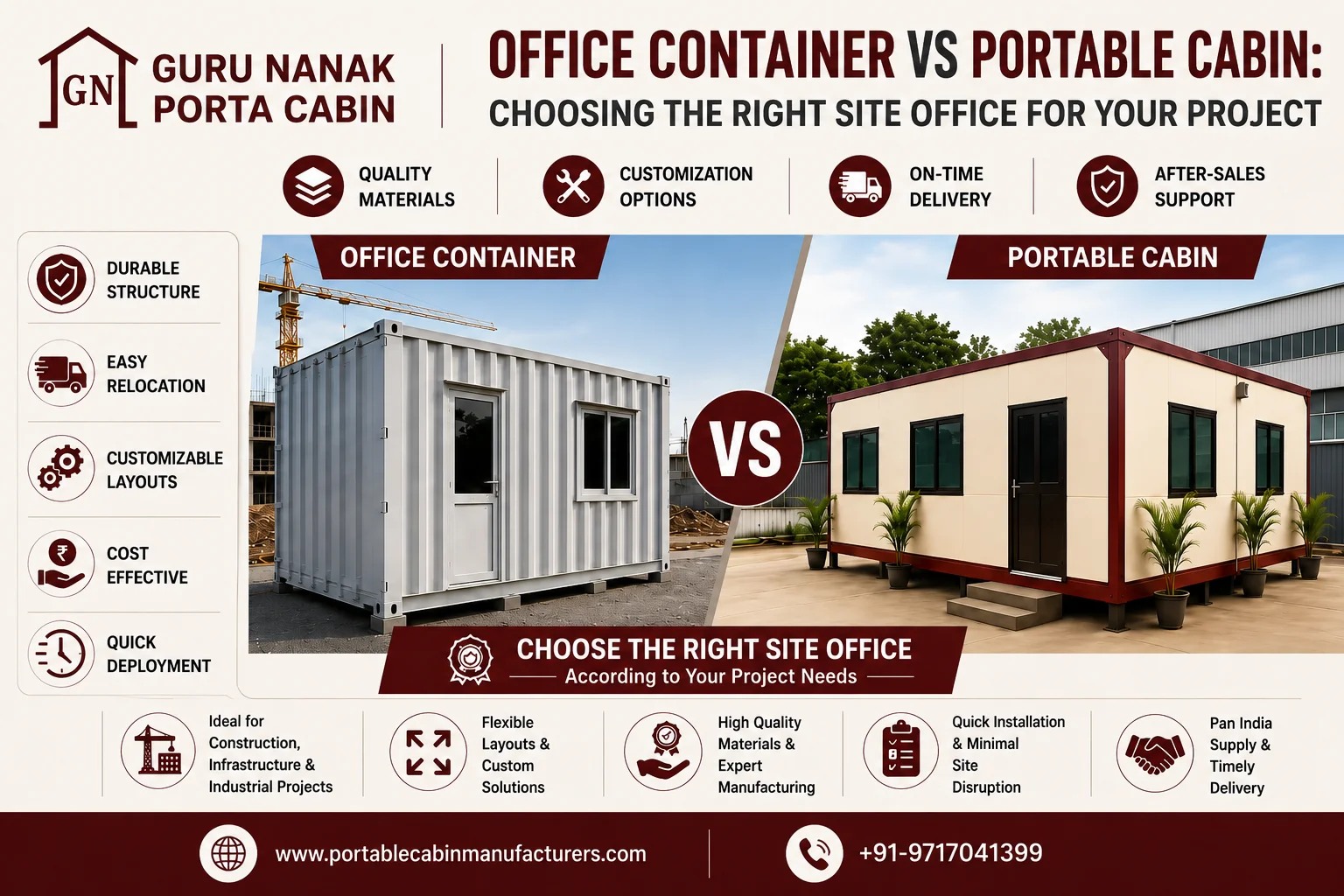
Office Container vs Portable Cabin: Choosing the Right Site Office for Your Project
04 Jul, 2026
Selecting the right temporary site office is more than choosing a prefabricated structure—it directly affects project efficiency, workforce productivity, relocation flexibility, and long-term operating costs. Whether you're managing a construction site in Delhi NCR, an infrastructure project in Noida, or a manufacturing expansion in Ghaziabad, the choice often comes down to Office Container vs Portable Cabin.
Although these terms are frequently used interchangeably, they are not always the same. Their structural design, mobility, customization options, installation requirements, and ideal applications can differ depending on project needs.
For procurement managers, EPC contractors, project engineers, and facility managers, selecting the wrong solution may lead to unnecessary transportation expenses, limited scalability, higher maintenance, or operational inefficiencies.
|
Comparison Factor
|
Office Container | Portable Cabin |
| Primary Purpose | Relocatable site office | Modular workspace with flexible layouts |
| Mobility | Excellent | Good |
| Structural Design | Steel container framework | Custom modular construction |
| Layout Flexibility | Moderate | High |
| Customization | Good | Extensive |
| Installation Time | Generally quick | Depends on customization |
| Expansion Possibility | Modular stacking and joining | Highly customizable |
| Suitable Project Duration |
Temporary to long-term |
Temporary to permanent |
| Transportation | Easier for repeated relocation | Depends on design |
| Typical Buyers | EPC, Construction, Infrastructure | Commercial, Industrial, Institutional |
This comparison explains the practical differences between an Office Container and a Portable Cabin, helping industrial buyers evaluate which solution aligns better with their project objectives instead of relying on marketing claims.
An Office Container is generally preferred when durability, frequent relocation, and secure modular workspaces are the priority. A Portable Cabin is often more suitable when greater design flexibility, customized layouts, or permanent-to-semi-permanent site offices are required. The better choice depends on project duration, mobility needs, customization requirements, and future expansion plans.
What is an Office Container?
An Office Container is a modular workspace built using a robust steel container framework that is designed for transportation, relocation, and repeated use across multiple project sites. These units are widely used as temporary or semi-permanent site offices in construction, infrastructure, mining, warehousing, manufacturing, and EPC projects.
Modern office containers can be equipped with:
- Administrative office space
- Meeting rooms
- Electrical wiring
- Insulation
- Air-conditioning provisions
- Washrooms
- Pantry areas
- Storage sections
- Modular furniture layouts
One of the biggest advantages of an office container is its ability to be transported with minimal dismantling, making it suitable for projects that frequently change locations.
Buyer Insight: If your project involves multiple sites over several years, relocation capability often becomes a more important factor than initial procurement cost.
When is an Office Container the Right Choice?
An Office Container is commonly selected for:
- Construction site offices
- Highway and metro projects
- Infrastructure development
- EPC contractor site offices
- Oil & Gas field offices
- Mining camps
- Renewable energy projects
- Temporary administrative buildings
- Warehouse management offices
- Industrial expansion projects
Projects requiring quick deployment and future relocation generally benefit from container-based office solutions.
Need detailed specifications or customization options? Explore the Office Container product page to understand available configurations before requesting quotations.
What is a Portable Cabin?
A Portable Cabin is a prefabricated modular structure manufactured for temporary, semi-permanent, or permanent use depending on the project requirement. Unlike a traditional shipping-style container, a portable cabin offers greater flexibility in dimensions, interior layouts, partition planning, and architectural customization.
Portable cabins are widely used as:
- Site offices
- Security cabins
- Staff accommodation
- Sales offices
- Classroom cabins
- Healthcare units
- Labour camps
- Commercial cabins
- Control rooms
- Retail kiosks
Depending on the intended application, portable cabins may be designed using insulated panels, steel sections, modular framing systems, and customized interior finishes.
For projects where aesthetics, layout flexibility, or customer-facing spaces are important, portable cabins often provide more design freedom than standard office containers.
Office Container vs Portable Cabin: Quick Comparison

The Biggest Difference Isn't the Structure It's the Project Requirement
Many buyers compare these two products based only on appearance. In reality, procurement decisions should focus on operational requirements rather than product names.
Ask these questions before comparing suppliers:
- Will the office need to move to another project site?
- How long will the structure remain in use?
- Is future expansion expected?
- Does the workspace require multiple cabins or departments?
- Are employee comfort and aesthetics major priorities?
- Will transportation happen multiple times during the project lifecycle?
Answering these questions first usually narrows the choice more effectively than comparing specifications alone.
Key Differences Procurement Teams Should Evaluate Before Buying
Choosing between an Office Container and a Portable Cabin should be based on operational requirements, not just product specifications. Below are the factors that typically influence procurement decisions across construction, infrastructure, manufacturing, and industrial projects.
1. Structural Strength
Office Container
An Office Container is generally built on a heavy-duty steel framework designed to withstand repeated transportation and challenging site conditions. Its rigid construction makes it suitable for projects where relocation is expected multiple times.
Best suited for:
- Infrastructure projects
- Mining sites
- Oil & Gas projects
- EPC contractors
- Remote industrial locations
Portable Cabin
Portable Cabins are also manufactured using steel structures but are designed with greater flexibility. The structural configuration can vary depending on project requirements, dimensions, insulation, and intended use.
Best suited for:
- Commercial offices
- Educational campuses
- Healthcare facilities
- Sales offices
- Long-duration project sites
Verdict
Choose an Office Container if structural durability during transportation is a primary concern.
Choose a Portable Cabin when project-specific customization matters more than repeated relocation.
2. Mobility and Relocation
One of the biggest differences between these two solutions is how easily they can be moved.
Office Container
Office Containers are specifically designed for transportation.
Advantages include:
- Minimal dismantling
- Faster loading and unloading
- Suitable for multiple project transfers
- Reduced relocation effort
For companies managing projects across different cities, mobility can significantly reduce future infrastructure investments.
Portable Cabin
Portable Cabins can also be relocated, but the process depends on:
- Overall dimensions
- Structural design
- Number of modules
- Interior customization
Highly customized cabins may require additional planning before transportation.
Buyer Recommendation
If your company executes multiple projects each year across different locations, mobility should receive higher priority than interior customization.
3. Interior Layout Flexibility
Interior planning directly impacts employee comfort and operational efficiency.
Office Container
Typical layouts include:
- Manager cabins
- Conference rooms
- Workstations
- Pantry
- Washroom
- Storage
Although customizable, layout flexibility is influenced by the container dimensions.
Portable Cabin
Portable Cabins offer significantly greater design flexibility.
Possible customizations include:
- Multiple cabins
- Reception areas
- Conference halls
- Open office layouts
- Large meeting rooms
- Executive cabins
- Double-height structures
- Glass partitions
Projects requiring customer interaction or administrative offices often benefit from this flexibility.
Decision Snapshot

4. Installation Requirements
Installation time influences project readiness and operational planning.
Office Container
Most Office Containers require:
- Site leveling
- Utility connections
- Positioning using cranes or lifting equipment
Since the primary structure is already manufactured, installation is generally straightforward.
Portable Cabin
Installation requirements depend on:
- Number of modules
- Foundation preparation
- Utility integration
- Customized interiors
- On-site assembly requirements
Larger cabins may involve additional installation activities.
Procurement Tip
When comparing quotations, always ask suppliers whether transportation, unloading, installation, and commissioning are included or quoted separately.
Hidden installation costs can affect the total project budget.
5. Customization Capabilities
No two industrial projects have identical workspace requirements.
A reliable manufacturer should be able to customize:
- Cabin size
- Internal partitions
- Flooring
- Wall insulation
- Windows
- Doors
- Electrical layout
- Lighting
- HVAC provisions
- Washrooms
- Pantry
- Branding elements
Portable Cabins generally offer more architectural flexibility, while Office Containers provide a practical balance between customization and mobility.
6. Maintenance Considerations
Maintenance costs influence the total cost of ownership over the life of the structure.
Office Container
Maintenance usually focuses on:
- Surface coating
- Corrosion protection
- Door hardware
- Electrical inspection
- Roof sealing
Routine inspections can help extend the usable life of the structure.
Portable Cabin
Maintenance depends on:
- Exterior materials
- Roofing system
- Panel quality
- Insulation
- Interior finishes
The maintenance schedule may vary based on project environment and usage intensity.
Which Option Requires Less Maintenance?
There is no universal answer.
Well-manufactured Office Containers and Portable Cabins can both provide long service life when appropriate materials, protective coatings, and regular maintenance practices are followed.
Instead of asking, "Which requires less maintenance?", procurement teams should ask:
- What materials are used?
- What protective finishes are applied?
- What maintenance is recommended?
- How easy are replacement parts to source?
Industry-Wise Recommendation
Different industries prioritize different performance requirements. The table below provides a practical guide.


