

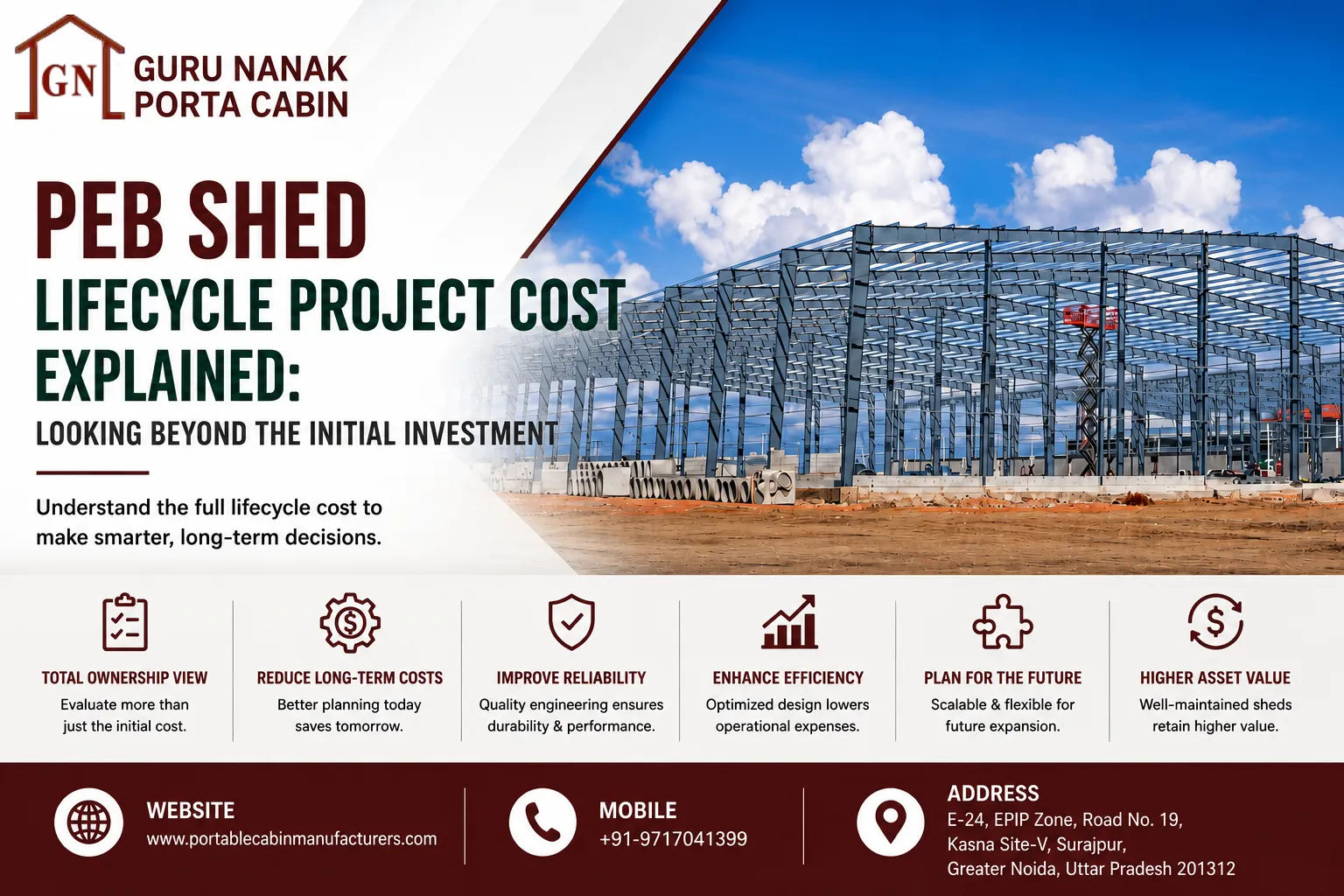
PEB Shed Lifecycle Project Cost Explained: Looking Beyond the Initial Investment
14 Aug, 2026
Many industrial buyers compare PEB shed quotations by looking at only one number—the initial project cost. While that may help shortlist suppliers, it rarely reveals what the building will actually cost over the next 20 to 30 years.
A PEB shed is a long-term business asset. Its financial impact extends far beyond fabrication and erection. Maintenance requirements, protective coatings, structural engineering, expansion capability, operating efficiency, repair planning, and residual asset value all contribute to the PEB shed lifecycle cost.
For procurement managers, project engineers, and factory owners, this broader perspective is essential. A quotation that appears economical today may result in higher maintenance expenses, operational disruptions, or costly structural modifications later. Conversely, a slightly higher initial investment supported by better engineering and quality manufacturing can significantly reduce the PEB shed total ownership cost throughout the building's service life.
This article explains how industrial buyers should evaluate a PEB shed from a lifecycle perspective rather than focusing solely on construction cost. Instead of discussing fixed prices—which vary according to engineering specifications and project requirements—we examine the factors that influence long-term investment and help organizations make commercially sound decisions before requesting quotations.
PEB shed lifecycle cost refers to the total cost incurred throughout the building's operational life rather than only the initial construction expense. It includes engineering, fabrication, transportation, erection, inspections, preventive maintenance, protective coatings, repairs, future expansions, operational efficiency, and eventual asset value. Evaluating these factors together provides a more accurate picture of project economics and supports better procurement decisions.
What Is PEB Shed Lifecycle Cost?
PEB shed lifecycle cost is the cumulative investment required to own, operate, maintain, repair, and eventually upgrade a steel building throughout its expected service life. It provides a broader financial assessment than the initial construction budget.
Unlike a simple project estimate, lifecycle costing evaluates every stage of ownership. It considers not only what is spent during construction but also the ongoing costs that influence the building's operational efficiency and longevity.
Typical lifecycle cost components include:
| Lifecycle Stage | Commercial Consideration |
|---|---|
| Engineering & Design | Structural optimization, design loads, detailing |
| Fabrication | Steel processing, welding quality, dimensional accuracy |
| Transportation | Logistics planning and site accessibility |
| Erection | Crane deployment, installation efficiency, alignment |
| Operations | Building performance during daily use |
| Preventive Maintenance | Scheduled inspections and upkeep |
| Repairs | Wear, corrosion management, component replacement |
| Future Expansion | Additional bays, extensions, structural modifications |
| Residual Asset Value | Remaining value after years of operation |
For industrial facilities such as manufacturing plants, warehouses, logistics centres, and processing units, this approach provides a realistic understanding of the PEB shed lifecycle project cost instead of focusing only on the purchase stage.
Why Initial Construction Cost Can Be Misleading
A lower construction quotation does not automatically translate into lower ownership cost. Engineering quality, material selection, maintenance requirements, and future adaptability often determine the actual financial outcome.
Many organizations issue RFQs with a primary objective of reducing upfront expenditure. While budget discipline is important, comparing quotations only by total price can overlook significant lifecycle considerations.
For example, two PEB sheds may appear similar in dimensions but differ substantially in:
- Structural steel optimization
- Protective coating specifications
- Connection detailing
- Fabrication precision
- Roof and wall cladding systems
- Drainage design
- Expansion provisions
- Corrosion protection strategy
Each of these elements influences maintenance frequency, repair requirements, and operational reliability over many years.
Commercial Insight
The lowest quotation often represents the lowest initial investment—not necessarily the lowest PEB shed long term cost.
A building designed with better engineering coordination and higher fabrication accuracy may require fewer structural interventions during its operational life, reducing both maintenance expenditure and production interruptions.
Major Cost Stages Throughout a PEB Shed's Life
Rather than treating the project as a single purchase, experienced procurement teams evaluate it as a sequence of commercial investments.
1. Engineering & Structural Design
Every lifecycle begins with engineering.
Structural calculations determine:
- Steel quantity
- Member sizing
- Wind resistance
- Seismic performance
- Future expansion capability
- Roof loading
- Crane loading (where applicable)
Engineering decisions made before fabrication influence almost every future cost category.
Poor optimization can increase:
- unnecessary steel consumption
- fabrication complexity
- erection time
- maintenance challenges
- future modification costs
2. Manufacturing & Fabrication
Fabrication quality affects more than appearance.
Accurate CNC cutting, controlled welding, dimensional consistency, and factory inspections help ensure that structural members fit correctly during erection.
Benefits include:
- Reduced site adjustments
- Lower installation delays
- Better structural alignment
- Improved coating performance
- Lower repair probability
Manufacturers with integrated engineering and fabrication processes generally provide greater consistency throughout project execution because design intent is maintained from detailing through production.
3. Transportation
Transportation is frequently underestimated when calculating PEB shed project cost.
Logistics expenses depend upon:
- project location
- vehicle accessibility
- component dimensions
- loading sequence
- unloading equipment
- route restrictions
Remote industrial locations or restricted-access sites often require additional transportation planning that should be considered during commercial budgeting.
4. Erection & Installation
The efficiency of structural erection directly influences labour costs, equipment utilization, and project schedules.
Installation expenses may vary depending on:
- foundation readiness
- crane availability
- weather conditions
- site logistics
- erection sequence
- workforce productivity
Delays during erection can also affect related project activities, increasing indirect costs beyond the structural package itself.
5. Operational Phase
After commissioning, the building enters its longest and most financially significant stage—daily operation.
During this period, owners should evaluate:
- structural stability
- roofing performance
- ventilation efficiency
- drainage effectiveness
- corrosion resistance
- accessibility for inspections
Operational efficiency influences the overall industrial shed lifecycle cost, especially for facilities expected to remain in service for decades.
Engineering Decisions That Influence Long-Term Cost
Engineering is one of the strongest predictors of lifecycle value because it determines how efficiently the building performs, how easily it can be maintained, and how adaptable it remains for future operational needs.
Several engineering decisions continue affecting costs long after construction has been completed.
Building Span Selection
Choosing an appropriate span improves material efficiency while supporting intended operational activities.
Oversized spans may increase structural steel usage unnecessarily, whereas undersized spans can restrict equipment movement and future layout flexibility.
Expansion Planning
Industrial facilities often evolve over time.
If expansion provisions are considered during the original design, additional bays can typically be integrated with less disruption than retrofitting an existing structure.
Ignoring expansion planning at the design stage may increase future engineering, fabrication, and installation costs.
Drainage Design
Improper drainage accelerates water accumulation, which may contribute to corrosion, roof deterioration, and maintenance interventions.
An effective drainage system reduces both maintenance effort and long-term repair expenditure.
Ventilation Strategy
Proper ventilation supports:
- employee comfort
- moisture control
- equipment protection
- roof longevity
Operational efficiency is therefore linked not only to productivity but also to reduced building deterioration.
Decision Summary
Engineering should not be viewed as a design expense alone. It is an investment that influences maintenance, repair frequency, operational efficiency, and future expansion costs throughout the building's lifecycle.
Material Selection and Structural Optimization
Material specifications significantly influence the PEB shed total ownership cost.
Important considerations include:
- Structural steel grades
- Roof and wall cladding specifications
- Fastener quality
- Protective coating systems
- Corrosion resistance
- Environmental exposure
- Industrial operating conditions
Selecting materials solely to reduce initial procurement costs may increase future maintenance requirements.
Conversely, specifications aligned with the intended operating environment generally improve durability and reduce lifecycle expenditure.
Commercial Insight
Before approving material substitutions, evaluate how they may affect inspection intervals, repainting frequency, structural durability, and operational reliability—not just the immediate project budget.
Fabrication Quality and Manufacturing Precision
Fabrication quality influences much more than installation speed.
High manufacturing accuracy helps achieve:
- Better structural alignment
- Improved connection performance
- Reduced on-site modifications
- Better load distribution
- Lower risk of premature wear
- Easier future maintenance
When evaluating a PEB shed manufacturer, buyers should review engineering capability alongside manufacturing processes rather than focusing solely on quoted prices.
Companies such as Guru Nanak Porta Cabin, with engineering-led project planning, in-house steel fabrication, and Greater Noida manufacturing facilities, typically support procurement teams with project-specific structural planning rather than offering one-size-fits-all solutions. However, buyers should always evaluate any supplier based on engineering competence, manufacturing capability, quality processes, and project suitability rather than price alone.
Transportation and Erection Costs Extend Beyond Delivery
Many buyers assume transportation costs end once structural members reach the site.
In reality, lifecycle planning also considers:
- unloading arrangements
- temporary storage
- lifting equipment
- handling practices
- erection sequencing
- protection against site damage
Poor handling during installation may create issues that only become visible years later through coating damage or localized corrosion.
Planning logistics properly therefore contributes to reducing the overall PEB shed lifecycle value by minimizing avoidable maintenance interventions.
Decision Checkpoint Before Comparing Quotations
Before selecting a supplier, ask whether each quotation clearly defines:
- Engineering scope
- Structural design assumptions
- Steel quantity basis
- Protective coating specification
- Fabrication quality process
- Transportation scope
- Erection responsibilities
- Future expansion provisions
- Inspection requirements
- Preventive maintenance recommendations
A quotation that answers these questions often provides greater commercial transparency than one that simply presents a lower total price.
Preventive Maintenance: The Biggest Driver of PEB Shed Operating Cost
Preventive maintenance is generally more economical than corrective repairs because it helps identify minor issues before they affect structural integrity, roofing performance, or operational continuity.
A well-maintained PEB shed can operate efficiently for decades with planned inspections and timely upkeep. In contrast, neglecting maintenance often leads to larger repair scopes, production interruptions, and higher lifecycle expenditure.
A structured maintenance plan should typically include:
| Maintenance Activity | Why It Matters |
|---|---|
| Structural member inspection | Detects deformation or damage early |
| Bolt and fastener checks | Maintains structural stability |
| Roof sheet inspection | Prevents water ingress |
| Wall cladding inspection | Identifies impact damage or corrosion |
| Protective coating assessment | Preserves corrosion resistance |
| Gutter and drainage cleaning | Prevents water accumulation |
| Sealant inspection | Maintains weather protection |
| Expansion joint inspection | Supports long-term structural movement |
The frequency of these activities depends on environmental exposure, operational conditions, and the building's intended use.
Commercial Insight
Maintenance should be included in the original project budget rather than treated as an unexpected future expense. Buyers who account for preventive maintenance during procurement often experience fewer unplanned costs over the building's service life.
Understanding PEB Shed Maintenance Cost
PEB shed maintenance cost depends on building specifications, operating environment, inspection frequency, coating systems, and maintenance practices—not simply on the age of the structure.
Industrial facilities located in coastal regions, chemical processing plants, mining operations, or areas with high humidity may require more frequent inspections than buildings operating in relatively mild environments.
Common maintenance cost drivers include:
- Environmental exposure
- Corrosion protection requirements
- Roof accessibility
- Building height
- Operational intensity
- Ventilation effectiveness
- Drainage performance
- Preventive inspection schedules
Many buyers incorrectly assume maintenance costs remain constant throughout the building's life. In reality, they vary depending on how consistently the building is maintained and whether minor issues are addressed promptly.
Protective Coatings: A Small Decision With Long-Term Financial Impact
Protective coating systems play a significant role in reducing PEB shed repair cost because they protect structural steel from corrosion, weather exposure, and environmental deterioration.
The coating selected during fabrication influences:
- Corrosion resistance
- Maintenance intervals
- Surface durability
- Future repainting requirements
- Structural longevity
A coating system should always be selected based on the project's operating environment rather than initial material cost alone.
For example:
- Industrial manufacturing facilities may require coatings suitable for dust and chemical exposure.
- Coastal installations often need enhanced corrosion protection.
- Warehouses with controlled environments may have different coating requirements than heavy industrial plants.
Decision Summary
Protective coatings should be evaluated as a lifecycle investment rather than an isolated procurement expense.
Planning for Repairs Before They Become Emergencies
Repair planning reduces operational disruptions by identifying predictable maintenance requirements before they become critical failures.
Even well-engineered buildings require periodic repairs during long service lives.
These may include:
- Localized roof sheet replacement
- Fastener replacement
- Sealant renewal
- Gutter repairs
- Drainage improvements
- Surface treatment restoration
- Local cladding repairs
- Minor structural adjustments following operational modifications
Reactive maintenance typically costs more than planned interventions because emergency repairs may involve production downtime, expedited logistics, and additional labour.
Commercial Insight
The objective is not to eliminate repairs—it is to plan them intelligently so they have minimal impact on operations and budgets.
Future Expansion and Its Effect on Lifecycle Cost
Future expansion is generally less expensive when anticipated during the original engineering stage than when introduced after the building has been operating for several years.
Many industrial facilities grow gradually.
Additional production lines, storage capacity, or logistics operations often require:
- Additional bays
- Mezzanine floors
- Crane systems
- New loading areas
- Extended roof coverage
- Utility expansion
If the original structure includes expansion provisions, future work usually becomes more efficient from both engineering and commercial perspectives.
Procurement Scenario
An EPC contractor constructing an initial warehouse for current operations may already know that capacity will double within five years.
Designing expansion compatibility into the first phase often reduces:
- redesign costs
- structural modifications
- operational disruptions
- future project approvals
Thinking beyond today's requirements is one of the strongest contributors to PEB shed lifecycle value.
Operational Efficiency Also Influences Total Ownership Cost
Lifecycle cost is not limited to maintenance.
Building design also affects daily operating expenses.
Examples include:
- Natural lighting through skylights
- Roof ventilators for heat management
- Efficient drainage systems
- Better internal clear spans
- Future solar-ready roofing
- Efficient access for maintenance
These engineering decisions may improve operational efficiency throughout the building's service life while supporting lower ownership costs.
Commercial Insight
A feature that slightly increases construction cost may deliver measurable operational savings over many years.
Residual Asset Value: An Often-Ignored Lifecycle Component
Residual asset value refers to the remaining economic value of the structure after years of operation. It forms part of the overall PEB shed ROI calculation.
Unlike temporary structures with limited long-term value, a well-maintained PEB shed may continue providing operational utility beyond its original planning horizon.
Residual value depends upon:
- Structural condition
- Maintenance history
- Corrosion control
- Adaptability
- Remaining service life
- Market demand
Considering residual value provides a more balanced assessment of PEB shed cost over 20 years than evaluating only construction expenditure.
How to Compare Quotations Using Lifecycle Cost Instead of Initial Cost
A commercial comparison should evaluate long-term ownership rather than simply identifying the lowest bid.
Use the following framework before approving any quotation.
| Evaluation Parameter | Why It Matters |
|---|---|
| Engineering scope | Determines structural efficiency |
| Steel quantity justification | Prevents over- or under-design |
| Design loads | Supports long-term safety |
| Protective coating specification | Influences corrosion resistance |
| Fabrication quality process | Affects installation and durability |
| Roof & wall cladding | Impacts maintenance requirements |
| Transportation scope | Clarifies logistics responsibility |
| Erection methodology | Influences installation quality |
| Future expansion capability | Reduces modification costs |
| Maintenance recommendations | Supports lifecycle budgeting |
| Inspection procedures | Improves long-term reliability |
| Warranty scope | Defines post-installation responsibilities |
Decision Checkpoint
Before approving the lowest quotation, ask:
- Does it reduce today's budget or tomorrow's ownership cost?
- Are engineering assumptions clearly documented?
- Does the supplier explain lifecycle implications?
- Is preventive maintenance addressed?
- Will the building support future expansion?
These questions often reveal differences that are not immediately visible in commercial proposals.
Buyer Mistakes That Increase PEB Shed Lifecycle Project Cost
Many cost overruns originate from procurement decisions rather than construction activities.
Common mistakes include:
- Comparing quotations only on total price
- Ignoring lifecycle maintenance planning
- Overlooking protective coating specifications
- Selecting suppliers without engineering evaluation
- Failing to plan for future expansion
- Underestimating transportation and erection requirements
- Neglecting inspection schedules
- Approving design revisions late in the project
Avoiding these mistakes improves budgeting accuracy and strengthens long-term project economics.
Frequently Asked Questions
1. What does PEB shed lifecycle cost include?
It includes engineering, fabrication, transportation, erection, inspections, preventive maintenance, repairs, future expansion, operational efficiency, and residual asset value throughout the building's service life.
2. Is lifecycle costing different from construction cost?
Yes. Construction cost represents the initial investment, whereas lifecycle costing evaluates the total cost of ownership over many years.
3. Does better engineering reduce long-term costs?
In many cases, optimized engineering can reduce maintenance requirements, improve operational efficiency, and simplify future expansion.
4. Why do two similar PEB shed quotations differ significantly?
Differences may arise from structural design, steel quantity, coating systems, fabrication quality, engineering scope, accessories, logistics, and installation responsibilities.
5. Is preventive maintenance expensive?
Planned maintenance is generally more economical than emergency repairs because it helps prevent larger structural or operational issues.
6. How does corrosion affect lifecycle cost?
Corrosion can increase repair frequency, repainting requirements, and component replacement costs if not managed through suitable protective systems and inspections.
7. Should expansion planning be considered during the initial design?
Yes. Designing for future expansion can reduce engineering complexity and project costs when additional space is required later.
8. Does transportation affect total ownership cost?
Transportation itself is an initial project cost, but poor handling or logistics planning can contribute to future maintenance and repair requirements.
9. Can operational features improve ROI?
Features such as efficient ventilation, drainage, skylights, and maintenance accessibility can contribute to improved operational performance over the building's lifespan.
10. How should buyers evaluate PEB shed ROI?
ROI should consider total ownership cost, operational efficiency, maintenance requirements, adaptability, service life, and residual asset value rather than only initial construction expenditure.
11. What information should I provide when requesting a lifecycle-based quotation?
Providing building dimensions, intended application, design loads, location, environmental conditions, expansion plans, and accessory requirements enables suppliers to prepare a more accurate engineering-based estimate.
12. Is lifecycle analysis useful for warehouse and factory projects?
Yes. Warehouses, manufacturing plants, logistics centres, workshops, and processing facilities all benefit from lifecycle-based budgeting because these structures are expected to operate for many years.
13. How does fabrication quality influence lifecycle cost?
High-quality fabrication improves fit-up during erection, reduces on-site modifications, and contributes to long-term structural reliability.
14. Why should procurement teams focus on total ownership cost?
Because decisions based solely on initial price may overlook future maintenance, repairs, operational efficiency, and expansion costs that significantly affect overall project economics.
15. When should a lifecycle cost assessment be carried out?
Ideally, before finalizing engineering specifications and requesting commercial quotations so that lifecycle considerations can be incorporated into the project budget.
Replace a PEB Shed Lifecycle Cost Evaluation
The true value of a PEB shed is measured over its entire operational life—not on the day the purchase order is issued. Engineering quality, structural optimization, fabrication standards, protective coatings, preventive maintenance, and future adaptability collectively determine whether the building remains a cost-effective asset for decades.
Organizations that evaluate PEB shed lifecycle cost rather than focusing solely on construction expenditure are better positioned to prepare realistic budgets, compare suppliers fairly, and justify investments with greater confidence. This approach also helps procurement teams minimize unexpected ownership costs while maximizing the long-term return on their infrastructure investment.
If you're evaluating a new industrial shed, warehouse, factory building, or expansion project, an engineering-led lifecycle assessment can provide a clearer understanding of the investment before any commercial commitment is made. Guru Nanak Porta Cabin supports project teams with engineering-based planning, project-specific structural solutions, and customized quotations based on actual technical requirements—not generic estimates.


