

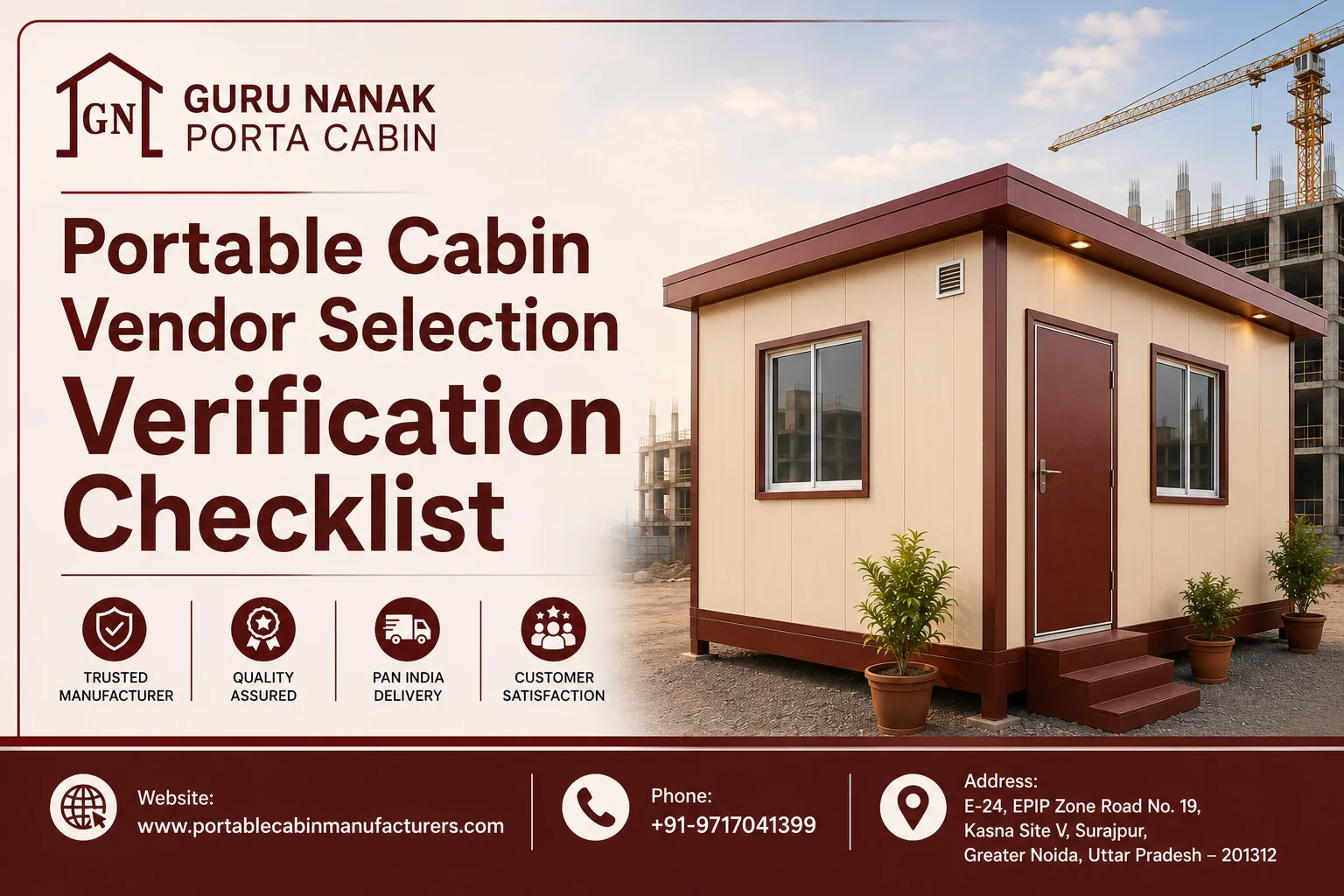
Portable Cabin Vendor Selection Verification Checklist for Procurement Teams
06 Jul, 2026
Selecting the right Portable Cabin Vendor requires more than comparing quotations. Procurement teams should verify manufacturing capability, certifications, product quality, customization options, delivery planning, installation support, warranty, and after-sales service before issuing a purchase order. A structured verification process reduces procurement risk and improves long-term project value.
Introduction
A portable cabin may look similar across multiple suppliers, but procurement teams know that the real difference lies behind the quotation.
Two vendors may offer comparable dimensions and layouts, yet differ significantly in manufacturing standards, material quality, delivery planning, technical support, and after-sales service. These differences often become visible only after production begins or when the cabin is delivered to the project site.
For construction companies, infrastructure contractors, factory owners, government procurement teams, and industrial buyers, choosing the wrong Portable Cabin Supplier can result in project delays, additional modification costs, installation challenges, or long-term maintenance issues.
This is why experienced procurement professionals rarely finalize a supplier based only on price. They follow a structured vendor verification process that evaluates the manufacturer's capability, commercial reliability, technical expertise, and ability to meet project-specific requirements.
This checklist is designed to help procurement teams reduce uncertainty before selecting a Portable Cabin Manufacturer in India. Instead of relying on sales presentations alone, buyers can use these verification points to compare suppliers objectively and make informed purchasing decisions.
Why Vendor Verification Matters Before Buying a Portable Cabin
A Portable Cabin is often purchased for projects where timelines, operational efficiency, and long-term usability are critical. Once manufacturing starts, changing suppliers becomes difficult and may disrupt project schedules.
Vendor verification helps procurement teams answer important questions before placing an order:
- Is the supplier an actual manufacturer or only a trader?
- Can the supplier customize the cabin according to project requirements?
- Does the company have the production capacity to meet delivery schedules?
- Are quality standards clearly defined?
- Is installation support available if required?
- What level of after-sales assistance can buyers expect?
Answering these questions early reduces procurement risk and helps ensure that the selected supplier can support the project beyond the initial delivery.
What Is a Portable Cabin Vendor Selection Verification Checklist?
A Portable Cabin Vendor Selection Verification Checklist is a structured procurement tool used to evaluate and compare suppliers before awarding a purchase order.
Rather than focusing only on the quoted price, the checklist examines factors that influence the overall success of the project, including:
- Manufacturing capability
- Product quality
- Commercial reliability
- Technical expertise
- Customization flexibility
- Delivery planning
- Installation support
- Warranty terms
- Documentation and compliance
Using a standardized checklist allows procurement teams to compare multiple vendors on consistent criteria instead of relying on assumptions or marketing claims.
When Should Procurement Teams Verify a Supplier?
Supplier verification should begin before requesting detailed commercial quotations—not after the purchase order has been finalized.
A structured verification process is especially valuable when:
- Procuring cabins for high-value infrastructure projects
- Purchasing multiple portable cabins in bulk
- Evaluating a new supplier for the first time
- Comparing several manufacturers during a tender process
- Requiring project-specific customization
- Working under strict project deadlines
- Planning future expansion or relocation of modular cabins
Early verification helps eliminate unsuitable vendors before commercial negotiations begin, saving both time and procurement effort.
Early Procurement Checklist
Before requesting quotations, confirm whether the supplier can provide:
- Portable Cabin manufacturing services
- Custom size and custom design options
- Modular Portable Cabin solutions
- Portable Office Cabin configurations
- Security Cabin and Site Office Cabin options
- Weatherproof or insulated cabin choices (if required)
- Pan-India delivery capability
- Installation guidance or site support
- Warranty information
- After-sales support
Completing this initial screening helps buyers focus on suppliers that are better aligned with project requirements.
Common Procurement Challenges
Many procurement teams encounter similar obstacles while comparing portable cabin vendors:
Inconsistent Quotations
Different suppliers may include different scopes of work, making direct price comparisons difficult.
Limited Technical Information
Some quotations provide only dimensions and pricing without clearly explaining material specifications, insulation options, structural details, or included accessories.
Unclear Delivery Commitments
Project timelines depend on accurate delivery planning. Buyers should verify production schedules and logistics before finalizing a supplier.
Customization Uncertainty
Not every manufacturer offers the same level of design flexibility. Procurement teams should confirm whether project-specific layouts and modifications are supported.
Procurement Insight
An experienced buyer does not ask only:
"Who is offering the lowest price?"
Instead, they ask:
- Which supplier best matches our project requirements?
- Can the vendor consistently meet delivery expectations?
- Are technical specifications clearly documented?
- Is the manufacturer capable of supporting future project requirements?
- What commercial risks exist if we choose this supplier?
These questions form the foundation of a reliable vendor verification process.
Soft Buying Guidance
Once your internal requirements are finalized, it's helpful to review detailed Portable Cabin configurations before requesting quotations. Understanding available designs, applications, and customization options enables procurement teams to compare suppliers on technical suitability rather than price alone.
Similarly, reviewing a manufacturer's background, certifications, and industry experience can provide additional confidence before entering commercial discussions.
Manufacturing Capability Verification
One of the first steps in vendor verification is determining whether you are dealing with an actual Portable Cabin Manufacturer or a company that primarily sources products from third parties.
This distinction can influence production control, customization flexibility, quality consistency, and communication throughout the project.
What Procurement Teams Should Verify
Before shortlisting a supplier, request information about:
- Manufacturing facility
- Production process
- Fabrication capability
- Design and engineering support
- Custom manufacturing capability
- Product range
- Production planning process
If project-specific customization is required, working directly with a manufacturer often allows faster technical discussions and better coordination.
Supplier Verification Matrix
A structured evaluation matrix helps procurement teams compare vendors using objective criteria instead of relying on marketing brochures.
| Verification Area |
Why It Matters |
Procurement Question |
|
Manufacturing Capability |
Indicates production control |
Is the company an actual manufacturer? |
|
Product Range |
Shows solution flexibility |
Can multiple cabin types be supplied? |
|
Customization |
Supports project-specific needs |
Can layouts and dimensions be modified? |
|
Technical Support |
Reduces design errors |
Will technical guidance be available before production? |
|
Commercial Documentation |
Improves procurement transparency |
Are specifications clearly documented? |
|
Delivery Planning |
Supports project schedules |
Can delivery milestones be discussed before ordering? |
|
After-Sales Support |
Reduces operational issues |
What support is available after installation? |
Using the same evaluation criteria for every supplier makes commercial comparisons more reliable.
Documentation Verification Checklist
Before moving to commercial negotiations, ensure the supplier can provide relevant business and technical documentation.
Business Documents
Verify whether the supplier can provide:
- GST registration
- ISO certification (if applicable)
- MSME registration (if applicable)
- Company profile
- Manufacturing information
These documents help procurement teams complete internal vendor approval processes where required.
Note: Always verify the validity and current status of any certifications or registrations provided by the supplier.
Technical Documentation
Request documents such as:
- Product specifications
- General arrangement (GA) drawings
- Layout drawings
- Material specifications
- Scope of supply
- Utility requirements (where applicable)
Well-documented specifications reduce misunderstandings during production and installation.
Quality Verification Before Purchase
Quality should be assessed through measurable specifications rather than visual appearance alone.
Structural Framework
The structural frame forms the backbone of a portable cabin. Procurement teams should understand:
- Structural material
- Section sizes (where specified)
- Fabrication methods
- Protective coating system
Wall & Roof Construction
Depending on project requirements, verify:
- Insulation type
- Panel construction
- Weather protection
- Roof design
- Waterproofing approach
These factors affect durability and suitability for different environments.
Doors & Windows
Check:
- Material specifications
- Locking arrangements
- Ventilation provisions
- Ease of maintenance
Interior Finishing
Review:
- Flooring options
- Ceiling finish
- Electrical provisions
- Lighting layout
- Internal partitioning
Interior specifications should align with the intended application, whether the cabin will be used as an office, security cabin, or accommodation unit.
Customization Verification
Every project has different operational requirements. A vendor should be able to explain the extent of customization available before production begins.
Common areas for customization include:
Layout
- Open-plan office
- Individual cabins
- Meeting rooms
- Reception area
- Storage space
Dimensions
Confirm whether custom sizes can be manufactured based on site constraints or project needs.
Utility Integration
Discuss the possibility of integrating:
- Electrical wiring
- Distribution boards
- Lighting
- Air-conditioning provisions
- Washrooms
- Pantry facilities
- Network cabling routes
Exterior Appearance
Some buyers may require:
- Corporate branding
- Colour preferences
- Exterior cladding finishes
- Window placement adjustments
Clarifying these requirements before production helps avoid costly modifications later.
Procurement Warning: Don't Compare Price Before Scope
One of the most common procurement mistakes is comparing quotations before confirming that each supplier is offering the same scope of work.
Compare These Elements First
| Comparison Point |
Why It Should Be Verified |
|
Structural specifications |
Ensures comparable strength and design |
|
Cabin dimensions |
Avoids misleading price differences |
|
Insulation type |
Affects performance and cost |
|
Flooring |
Impacts durability and maintenance |
|
Electrical work |
Clarifies inclusions and exclusions |
|
Transportation |
Prevents unexpected logistics costs |
|
Installation |
Defines project responsibilities |
|
Warranty |
Helps evaluate long-term support |
Only after these elements are aligned should price become a deciding factor.
Decision Checkpoint
Before adding a supplier to the final shortlist, ask:
- Has the manufacturer demonstrated the capability to produce the required cabin configuration?
- Are technical specifications complete and easy to understand?
- Can the supplier accommodate project-specific customization?
- Are commercial documents available for internal approval?
- Does the quotation clearly define the scope of supply?
If the answer to these questions is yes, the supplier is better positioned to move to the next stage of the procurement evaluation process.
Learn More Before Finalizing Specifications
Before comparing multiple vendors, review the available Portable Cabin configurations to understand different layouts, applications, and modular design possibilities. This helps procurement teams prepare more accurate technical specifications and obtain comparable quotations from different suppliers.
Commercial Evaluation Beyond Product Quality
A technically sound Portable Cabin is only one part of a successful procurement decision. The supplier's commercial capability plays an equally important role in ensuring smooth project execution.
Professional procurement teams evaluate whether a vendor can communicate clearly, manage documentation, coordinate logistics, and provide support throughout the project lifecycle.
Delivery Capability Verification
Delivery delays can disrupt construction schedules, manpower planning, and project milestones. Before finalizing a supplier, verify how delivery will be planned rather than assuming all vendors follow the same process.
Questions Procurement Teams Should Ask
- How is the production schedule planned?
- What information is required before manufacturing begins?
- How will transportation be coordinated?
- Who will arrange unloading at the site?
- What preparations should the buyer complete before delivery?
- How are multiple cabin deliveries managed for large projects?
Clear answers to these questions reduce uncertainty and improve project planning.
Installation Readiness Assessment
Portable cabins are designed for relatively quick deployment, but successful installation depends on proper coordination between the supplier and the project team.
Verify Installation Responsibilities
Before issuing a purchase order, clarify:
- Foundation requirements
- Site accessibility
- Utility connection points
- Crane or lifting equipment requirements (if applicable)
- Positioning responsibilities
- Final inspection process
Knowing these responsibilities in advance helps prevent avoidable delays on installation day.
Warranty and After-Sales Support Verification
Warranty should not be treated as a simple document—it reflects how post-delivery issues may be handled.
During supplier evaluation, discuss:
- Warranty coverage
- Reporting procedure for defects
- Support during the warranty period
- Availability of replacement components
- Technical assistance after installation
Instead of comparing only the warranty duration, buyers should understand what is actually covered.
Supplier Communication Assessment
Communication quality often predicts how efficiently a project will be managed after the order is placed.
Positive Indicators
A reliable supplier generally:
- Responds with clear technical explanations
- Provides organized documentation
- Clarifies specifications before production
- Identifies missing project information
- Explains commercial terms transparently
Warning Signs
Procurement teams should investigate further if a supplier:
- Avoids technical discussions
- Provides incomplete quotations
- Cannot explain material specifications
- Frequently changes commercial commitments
- Delays responses without explanation
Good communication reduces misunderstandings throughout manufacturing and delivery.
Risk Assessment Checklist
Every procurement decision carries some level of commercial risk. A structured risk review helps identify potential issues before committing to a supplier.
| Risk Area |
Potential Impact |
Verification Action |
|
Incomplete specifications |
Scope disputes |
Confirm detailed technical documents |
|
Unclear delivery commitments |
Project delays |
Discuss delivery milestones |
|
Limited customization |
Operational compromises |
Verify design flexibility |
|
Poor communication |
Coordination issues |
Evaluate responsiveness during quotation stage |
|
Undefined installation scope |
Additional costs |
Clarify installation responsibilities |
|
Weak documentation |
Procurement delays |
Request complete commercial documents |
A simple checklist like this allows procurement teams to compare vendors consistently.
Pricing Verification: Look Beyond the Final Figure
Many buyers search for Portable Cabin Price, but the quoted amount alone rarely reflects the complete project cost.
Instead of asking, "Which quotation is cheaper?", ask:
"What does each quotation actually include?"
Pricing Elements to Compare
- Cabin dimensions
- Structural framework
- Wall and roof construction
- Insulation requirements
- Electrical installation
- Flooring
- Doors and windows
- Transportation
- Installation
- Taxes (where applicable)
- Optional accessories
Comparing identical scopes of work provides a much more meaningful commercial evaluation.
Cost vs. Long-Term Value
The lowest purchase price does not always result in the lowest overall ownership cost.
Procurement teams often consider factors such as:
- Expected service life
- Ease of maintenance
- Future relocation capability
- Expansion possibilities
- Operational suitability
- Downtime risk
- Maintenance requirements
A supplier offering better long-term value may provide greater commercial benefits over the life of the project.
Practical Procurement Scenario
Scenario: Comparing Two Portable Cabin Suppliers
A project engineer receives quotations from two suppliers for a modular office cabin.
Supplier A
- Lower quoted price
- Limited technical documentation
- Standard layout only
- Installation excluded
Supplier B
- Detailed specifications
- Custom layout available
- Clear delivery planning
- Installation guidance included
- Warranty terms explained
Although Supplier A appears less expensive initially, Supplier B provides greater procurement transparency, making it easier for the buyer to evaluate the complete project scope and reduce execution risks.
This example highlights why procurement decisions should consider overall project value rather than headline pricing alone.
Final Verification Before Vendor Approval
Before recommending a supplier for internal approval, verify the following:
Commercial Verification Checklist
- Manufacturing capability reviewed
- Business documents verified
- Technical specifications received
- Customization requirements confirmed
- Scope of supply clearly defined
- Delivery process discussed
- Installation responsibilities agreed
- Warranty information reviewed
- Communication responsiveness assessed
- Commercial quotation compared on equal specifications
Completing these checks helps procurement teams make more confident purchasing decisions and minimizes the likelihood of unexpected issues during project execution.
Procurement Tip
Once your verification checklist is complete, compare suppliers using the same evaluation criteria instead of relying on price alone. You can also review the manufacturer's
About Us page to understand its background, experience, and production capabilities before moving to the quotation stage.
Case-Based Procurement Scenarios
Every procurement decision is influenced by the project's timeline, budget, and operational requirements. The following scenarios demonstrate how different buyers can apply a vendor verification checklist before selecting a Portable Cabin Supplier.
Scenario 1: Government Infrastructure Tender
A contractor has secured a government infrastructure project and requires multiple portable cabins for site administration, engineers, security personnel, and workforce facilities.
Procurement Priorities
- Vendor documentation
- Manufacturing capability
- Consistent product quality
- Delivery planning
- Commercial transparency
Verification Focus
The procurement team verifies:
- Business registrations
- Manufacturing facility
- Product specifications
- Installation responsibilities
- Warranty terms
Instead of selecting the first compliant quotation, the team evaluates whether the supplier can consistently support a multi-cabin project.
Scenario 2: Factory Expansion Project
A manufacturing company plans to expand its production facility while keeping operations running.
The project requires:
- Portable Office Cabin
- Site Office
- Meeting Room
- Storage Cabin
Buying Priorities
- Comfortable workspace
- Professional appearance
- Future expansion
- Easy maintenance
Vendor Verification
The buyer confirms:
- Custom layout capability
- Interior finish options
- Electrical provisions
- Insulation availability
- Long-term maintenance considerations
Since the cabins may remain operational for several years, lifecycle value becomes more important than the lowest purchase price.
Scenario 3: Multi-Site Construction Company
A construction company regularly shifts equipment and workforce between projects across different states.
Procurement Requirements
- Relocatable cabins
- Durable construction
- Modular design
- Quick installation
Verification Questions
- Can the cabin be relocated safely?
- Is the structural framework suitable for repeated movement?
- Can additional modules be added later?
- Will future projects require the same design?
The procurement team prioritizes adaptability because the cabins are expected to serve multiple projects over time.
Common Vendor Selection Mistakes Procurement Teams Should Avoid
Many procurement issues arise long before manufacturing begins. Avoiding these common mistakes can significantly reduce commercial and operational risks.
Selecting a Vendor Only on Price
A lower quotation may seem attractive, but it may exclude important components such as transportation, electrical work, installation, or insulation.
Always compare quotations based on identical technical specifications.
Skipping Vendor Verification
Even experienced buyers sometimes rely solely on brochures or sales discussions.
Verify:
- Manufacturing capability
- Documentation
- Product specifications
- Commercial terms
- Communication quality
before approving a supplier.
Providing Incomplete Project Information
Suppliers can only prepare accurate quotations when buyers clearly define their requirements.
Share information such as:
- Intended application
- Number of users
- Preferred dimensions
- Utility requirements
- Installation location
- Delivery expectations
The more complete the project brief, the more accurate the proposal.
Ignoring Future Project Needs
Some projects expand after completion of the first phase.
Before purchasing, consider:
- Additional office space
- Modular expansion
- Future relocation
- Layout modifications
Planning ahead can reduce future infrastructure costs.
Delaying Technical Discussions
Many buyers negotiate pricing before finalizing specifications.
Instead:
- Confirm technical requirements.
- Finalize scope of supply.
- Review drawings.
- Compare equivalent quotations.
- Begin commercial negotiations.
This sequence usually leads to more meaningful supplier comparisons.
Procurement Questions to Ask Every Portable Cabin Vendor
A well-prepared procurement team asks practical questions that reveal whether a supplier can genuinely support the project.
Company Verification
- Is the company a manufacturer or a trading firm?
- How long has it been operating?
- Which industries does it primarily serve?
- Does it manufacture modular portable cabins?
Product Questions
- Can the cabin be customized?
- Which cabin types are available?
- Are insulated options offered where required?
- Can layouts be modified during the design stage?
Commercial Questions
- What is included in the quotation?
- Is transportation included?
- Is installation support available?
- What are the warranty terms?
- How are project changes handled before production?
Project Planning Questions
- What information is needed before manufacturing starts?
- What site preparations are required?
- How should utilities be planned?
- What documentation will be provided before delivery?
These discussions often reveal more about a supplier's capabilities than marketing material alone.
Commercial Buying Checklist
Before issuing a purchase order, complete this verification checklist.
Technical Review
- Cabin application confirmed
- Layout approved
- Structural specifications reviewed
- Utility requirements finalized
- Customization requirements documented
Commercial Review
- Scope of supply confirmed
- Commercial quotation reviewed
- Payment terms understood
- Warranty conditions verified
- Delivery responsibilities discussed
Supplier Review
- Manufacturing capability assessed
- Business documents verified
- Communication evaluated
- Installation planning completed
- After-sales support clarified
A structured review process helps procurement teams minimize uncertainty before supplier approval.
Why Procurement Teams Consider Guru Nanak Porta Cabin
Choosing a supplier is about more than selecting a product—it is about working with a manufacturer capable of supporting project requirements from design through delivery.
Guru Nanak Porta Cabin manufactures portable, prefabricated, and modular cabin solutions for industrial, commercial, construction, and infrastructure projects across India.
Depending on project requirements, buyers can explore solutions such as:
- Portable Office Cabins
- Site Office Cabins
- Security Cabins
- Portable Toilet Cabins
- Labour Accommodation Cabins
- Storage Cabins
- Custom Modular Portable Cabins
The company also offers custom size and custom design solutions, weatherproof and insulated cabin options, pan-India supply, and after-sales support. Procurement teams can review the company's background on the About Us page before initiating commercial discussions.
Frequently Asked Questions
1. Why is vendor verification important before buying a Portable Cabin?
Vendor verification helps buyers evaluate manufacturing capability, documentation, quality standards, delivery planning, and commercial reliability before issuing a purchase order.
2. Should procurement teams buy directly from a manufacturer?
Buying directly from a manufacturer can simplify technical discussions, customization, production coordination, and project communication. Buyers should verify manufacturing capability before making a decision.
3. What documents should a Portable Cabin supplier provide?
Depending on procurement requirements, buyers may request business registrations, technical specifications, layout drawings, scope of supply, warranty information, and relevant certifications.
4. How can buyers compare multiple Portable Cabin suppliers fairly?
Compare suppliers using identical technical specifications, delivery scope, installation responsibilities, customization capability, warranty terms, and commercial documentation rather than relying only on quoted prices.
5. Can Portable Cabins be customized?
Yes. Many manufacturers offer customization in dimensions, layouts, insulation, electrical provisions, flooring, partitions, washrooms, and exterior finishes depending on project needs.
6. What factors influence Portable Cabin pricing?
Pricing depends on size, structural materials, insulation, interior finishes, customization, transportation, installation, and project quantity rather than a single standard rate.
7. How should procurement teams verify product quality?
Review structural specifications, material details, fabrication quality, insulation options, protective finishes, and technical documentation before approving a supplier.
8. What industries commonly purchase Portable Cabins?
Construction, infrastructure, manufacturing, logistics, warehousing, government projects, commercial developments, and industrial facilities commonly use portable cabins.
9. What should buyers confirm before delivery?
Verify site readiness, transportation planning, unloading arrangements, installation responsibilities, utility connections, and delivery scheduling.
10. What is the biggest mistake when selecting a Portable Cabin supplier?
The most common mistake is selecting a supplier based solely on the lowest quotation without verifying manufacturing capability, scope of supply, documentation, and long-term support.
Final Thoughts
A well-structured vendor verification process helps procurement teams reduce commercial risk long before manufacturing begins. Instead of comparing suppliers only on price, evaluate technical capability, documentation, customization, delivery planning, installation support, and after-sales service using a consistent checklist.
If your project requires a Portable Cabin, Portable Office Cabin, Site Office Cabin, or another modular solution, the next practical step is to review available configurations, verify the manufacturer's capabilities, and discuss your project requirements in detail.
Request a Project-Specific Quote
Whether you're planning a construction project, factory expansion, infrastructure development, or government tender, Guru Nanak Porta Cabin can help you evaluate the right modular solution for your application.
Explore the Portable Cabin product page for detailed configurations, learn more about the company's manufacturing background on the About Us page, and contact the team through the Contact Us page to request a project-specific quotation.


