

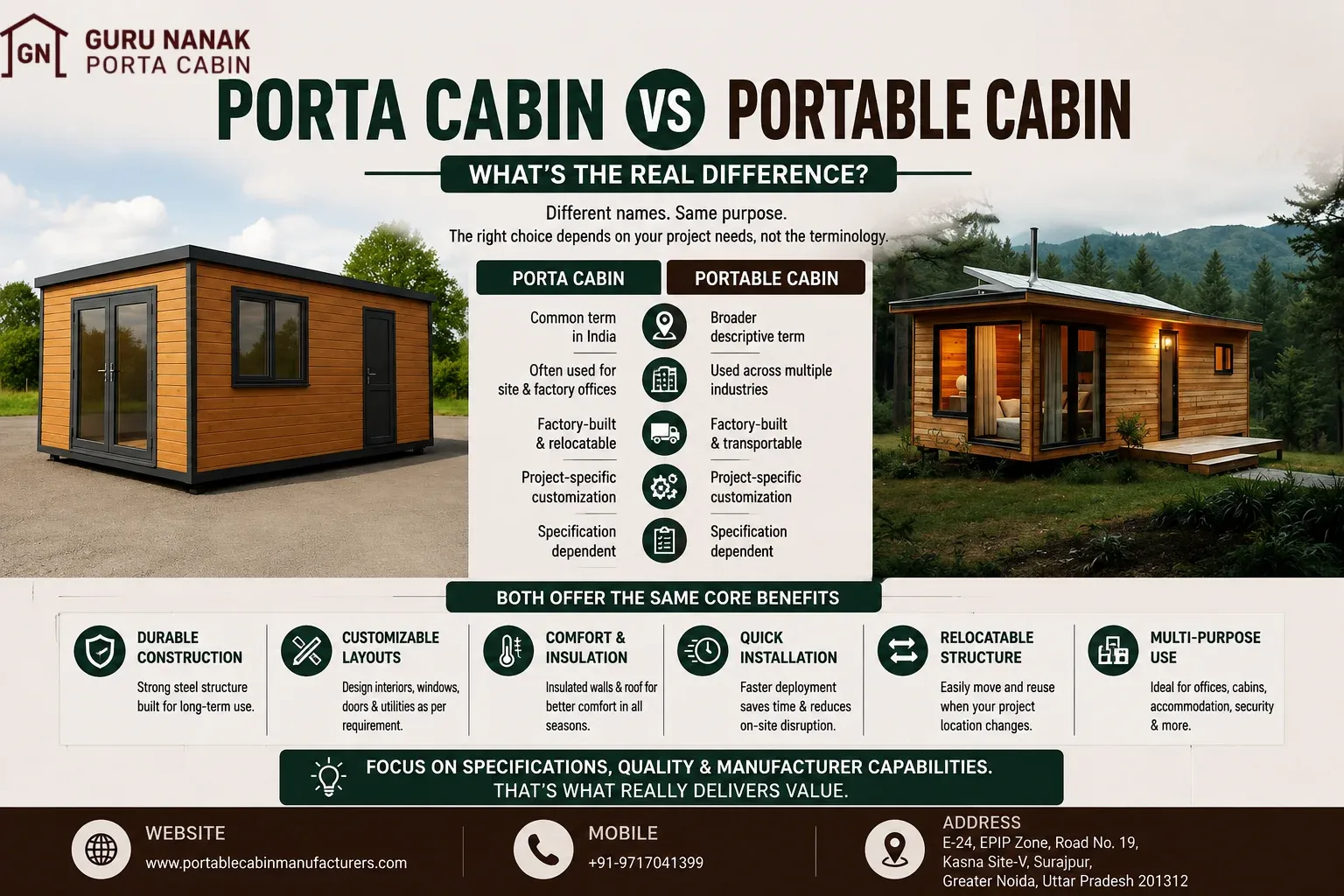
Porta Cabin vs Portable Cabin — What’s the Real Difference?
27 Aug, 2026
A project manager asks for a porta cabin. The procurement team prepares an enquiry for a portable cabin. One supplier quotes a modular office cabin, while another describes almost the same structure as a prefabricated site office.
Are these actually different products?
In most industrial and commercial projects, porta cabin and portable cabin refer to the same broad category of factory-manufactured, relocatable or semi-relocatable structures. The difference is generally terminology, regional usage and supplier preference rather than a defined engineering distinction.
That does not mean every cabin offered under either name is technically equal.
Two suppliers may both quote a “porta cabin” while offering completely different structural frames, wall panels, insulation, flooring, electrical systems, interior finishes and installation scopes.
For procurement teams, the wording on the quotation matters much less than the specification behind it.
The right question is therefore not: “Should we purchase a porta cabin or portable cabin?”
It is: “What structure, materials, layout, utilities and installation scope does the project actually require?”
Porta cabin and portable cabin are generally interchangeable industry terms.
Neither term guarantees a particular material, structural strength, insulation level, lifespan or manufacturing quality.
Buyers should compare:
- Engineering Specifications
- Intended Application
- Structural Construction
- Materials
- Customization
- Utilities
- Transport Requirements
- Installation Scope
- Manufacturer Capability
rather than selecting a product based on terminology alone.
Porta Cabin vs Portable Cabin at a Glance
| Comparison Area | Porta Cabin | Portable Cabin |
|---|---|---|
| General meaning | Factory-built cabin | Factory-built transportable/modular cabin |
| Industry usage | Common term in India | Broader descriptive term |
| Engineering definition | No separate universal definition | No separate universal definition |
| Structural frame | Can use steel fabrication | Can use steel fabrication |
| Insulation | Project specific | Project specific |
| Mobility | Often movable | Often movable |
| Customization | Project specific | Project specific |
| Applications | Site, factory and project offices | Same applications |
| Price | Specification dependent | Specification dependent |
| Lifespan | Design and maintenance dependent | Design and maintenance dependent |
Winner: Neither.
The better cabin is the one that meets the project's technical and operational requirements.
1. Why Do Both Terms Exist?
“Portable cabin” is the clearer descriptive term. It generally refers to a cabin manufactured away from its final installation location and designed so it can be transported and installed on site.
“Porta cabin” has become a commonly used market term, particularly among manufacturers, contractors and industrial buyers in India.
Both terms may appear in:
- Construction Tenders
- Contractor Enquiries
- Industrial Catalogues
- Supplier Quotations
- Project RFQS
- Factory-Expansion Plans
- Infrastructure Projects
- Warehouse Requirements
Some suppliers prefer “porta cabin” because local buyers recognize the phrase.
Others use “portable cabin” because it describes the product more directly.
Direct Answer
The difference is mainly linguistic and commercial. The terminology itself does not establish different structural systems, materials or performance levels.
2. Is There a Technical Difference?
Usually, no.
Either term may describe a cabin containing:
- Structural Steel Framing
- Wall And Roof Panels
- Insulation
- Flooring
- Partitions
- Doors
- Windows
- Electrical Systems
- Lighting
- HVAC Provisions
- Plumbing
- Interior Finishes
- Lifting Arrangements
One portable cabin may be a basic temporary office.
Another may be a customized factory office containing several rooms, insulated walls, electrical distribution, AC provisions, data points, pantry and washroom facilities.
Both may still be called portable cabins.
Exactly the same variation exists under the term porta cabin.
Procurement Rule
Never assume two quotations are technically equivalent simply because they use the same product name.
Compare the complete specification.
3. Compare the Structural Frame, Not the Name
The structural frame influences how the cabin handles:
- Roof Loads
- Wall Loads
- Floor Loads
- Occupancy
- Lifting
- Transportation
- Repeated Relocation
Buyers should ask:
- Which steel sections are used?
- What material thickness is proposed?
- How is the floor frame constructed?
- How are columns and beams connected?
- Are lifting points provided?
- Is repeated relocation expected?
- What support arrangement is required?
- How is roof drainage handled?
- Can additional modules be connected later?
A cabin intended for one-time installation may have different requirements from one expected to move between several project locations.
Choose According to Structural Duty
A small site office does not necessarily require the same configuration as:
- A Multi-Room Project Office
- A High-Occupancy Factory Office
- A Cabin With Washrooms
- A Document-Storage Cabin
- A Multi-Module Office Complex
- A Repeatedly Relocated Project Cabin
Application should determine specification.
4. Material Specifications Can Differ Significantly
Neither “porta cabin” nor “portable cabin” tells the buyer which materials are included.
Wall and Roof Systems
Possible specifications include:
- Insulated Sandwich Panels
- Profile-Sheet Systems
- Internal Lining
- Steel Exterior Cladding
- Composite Panels
- Project-Specific Insulated Assemblies
Verify:
- External Skin
- Internal Lining
- Insulation Material
- Panel Thickness
- Roof Construction
- Joint Treatment
- Water Sealing
- Interior Finish
Flooring
Compare:
- Structural Floor Support
- Subfloor
- Finished Flooring
- Moisture Resistance
- Expected Traffic
- Furniture Loads
- Cleaning Requirements
Doors and Windows
Specify:
- Type
- Size
- Material
- Locking
- Glass
- Ventilation
- Grills
- Mosquito Mesh Where Required
Corrosion Protection
Industrial environments may expose cabins to dust, moisture and weather.
Ask suppliers to clarify:
- Surface Preparation
- Primer
- Coating
- Exterior Finish
- Installation Touch-Up
- Maintenance Requirements
Neither term indicates better material quality.
5. Manufacturing Process
Both products generally follow the same broad modular manufacturing process:
Requirement Review → Layout → Structural Fabrication → Wall & Roof Installation → Flooring → Utilities → Interior Fit-Out → Inspection → Dispatch → Installation
Depending on scope, manufacturing may include:
- Steel Cutting
- Welding
- Frame Assembly
- Panel Installation
- Insulation
- Electrical Integration
- Plumbing
- Hvac Provisions
- Doors And Windows
- Interior Finishing
- Coating
- Quality Inspection
Guru Nanak Porta Cabin supports project-specific modular manufacturing and in-house fabrication for portable cabin requirements.
The important question for buyers is not which terminology appears on the supplier's website.
It is whether the manufacturer can convert the requirement into a clearly defined and inspectable scope.
6. Applications Are Largely the Same
Porta cabins and portable cabins are used across similar applications.
Construction and EPC
- Site Office
- Engineer Cabin
- Project-Manager Cabin
- Planning Room
- Document-Control Office
- Contractor Office
Manufacturing
- Factory Office
- Maintenance Office
- Quality Office
- Temporary Administration
- Expansion-Project Office
Warehousing and Logistics
- Dispatch Office
- Supervisor Cabin
- Warehouse Administration
- Planning Office
- Gate Operations
Infrastructure
- Project Office
- Field Office
- Contractor Cabin
- Inspection Office
Renewable Energy and Mining
- Coordination Cabin
- Engineer Office
- Safety Office
- Temporary Administration
The application should determine the specification, regardless of the product name.
7. Customization Depends on Manufacturer Capability
Both porta cabins and portable cabins can be customized.
Possible layouts include:
- Open Office
- Manager Cabin
- Meeting Room
- Reception
- Storage
- Pantry
- Washroom
- Electrical Room
- Server Provision
- Engineer Cabin
- Safety Office
Customization should begin with the intended workflow.
A warehouse office may need visibility toward loading areas.
A project office may need drawing review and document storage.
A factory office may require stronger insulation and longer operating hours.
Customization Checklist
Define:
- Dimensions
- Internal Height
- Occupancy
- Rooms
- Partitions
- Windows
- Doors
- Insulation
- Electrical Points
- Lighting
- Data Points
- HVAC
- Plumbing
- Pantry
- Washroom
- Furniture
- Branding
- Future Expansion
Do not request a “standard porta cabin” when the intended operation is not standard.
8. Electrical, HVAC and Plumbing Scope
Utilities are a common source of quotation differences.
“Electrical work included” is not specific enough.
The RFQ should clarify:
- Lighting Points
- Socket Outlets
- Distribution Board
- Protection Devices
- Wiring
- Connected Load
- External Supply Interface
- Earthing
- Data Points
- Ac Points
- HVAC Equipment
- Water Inlet
- Drainage
- Washroom Fixtures
- Pantry Plumbing
The manufacturer may complete internal services while the buyer remains responsible for external site connections.
This responsibility should be written clearly.
Scope ambiguity creates more project risk than terminology ambiguity.
9. Mobility and Relocation
The word “portable” does not automatically mean a cabin can be moved repeatedly without additional planning.
Relocation depends on:
- Structural Frame
- Lifting Points
- Cabin Dimensions
- Transport Route
- Crane Access
- Utility Disconnection
- Internal Condition
- New Supports
- Reinstallation
Some cabins are manufactured off-site and transported only once.
Others are designed for repeated project relocation.
The RFQ should clarify whether the requirement is:
- One-Time Transportation
- Occasional Movement Within The Site
- Repeated Movement Between Sites
- Multi-Project Reuse
There is no reliable rule that a porta cabin is more or less movable than a portable cabin.
Verify the actual design.
10. Installation Requirements
Both generally require:
- Accessible Installation Location
- Level Support
- Unloading
- Safe Lifting
- Placement Clearance
- Anchoring Where Required
- Electrical Connection
- Hvac Connection
- Plumbing Connection Where Applicable
- Drainage
- Final Inspection
Before delivery, verify:
- Can the vehicle reach the site?
- Is turning space available?
- Can lifting equipment operate?
- Are overhead lines present?
- Is the ground suitable?
- Are supports ready?
- Is drainage planned?
- Are external utilities available?
- Will installation affect plant operations?
A complete cost comparison should include logistics and site installation rather than only cabin supply.
11. Lifespan and Maintenance
Neither term guarantees a particular service life.
Cabin longevity depends on:
- Structural Design
- Steel Quality
- Fabrication
- Coating
- Roof System
- Water Sealing
- Insulation
- Environmental Exposure
- Relocation Frequency
- Installation
- Maintenance
Typical maintenance areas include:
- Roof Joints
- Wall Joints
- Sealants
- Coating
- Corrosion
- Doors
- Windows
- Flooring
- Electrical Panels
- Plumbing Joints
- HVAC Openings
- Supports
Which Lasts Longer?
Neither automatically.
The cabin with appropriate materials, correct installation and proper maintenance is more likely to provide better long-term performance.
12. Cost Comparison
A porta cabin does not cost more or less simply because of the terminology.
Cost depends on:
- Dimensions
- Structural Specification
- Quantity
- Panels
- Insulation
- Flooring
- Partitions
- Electrical Work
- Hvac
- Plumbing
- Furniture
- Exterior Finish
- Transportation
- Unloading
- Foundation
- Installation
- Site Conditions
A lower quotation may reflect:
- Lighter Structural Sections
- Thinner Panels
- Less Insulation
- Fewer Electrical Points
- Basic Flooring
- Excluded Transport
- Excluded Unloading
- Excluded Installation
Therefore, compare:
Total Installed Cost = Cabin Supply + Transport + Unloading + Supports/Foundation + Installation + Utility Connections
13. Common Myths
Myth: Porta Cabin Is Temporary and Portable Cabin Is Permanent
Incorrect. Either may be used for temporary, semi-permanent or longer-term applications.
Myth: Portable Cabins Are Shipping Containers
Not necessarily. Purpose-built portable cabins can use their own modular steel structure.
Myth: Porta Cabins Use Lower-Quality Materials
The term does not determine material quality.
Myth: Portable Cabins Cannot Be Customized
They can support partitions, electrical systems, HVAC, plumbing and interior fit-outs.
Myth: Every Portable Cabin Is Easy to Move
Relocation depends on dimensions, structural design, lifting arrangements and transportation conditions.
Myth: The Cheapest Cabin Is Suitable for Any Application
Specification should match occupancy, environment and intended service period.
14. Procurement Risks
Different terminology becomes a problem when buyers assume different quotations contain the same scope.
Non-Comparable Quotations
One supplier may include insulation and electrical work while another quotes only the shell.
Wrong Application
A basic site cabin may be offered for a factory office requiring higher comfort and longer service.
Missing Installation
Transport may be included while unloading and placement are excluded.
Undefined Structure
“Steel structure” does not explain section sizes, thickness or fabrication.
Poor Relocation Planning
The buyer may expect repeated reuse without specifying lifting and transport requirements.
Limited Expansion
The initial cabin may not be designed to connect with future modules.
15. RFQ Checklist
Instead of focusing on terminology, define:
Project
- Application
- Location
- Service Period
- Deployment Schedule
- Relocation Frequency
Dimensions
- External Dimensions
- Internal Dimensions
- Occupancy
- Number Of Rooms
- Storage
- Furniture
Structure
- Steel Frame
- Floor Frame
- Roof Arrangement
- Lifting Provision
- Supports
- Anchoring
- Module Connections
Envelope
- Walls
- Roofing
- Insulation
- Lining
- Exterior Finish
- Sealing
Utilities
- Electrical Load
- Lights
- Sockets
- Data
- Hvac
- Plumbing
- Pantry
- Washroom
Logistics
- Transportation
- Unloading
- Lifting
- Foundation/Supports
- Placement
- Installation
- External Connections
Commercial Scope
- Inclusions
- Exclusions
- Delivery
- Payment Terms
- Warranty
- Inspection
- Drawing Approval
16. Supplier Evaluation Matrix
| Evaluation Area | What to Verify |
|---|---|
| Requirement understanding | Application, occupancy and service period |
| Engineering | Structural specification |
| Materials | Wall, roof, insulation and flooring |
| Customization | Layout and utility capability |
| Manufacturing | In-house vs outsourced scope |
| Quality | Pre-dispatch inspection |
| Logistics | Transport and unloading |
| Installation | Supports, placement and connections |
| Expansion | Future module compatibility |
| Relocation | Suitability for movement frequency |
| Documentation | Drawings, scope and exclusions |
| Lifecycle | Reuse and reconfiguration |
17. Which Term Should Buyers Use?
Use “Porta Cabin” When:
- Local Project Documents Use The Term
- Suppliers Commonly Recognize It
- The Tender Already Uses The Terminology
- The Technical Specification Is Clearly Attached
Use “Portable Cabin” When:
- A Broader Descriptive Term Is Preferred
- Mobility Is Important
- Procurement Terminology Is Standardized
- Multiple Project Locations Are Involved
Neither choice improves the technical product.
Better RFQ Approach
Use a descriptive title such as:
Customized Portable Office Cabin
Then provide the complete specification.
18. Alternative Terms Buyers May See
Similar products may also be described as:
- Modular Office Cabin
- Prefab Office
- Site Office Cabin
- Office Container
- Portable Office Container
- Modular Site Office
- Factory Office Cabin
- Temporary Project Office
- Steel Portable Cabin
These categories can overlap.
However, an office container may sometimes describe a container-style structure, while “prefab structure” can refer to a much broader building category.
Always ask what construction system is actually being proposed.
Final Decision Matrix
| Buying Priority | What Matters |
|---|---|
| Terminology | Low importance |
| Intended application | Critical |
| Structural frame | Critical |
| Material specification | Critical |
| Insulation | Application dependent |
| Interior layout | High importance |
| Utilities | High importance |
| Mobility | Define expected relocation |
| Manufacturer capability | Critical |
| Installation scope | Critical |
| Maintenance | Long-term consideration |
| Total installed cost | Commercial priority |
Frequently Asked Questions
1.Is there a real difference between a porta cabin and a portable cabin?
In most industrial applications, no defined technical difference exists. The terms are commonly used interchangeably.
2. Is porta cabin a short form of portable cabin?
It is commonly used as an abbreviated market term for portable cabin.
3. Which term is technically correct?
Portable cabin is the clearer descriptive term, while porta cabin is widely accepted in the market.
4. Is a porta cabin cheaper?
Not because of the name. Cost depends on specification and project scope.
5. Which is more durable?
Durability depends on structure, materials, coating, installation and maintenance.
6. Are they manufactured differently?
Not necessarily. Manufacturing depends on the supplier's construction system.
7. Can both be used as site offices?
Yes.
8. Can both be customized?
Yes. Layouts, utilities, insulation, washrooms, pantry and interior finishes can be project specific.
9. Can a porta cabin be relocated?
Yes, where the structure and lifting arrangement are suitable.
10. Is every portable cabin designed for repeated relocation?
No. Repeated movement should be specified during procurement.
11. Is an office container the same as a portable cabin?
The terms can overlap, but an office container may use a different container-style structural approach.
12. Do portable cabins need foundations?
They generally require suitable supports or foundations according to size, site and service requirements.
13. Can multiple cabins be connected?
Yes, where the structural layout and utilities are designed accordingly.
14. Which term should be used in an RFQ?
Either can be used, but the technical specification matters more. “Customized portable office cabin” is a clear procurement description.
15. How should quotations be compared?
Compare structure, panels, insulation, flooring, utilities, transport, unloading, installation, warranty and exclusions.
Final Recommendation: Compare Specifications, Not Terminology
Porta cabin and portable cabin are usually two names for the same broad modular-building category.
Neither term guarantees:
- Stronger Steel
- Better Fabrication
- Higher Insulation
- Longer Lifespan
- Easier Relocation
- Lower Cost
- Better Interiors
- Faster Installation
Those outcomes depend on the specification.
Procurement teams should first define the application, dimensions, occupancy, service period, relocation requirement, materials, insulation, utilities, layout and installation conditions.
Then every manufacturer should quote against the same requirement.
That removes terminology confusion and makes commercial comparison more reliable.
Request a Specification-Based Portable Cabin Quotation
Whether your project calls it a porta cabin, portable cabin, modular office cabin or site office cabin, share your application, required dimensions, occupancy, internal layout, insulation, electrical load, HVAC, plumbing, project location, installation scope, future expansion and relocation requirements with Guru Nanak Porta Cabin.
The requirement can then be reviewed from a design, manufacturing, logistics and installation perspective to prepare a project-specific proposal.
To discuss your requirement, contact Guru Nanak Porta Cabin through the Contact Us page.


