

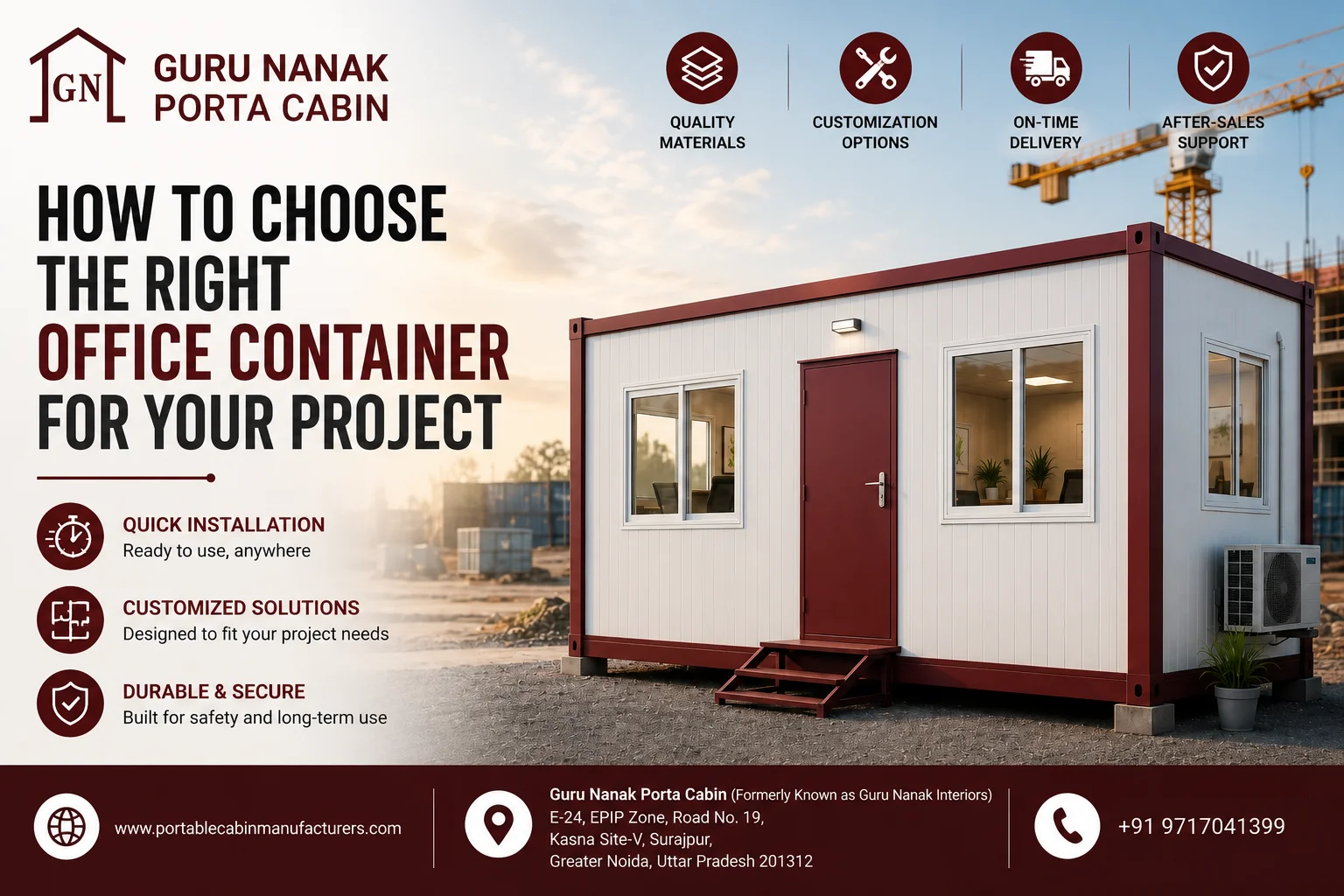
How to Choose the Right Office Container for Your Project
02 Jul, 2026
Choosing the right office container starts with understanding your project's duration, workforce size, site conditions, mobility requirements, and future expansion plans. A well-designed office container should provide durability, efficient space utilization, weather protection, and customization options while supporting smooth project execution without unnecessary operational costs.
Why Office Containers Have Become the Preferred Project Office Solution
Every construction site, infrastructure project, industrial expansion, or temporary facility requires a workspace where engineers, supervisors, procurement teams, and project managers can operate efficiently.
Building a conventional office for a temporary project often increases both cost and project timelines. An office container offers a practical alternative by providing a ready-to-install workspace that can be relocated, expanded, or modified as project requirements change.
Today, industries such as construction, manufacturing, logistics, renewable energy, mining, and government infrastructure projects rely on portable office solutions because they combine flexibility with operational efficiency.
Rather than investing in permanent structures that may only be required for a limited period, organizations increasingly prefer modular office solutions that can continue to deliver value across multiple projects.
What Is an Office Container?
An office container is a prefabricated modular workspace manufactured using high-strength steel and designed to function as a fully operational office at temporary or semi-permanent project locations.
Depending on project requirements, an office container may include:
• Workstations
• Manager cabins
• Conference rooms
• Electrical wiring
• Lighting systems
• Air conditioning provisions
• Insulated wall panels
• Washroom facilities
• Storage areas
• Pantry sections
Unlike traditional construction, modular office containers are manufactured in controlled factory conditions before being transported to the project location for quick installation.
For buyers comparing available options, exploring detailed specifications and configurations on the company's Office Container page can provide a clearer understanding of available layouts and project-specific solutions.
Why Businesses Choose Office Containers Instead of Conventional Site Offices
The decision is rarely based on cost alone.
Project owners and procurement teams usually evaluate operational efficiency over the entire project lifecycle.
Some of the biggest advantages include:
Faster Project Mobilization: Construction activities can begin without waiting for permanent office construction.
Relocation Capability: A portable office container can be shifted from one project site to another, making it a long-term asset rather than a one-time investment.
Lower Overall Project Cost: Reduced construction labor, minimal civil work, and shorter installation time contribute to improved project economics.
Modular Expansion: As project teams grow, additional units can be integrated without disrupting existing operations.
Consistent Working Environment: Insulated office containers provide better indoor comfort for engineers and management staff working in varying weather conditions.
Practical Procurement Scenario
Imagine an EPC contractor managing three infrastructure projects across different states.
Instead of constructing three separate temporary office buildings, the contractor purchases modular office containers that can be relocated after project completion.
This approach reduces future infrastructure costs while improving asset utilization over multiple projects.
For organizations handling recurring projects, this often delivers a significantly better long-term return on investment than conventional temporary construction.
When Should You Invest in an Office Container?
An office container becomes a practical solution when your project requires a secure, functional workspace without the time and expense of permanent construction.
Common situations include:
• Large construction sites
• Highway projects
• Metro rail development
• Industrial plant expansion
• Factory construction
• Mining operations
• Solar and renewable energy projects
• Warehousing developments
• Infrastructure contracts
• Government engineering projects
• Temporary administrative offices
• Project management offices
• Sales offices for real estate developments
If the workspace is expected to be temporary, expandable, or relocatable, a modular office solution generally offers greater operational flexibility than traditional buildings.
Industries That Commonly Use Office Containers
Office containers have applications across multiple sectors because they can be adapted to different operational requirements.
Industry and there Typical Application
Construction
Site offices for engineers and project managers
Infrastructure
Project coordination offices
Industrial Manufacturing
Factory administration offices
Logistics
Dispatch and operations offices
Warehousing
Temporary management offices
Mining
Remote site offices
Renewable Energy
Solar and wind farm project offices
Government Projects
Temporary field administration
Railways
Site supervision offices
Oil & Gas
Project coordination cabins
Each industry has unique operational requirements, which is why customization plays a critical role during procurement.
Before Comparing Suppliers, Answer These Five Questions
Many buyers start by comparing prices.
Experienced procurement teams begin by defining project requirements.
Ask yourself:
1. How long will the office be required?
A six-month project has different requirements than a three-year infrastructure project.
2. How many people will use the office?
The expected workforce directly affects container size and internal layout.
3. Will the container be relocated?
Projects involving frequent movement require designs optimized for transportation.
4. What weather conditions will the office face?
High temperatures, heavy rainfall, or dusty environments may require better insulation and weather-resistant construction.
5. Will future expansion be required?
Selecting a modular office container allows additional units to be integrated later without replacing the existing structure.
Buying Insight: Choosing the right office container isn't just about today's project. It's about selecting a solution that continues to deliver value across future sites, reducing both operational disruptions and long-term infrastructure costs.
Types of Office Containers: Which One Fits Your Project?
No two projects have identical workspace requirements. The right office container depends on project duration, workforce size, site conditions, mobility needs, and future expansion plans. Understanding the available options helps procurement teams avoid overspending on unnecessary features while ensuring the workspace remains functional throughout the project lifecycle.
1. Standard Office Container
A standard office container is suitable for projects requiring a compact administrative workspace. It typically accommodates project managers, engineers, or supervisory staff and includes essential electrical fittings, lighting, insulation, and ventilation.
Best suited for:
• Small construction sites
• Temporary project offices
• Site engineers
• Sales offices
2. Portable Office Container
A portable office container is designed for projects where relocation is expected. Since these units are manufactured for repeated transportation, they provide flexibility without compromising structural strength.
Ideal for:
• EPC contractors
• Highway projects
• Railway projects
• Mining operations
• Infrastructure development
Commercial Advantage
Instead of constructing new temporary offices for every project, businesses can relocate the same container, reducing future infrastructure investments.
3. Modular Office Container
A modular office container consists of multiple units that can be connected to create larger workspaces. As project requirements grow, additional modules can be integrated without replacing the existing structure.
Common configurations include:
• Reception area
• Manager cabin
• Conference room
• Engineering department
• Documentation room
• Pantry
• Washroom
Recommended for
• Industrial plants
• Manufacturing facilities
• Corporate site offices
• Government projects
• Large infrastructure developments
4. Customized Office Container
Every project operates differently.
Some projects require additional electrical capacity, while others prioritize conference spaces, storage, washrooms, or branding requirements.
A customized office container allows buyers to specify:
• Internal layout
• Cabin partitions
• Flooring
• Wall panel finish
• Doors and windows
• Electrical distribution
• Air-conditioning provisions
• Furniture integration
• Exterior branding
Customization helps avoid post-installation modifications that often increase project costs.
Office Container Comparison
Standard Office Container
• Mobility: Medium
• Best For: Small Projects
• Expansion: Limited
• Initial Investment: Lower
Portable Office Container
• Mobility: High
• Best For: Multi-location Projects
• Expansion: Moderate
• Initial Investment: Medium
Modular Office Container
• Mobility: Medium
• Best For: Large Projects
• Expansion: Excellent
• Initial Investment: Higher
Customized Office Container
• Mobility: Depends on Design
• Best For: Specialized Projects
• Expansion: Excellent
• Initial Investment: Project Based
Which Office Container Size Should You Choose?
Selecting the wrong size is one of the most expensive procurement mistakes.
An undersized office affects productivity and employee comfort, while an oversized container increases procurement and transportation costs unnecessarily.
Rather than focusing only on dimensions, procurement teams should estimate:
• Number of employees
• Departments using the office
• Meeting frequency
• Visitor movement
• Storage requirements
• Future workforce expansion
Typical Planning Requirements
• Site Engineer Office
Suggested Planning Approach: Compact workspace
• Project Manager Cabin
Suggested Planning Approach: Medium layout with meeting space
• Site Administration
Suggested Planning Approach: Multiple workstations
• EPC Project Office
Suggested Planning Approach: Modular interconnected units
• Factory Administrative Office
Suggested Planning Approach: Customized modular office
A scalable layout often proves more economical than replacing an existing office container midway through a project.
Features That Directly Influence Procurement Decisions
Price is only one part of the buying decision. Long-term operational performance depends on several technical and commercial factors.
Structural Strength
The frame should withstand transportation, lifting, stacking (if applicable), and varying site conditions without compromising stability.
Weather Resistance
Projects across India experience diverse climatic conditions. Weather-resistant construction helps protect the workspace from heat, rain, dust, and corrosion, reducing maintenance over time.
Thermal Insulation
Poor insulation can lead to uncomfortable working conditions and higher energy consumption. Proper insulation improves employee comfort while reducing dependence on cooling equipment.
Electrical Planning
An office container should be designed with sufficient electrical capacity to accommodate lighting, computers, networking equipment, printers, air conditioning, and future expansion.
Ventilation
Good airflow improves indoor comfort and contributes to a healthier working environment, especially at remote construction sites.
Security
Project documentation, laptops, equipment, and operational records often remain inside site offices. Secure doors, windows, and locking systems help protect valuable assets.
Interior Finish
A functional workspace should support productivity. Proper flooring, wall finishes, lighting, and furniture integration create a more organized and professional environment.
Customization Options That Deliver Long-Term Value
Standard layouts may not always match project requirements. Custom manufacturing allows organizations to optimize both functionality and operational efficiency.
Popular customization requests include:
Interior Planning
• Cabin partitions
• Meeting rooms
• Reception
• Executive cabins
• Open workstations
Electrical Integration
• Power distribution
• Modular switchboards
• Network points
• UPS provision
• Generator compatibility
Comfort Enhancements
• False ceiling
• Thermal insulation
• Ventilation systems
• Air-conditioner provisions
• Acoustic treatment where required
Exterior Customization
• Corporate branding
• Company colors
• Glass façades
• Canopies
• Staircases
• Double-storey configurations
A customized office container often reduces future renovation costs because the workspace is designed around actual operational needs from the beginning.
Buying Factors That Matter More Than Price
Experienced procurement teams rarely select suppliers based solely on the lowest quotation.
Instead, they evaluate the overall value offered throughout the project lifecycle.
Manufacturing Capability
Can the manufacturer produce custom designs, or do they only supply standard models?
Material Quality
The quality of steel, insulation panels, flooring, doors, and roofing directly impacts durability and maintenance costs.
Design Flexibility
Every project evolves. A supplier capable of modifying layouts provides greater long-term value than one offering only fixed designs.
Delivery Commitment
Construction schedules often depend on timely office installation. Delays can disrupt project planning and increase operational costs.
Installation Support
Professional installation minimizes on-site adjustments and helps the workspace become operational more quickly.
After-Sales Support
Future relocation, expansion, repairs, or modifications become much easier when the supplier provides ongoing technical support.
How to Evaluate an Office Container Manufacturer
Before requesting quotations, compare suppliers using objective evaluation criteria rather than focusing only on cost.
• Manufacturing Experience
Why It Matters: Indicates process maturity and product consistency.
• In-house Fabrication
Why It Matters: Better quality control and customization.
• Custom Design Capability
Why It Matters: Supports project-specific requirements.
• Material Quality
Why It Matters: Influences durability and lifecycle cost.
• Certifications
Why It Matters: Reflects adherence to recognized standards.
• Delivery Network
Why It Matters: Important for multi-location projects.
• Installation Support
Why It Matters: Reduces deployment delays.
• Project Experience
Why It Matters: Demonstrates understanding of industrial applications.
• Communication & Technical Guidance
Why It Matters: Simplifies procurement decisions.
When evaluating potential partners, reviewing the company's manufacturing approach, experience, and project background through the About Us page can help buyers understand its capabilities before making a commercial decision.
For detailed product configurations, layout possibilities, and project-specific options, buyers should also explore the dedicated Office Container page before requesting a quotation.
Common Mistakes Buyers Make While Purchasing Office Containers
Even experienced procurement teams can make decisions that increase project costs later.
Choosing Only on Price
The lowest quotation may result in higher maintenance expenses, reduced durability, or additional modification costs.
________________________________________
Ignoring Future Expansion
Selecting a fixed layout without considering workforce growth often leads to expensive replacements or extensions.
________________________________________
Underestimating Site Conditions
Heat, rainfall, dust, and environmental exposure should influence insulation, material selection, and weather protection requirements.
________________________________________
Overlooking Transportation Requirements
Projects involving multiple locations require office containers designed for safe and efficient relocation.
________________________________________
Failing to Define Customization Early
Late-stage design changes usually increase manufacturing costs and extend delivery timelines.
________________________________________
What Influences Office Container Pricing?
There is no universal office container price because every project has unique technical and commercial requirements.
The final cost generally depends on:
• Overall container size
• Structural design
• Steel specifications
• Insulation requirements
• Interior finishes
• Electrical systems
• Doors and windows
• Furniture integration
• HVAC provisions
• Washroom and pantry additions
• Transportation distance
• Installation scope
• Custom branding
• Quantity ordered for bulk projects
Instead of comparing quotations based solely on the final figure, buyers should compare the scope of supply to understand what is included and avoid hidden costs after procurement.
________________________________________
Procurement Decision Matrix
• If Your Priority Is: Lowest Lifecycle Cost
Focus On: Durable materials and quality fabrication.
• If Your Priority Is: Fast Deployment
Focus On: Manufacturing lead time and installation support.
• If Your Priority Is: Multiple Future Projects
Focus On: Portable and relocatable design.
• If Your Priority Is: Growing Workforce
Focus On: Modular expansion capability.
• If Your Priority Is: Corporate Appearance
Focus On: Interior finish and exterior customization.
• If Your Priority Is: Harsh Site Conditions
Focus On: Weather resistance and insulation.
• If Your Priority Is: Long-term Asset Value
Focus On: Custom design with quality construction.
Commercial Buying Checklist Before Placing Your Order
Before issuing a purchase order, ensure every technical and commercial requirement has been discussed with the supplier. A structured evaluation minimizes procurement risks and helps avoid unexpected project delays.
Technical Checklist
• Office size aligns with workforce requirements
• Internal layout finalized
• Structural material confirmed
• Insulation requirement evaluated
• Electrical layout approved
• Door and window positions finalized
• Ventilation requirements discussed
• Flooring specification confirmed
Lighting arrangement planned
Air-conditioning provision included (if required)
________________________________________
Commercial Checklist
• Manufacturing capability verified
• Certifications reviewed
• Customization scope finalized
• Delivery schedule confirmed
• Transportation responsibility clarified
• Installation scope discussed
• Warranty terms understood
• Scope of supply clearly documented
• Future expansion requirements considered
• Final commercial quotation reviewed
Procurement Tip: A detailed quotation with clearly defined specifications often prevents disputes more effectively than selecting the lowest-priced offer.
________________________________________
Practical Buying Scenarios
Scenario 1: Construction Company Managing Multiple Projects
A construction company operating across different states requires office space at each project location. Instead of constructing temporary buildings repeatedly, investing in portable office containers enables relocation after project completion, reducing infrastructure costs over time.
________________________________________
Scenario 2: Manufacturing Plant Expansion
A factory undergoing expansion needs a temporary administrative office for engineers, consultants, and project managers. A modular office container allows additional workspace to be added as the project progresses without interrupting operations.
________________________________________
Scenario 3: Infrastructure Development Project
A government contractor working on a long-duration infrastructure project requires multiple functional areas, including project management offices, meeting rooms, documentation areas, and staff facilities. Modular office containers provide scalable workspace while supporting phased project execution.
________________________________________
Why Businesses Consider Guru Nanak Porta Cabin
Choosing a supplier involves more than comparing quotations. Buyers generally look for manufacturing capability, customization flexibility, delivery reliability, and long-term support.
For projects requiring office containers, Guru Nanak Porta Cabin offers:
• Factory-direct manufacturing
• Custom-designed office container solutions
• In-house fabrication capabilities
• High-quality steel construction
• Weather-resistant designs
• Fast installation support
• PAN India project delivery
• ISO, MSME, and GST registered business
• More than 15 years of industry experience
Depending on project requirements, buyers can also explore related modular infrastructure solutions such as Portable Cabins where appropriate.
________________________________________
Frequently Asked Questions
1. What is an office container?
An office container is a prefabricated modular workspace manufactured using steel and designed for temporary or semi-permanent office applications across construction, industrial, infrastructure, and commercial projects.
________________________________________
2. Is a portable office container suitable for long-term use?
Yes. When manufactured using quality materials and maintained properly, portable office containers can serve long-term operational requirements while remaining relocatable.
________________________________________
3. Can an office container be customized?
Yes. Layout, insulation, partitions, flooring, electrical systems, windows, doors, washrooms, pantry areas, and branding can typically be customized based on project needs.
________________________________________
4. How is an office container different from a conventional building?
An office container offers faster installation, relocation capability, modular expansion, and reduced civil construction compared to conventional buildings.
________________________________________
5. Which industries commonly use office containers?
Construction, infrastructure, manufacturing, logistics, mining, renewable energy, railways, warehousing, power, and government projects are among the most common users.
________________________________________
6. How do I choose the right office container size?
Evaluate workforce strength, workspace functions, meeting requirements, storage needs, and possible future expansion before selecting the container size.
________________________________________
7. What affects office container pricing?
Pricing depends on dimensions, structural materials, insulation, customization, interior finish, electrical work, transportation, installation, and project-specific requirements.
________________________________________
8. Can office containers be relocated?
Yes. Portable office containers are specifically designed to be transported and reused across multiple project sites.
________________________________________
9. What should I verify before selecting an office container manufacturer?
Review manufacturing capability, customization options, quality standards, certifications, project experience, delivery commitment, and after-sales support.
________________________________________
10. Are insulated office containers necessary?
For projects exposed to high temperatures, cold weather, or challenging environments, insulation improves indoor comfort and energy efficiency.
________________________________________
11. Can office containers include meeting rooms?
Yes. Modular layouts can incorporate conference rooms, cabins, workstations, reception areas, and support spaces.
________________________________________
12. How quickly can an office container be installed?
Installation timelines vary depending on project scope, customization, transportation, and site readiness. Buyers should confirm delivery and installation schedules before placing an order.
________________________________________
13. Is maintenance expensive?
Routine inspection, cleaning, and periodic maintenance help preserve structural integrity and appearance while keeping operating costs manageable.
________________________________________
14. Can office containers support future expansion?
Yes. Modular designs allow additional units to be integrated as project requirements grow.
________________________________________
15. Why should buyers request a customized quotation instead of relying on standard prices?
Every project has unique technical and operational requirements. A customized quotation ensures the proposed solution aligns with the required specifications, helping buyers avoid unnecessary costs or missing features.
________________________________________
Final Thoughts
Selecting the right office container is a strategic procurement decision rather than simply purchasing temporary workspace. Factors such as project duration, workforce size, relocation requirements, customization, insulation, material quality, and supplier capability all influence long-term value.
Instead of comparing quotations based only on price, procurement teams should evaluate the complete solution—design flexibility, manufacturing standards, delivery commitments, and lifecycle performance. A well-planned office container not only supports daily operations but also remains a reusable asset across future projects.
For organizations seeking a tailored solution, reviewing product specifications, discussing project requirements, and comparing available configurations before finalizing the purchase can significantly reduce commercial risk.
________________________________________
Request a Project-Specific Office Container Solution
Every project has unique workspace requirements. Whether you need a portable office container for a construction site, a modular office container for industrial expansion, or a fully customized office container for a large infrastructure project, selecting the right configuration begins with understanding your operational needs.
If you're planning an upcoming project, explore the complete Office Container range to review available options, and connect with the team through the Contact Us page to discuss your project requirements and request a customized quotation.


