

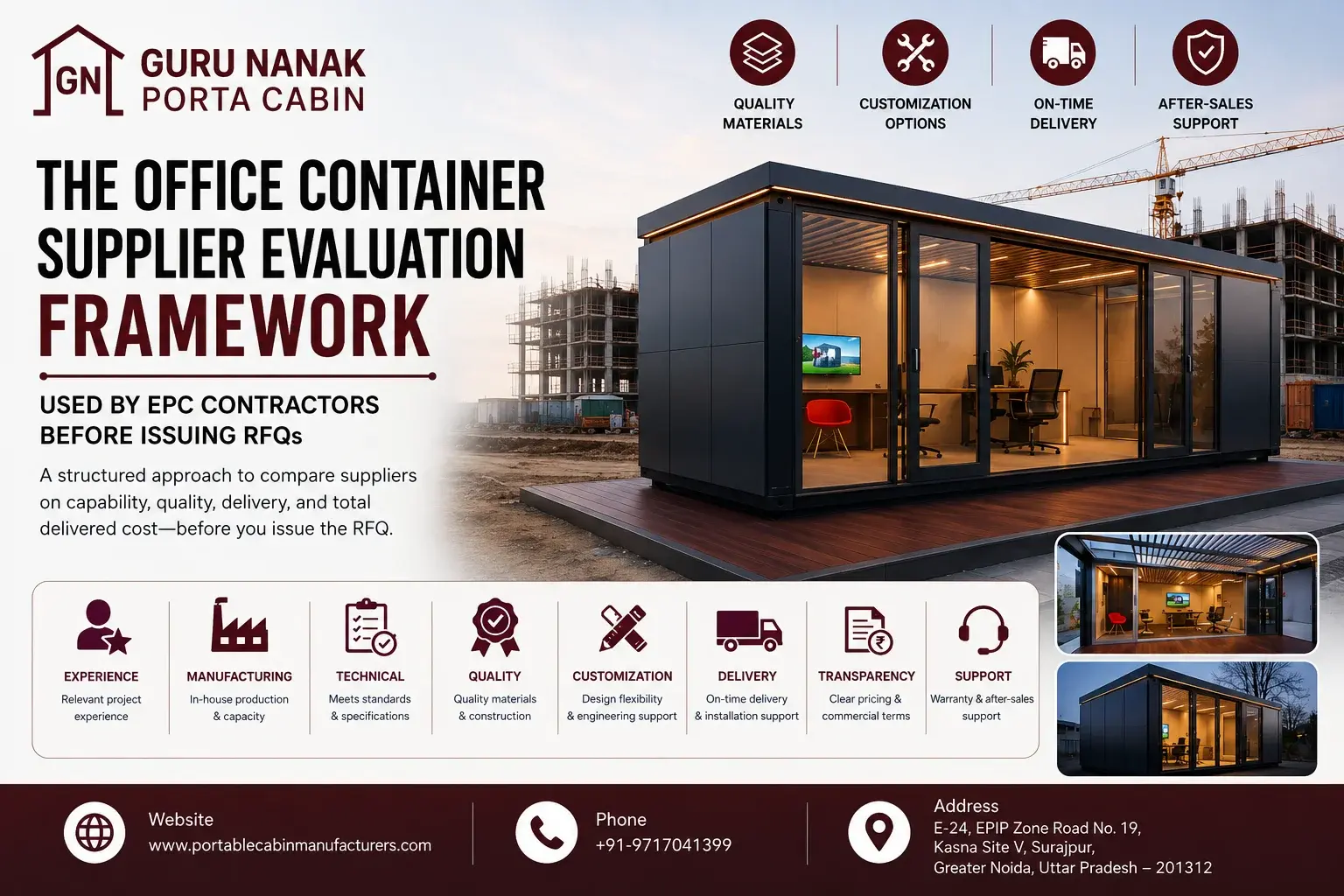
The Office Container Supplier Evaluation Framework Used by EPC Contractors Before Issuing RFQs
28 Jul, 2026
An office container quotation can appear commercially attractive while leaving critical project requirements unanswered.
The quoted amount may not clearly identify the structural materials, insulation system, electrical provisions, transportation responsibility or installation scope. Two suppliers may also quote for units of the same external size while offering substantially different construction quality and inclusions.
For EPC contractors, this is not simply a product-selection problem. An unsuitable supplier can delay site mobilization, create variation claims and leave project teams managing defects after delivery.
A structured supplier evaluation framework helps procurement and project teams determine whether an office container supplier can satisfy the technical, commercial and execution requirements of the project before the RFQ is issued.
This framework covers supplier prequalification, RFQ preparation, technical evaluation, commercial normalization, factory assessment and final vendor shortlisting.
How Should EPC Contractors Evaluate an Office Container Supplier?
EPC contractors should evaluate an office container supplier across eight areas:
- Relevant project experience
- Manufacturing capability
- Technical compliance
- Material and construction quality
- Customization and engineering support
- Delivery and installation capacity
- Commercial transparency
- Warranty, documentation and after-sales support
The lowest quotation should not automatically receive the order. The preferred supplier should demonstrate that the proposed unit meets the approved specifications, operational requirements, project schedule and total delivered-cost expectations.
Why Supplier Evaluation Must Begin Before the RFQ
A loosely written enquiry often produces quotations that cannot be compared fairly.
One supplier may include electrical wiring, insulation and flooring, while another may quote only for the basic shell. Transportation might be included in one proposal but charged separately in another. Crane unloading, foundations, site connections and installation supervision may remain completely unaddressed.
The resulting commercial comparison gives procurement teams an inaccurate picture of the actual cost.
An EPC-focused evaluation begins by defining the requirement and identifying capable suppliers before requesting prices. This approach helps the contractor:
- Receive technically comparable proposals
- Reduce qualification work after bids arrive
- Identify exclusions before commercial negotiation
- Check production and delivery capacity
- Reduce the risk of substandard materials
- Prevent disputes over installation responsibilities
- Improve coordination between procurement and project teams
A well-prepared RFQ therefore functions as both a quotation request and a supplier-screening document.
Step 1: Establish the Operational Requirement
Before contacting an office container manufacturer, the project team should determine how the unit will be used.
An engineer’s site office, a project-control room and a client meeting office may require different layouts and utility provisions. Occupancy, document storage, working hours, climate and relocation frequency can all affect the design.
The requirement brief should answer the following questions:
- What will the office container be used for?
- How many people will regularly occupy it?
- What furniture and equipment must fit inside?
- Is the unit temporary, semi-permanent or intended for repeated relocation?
- Will it require separate cabins or an open-plan layout?
- Are plumbing facilities required?
- What electrical load and air-conditioning provisions are expected?
- What are the site temperature, rainfall, dust and wind conditions?
- How will the unit be transported and positioned?
- Will multiple containers be installed as a connected office complex?
This information allows the supplier to recommend an appropriate configuration instead of quoting a standard unit that may not suit the site.
Buyers reviewing available configurations can first explore the company’s office container solutions before preparing the technical enquiry.
Step 2: Prequalify Suppliers Before Sending the RFQ
An RFQ should be issued to suppliers that have a reasonable chance of completing the project successfully.
Sending the enquiry to a large, unfiltered vendor list may create more quotations, but it also increases technical evaluation work. Procurement teams then spend time reviewing incomplete offers from suppliers without the required manufacturing or project-execution capability.
Supplier Prequalification Checklist
Ask prospective suppliers to provide:
- Company profile and years of experience
- Registered business details
- Applicable certifications and registrations
- Manufacturing facility location
- In-house and outsourced production activities
- Relevant project categories
- Experience with multi-unit requirements
- Available design and customization support
- Production-capacity information
- Quality-control process
- Delivery coverage
- Installation capabilities
- Warranty terms
- References for comparable project requirements
Project references should be relevant to the proposed scope. A supplier’s experience with a single standard cabin does not necessarily confirm its ability to execute a customized, multi-unit site office container requirement.
Guru Nanak Porta Cabin has over 15 years of experience and supports custom manufacturing, in-house fabrication, modular assembly and Pan-India delivery from its Greater Noida base. Buyers can review additional company information on the About Guru Nanak Porta Cabin page.
Step 3: Assess the Supplier’s Manufacturing Capability
A capable supplier should be able to explain how the proposed office container will move from approved drawing to completed unit.
The assessment should distinguish between actual manufacturing capability and sales representation. This matters when the project requires custom layouts, multiple units or schedule-controlled production.
What EPC Teams Should Verify
| Evaluation area | Evidence or clarification to request |
|---|---|
| Facility | Manufacturing address and available production setup |
| Fabrication | Whether structural fabrication is completed in-house |
| Engineering | Ability to prepare and revise project-specific drawings |
| Assembly | Process followed for frame, walls, roof and flooring |
| Utilities | Capability for electrical and plumbing integration |
| Finishing | Interior, door, window and flooring options |
| Quality control | Inspection stages and pre-dispatch checks |
| Capacity | Number and size of units that can be handled concurrently |
| Schedule | Production plan based on confirmed order quantity |
| Outsourcing | Activities completed by external vendors |
Production capacity should be evaluated against the actual project schedule. A supplier may produce good-quality units but still be unsuitable if its available capacity cannot accommodate the required quantity within the mobilization programme.
For substantial or technically sensitive orders, a factory visit can help verify the fabrication setup, material handling, ongoing work and quality practices.
Step 4: Define Technical Requirements That Can Be Measured
Terms such as “heavy-duty,” “premium quality” and “weatherproof” are too subjective for a procurement document. They do not create an objective basis for technical evaluation or final inspection.
The RFQ should request measurable information for each major component.
Structural and Material Information
Ask each supplier to specify:
- Primary structural framework
- Secondary framing members
- Material grades, where applicable
- Member sizes and thicknesses
- External wall construction
- Internal wall finish
- Roof construction and water-drainage arrangement
- Floor support system
- Flooring material and finish
- Corrosion-protection process
- Paint or coating system
- Door and window materials
- Lifting and relocation provisions
Avoid evaluating steel quality through appearance alone. Procurement teams should compare the offered material with the approved specification and request supporting material information where required by the project.
Insulation and Thermal Comfort
Poor insulation can turn an otherwise usable portable office container into an uncomfortable workplace. The required system depends on the operating climate, occupancy, working hours and air-conditioning plan.
The RFQ should state or request:
- Insulation material
- Insulation thickness
- Wall and roof application
- Internal lining
- Treatment of joints and possible thermal bridges
- Ventilation requirements
- Air-conditioning provisions
Instead of asking only whether a unit is insulated, ask the supplier to describe the complete wall and roof build-up. This makes competing offers easier to compare and helps expose material substitutions.
Electrical, Plumbing and Safety Provisions
The RFQ should identify whether the supplier must provide:
- Internal wiring
- Distribution board
- Lighting points
- Socket outlets
- AC points
- Data and communication points
- Earthing provisions
- External power-inlet arrangement
- Plumbing lines and fixtures
- Fire-safety provisions
- Emergency lighting or exit signage, when applicable
All project-specific electrical and safety requirements should be reviewed by the responsible engineering team before they are released to suppliers.
Step 5: Evaluate Customization and Design Support
A customized office container is not created by changing only the paint colour or adding furniture. Genuine customization should respond to occupancy, workflow, site constraints and utility requirements.
The supplier should be able to translate the requirement into a coordinated layout covering:
- Workstation positions
- Manager or meeting cabins
- Entry and exit locations
- Door-swing clearances
- Window placement
- Storage requirements
- Electrical points
- AC locations
- Plumbing fixtures
- Internal movement
- Furniture dimensions
Ask for a layout drawing before commercial and technical finalization. If several units will be connected, the drawing should also clarify junctions, circulation, weather sealing and utility coordination.
A supplier that asks detailed questions before recommending a design is usually providing more useful engineering input than one that sends a standard quotation immediately.
Practical Scenario
Suppose an EPC contractor requests a container office for 12 personnel but provides only the external unit size. One supplier may assume an open office, while another may include a project-manager cabin and meeting area.
Both proposals technically describe an office for 12 people, but they are not functionally equivalent. An approved layout eliminates this ambiguity before price comparison.
Step 6: Build a Technical Compliance Matrix
Every supplier should respond to the same specification in the same format.
A compliance matrix makes deviations visible and prevents important differences from being buried in brochures or quotation notes.
| Evaluation area | Evidence or clarification to request |
|---|---|
| Facility | Manufacturing address and available production setup |
| Fabrication | Whether structural fabrication is completed in-house |
| Engineering | Ability to prepare and revise project-specific drawings |
| Assembly | Process followed for frame, walls, roof and flooring |
| Utilities | Capability for electrical and plumbing integration |
| Finishing | Interior, door, window and flooring options |
| Quality control | Inspection stages and pre-dispatch checks |
| Capacity | Number and size of units that can be handled concurrently |
| Schedule | Production plan based on confirmed order quantity |
| Outsourcing | Activities completed by external vendors |
Suppliers should not be permitted to answer critical requirements with “as per standard” unless that standard has been clearly defined and accepted.
Step 7: Compare Complete Commercial Scope, Not Headline Price
The quoted office container price is only one part of the purchase decision.
A lower ex-factory price may become more expensive after transportation, unloading, installation and utility connections are added. Conversely, a higher initial quotation may include work that other suppliers have excluded.
Normalize These Commercial Components
- Basic unit price
- Design and drawing charges
- Customization cost
- Electrical work
- Plumbing provisions
- HVAC supply or installation
- Furniture, if required
- Taxes
- Packing
- Transportation
- Transit insurance
- Unloading or crane arrangement
- Installation
- Site supervision
- Foundation or support requirements
- Utility connections
- Testing and handover
- Warranty support
- Additional visit charges
Commercial Comparison Example
| Cost component | Supplier A | Supplier B | Supplier C |
|---|---|---|---|
| Base container | Included | Included | Included |
| Insulation | Included | Additional | Included |
| Electrical work | Included | Partial | Additional |
| Transportation | Additional | Included | Additional |
| Unloading | Excluded | Excluded | Included |
| Installation | Included | Additional | Included |
| Taxes | Extra | Extra | Extra |
| Warranty | Confirm scope | Confirm scope | Confirm scope |
The comparison should be completed using a common delivered and installed scope. If exclusions cannot be priced accurately, they should be treated as commercial risks rather than ignored.
Warning: Watch for Ambiguous Price Language
Clarify phrases such as:
- Transportation at actuals
- Installation if required
- Electricals as per standard
- Civil work by client
- Unloading in buyer’s scope
- Changes charged extra
- Taxes as applicable
These statements may be reasonable, but their cost and responsibility must be established before purchase-order finalization.
Step 8: Examine Delivery and Site-Execution Capability
An office container for a construction site is often linked to the project mobilization schedule. Late delivery can affect engineering coordination, site administration and contractor deployment.
The supplier evaluation should therefore cover:
- Drawing-approval period
- Material-procurement dependencies
- Production duration
- Inspection date
- Dispatch sequence
- Transport route and restrictions
- Site-access requirements
- Unloading arrangement
- Installation duration
- Utility-connection responsibility
- Handover documentation
For multi-unit requirements, ask whether the supplier will dispatch the entire order together or in phases. The answer should align with site readiness and installation priorities.
Buyers seeking a portable container office outside Delhi NCR should also verify delivery responsibilities for the relevant state and site conditions. Pan-India delivery capability is valuable only when transport planning, unloading scope and local access constraints are addressed in the commercial offer.
Step 9: Define Inspection and Acceptance Requirements
Final inspection should not begin after the container reaches the project site.
The RFQ or purchase order should identify the required inspection stages and acceptance criteria. Depending on the project, the process may include:
- Review of approved drawings
- Verification of major materials
- In-process workmanship checks
- Dimensional inspection
- Visual inspection of fabrication and finishes
- Verification of doors and windows
- Electrical and plumbing checks
- Inspection of interior finish
- Review of accessories
- Pre-dispatch inspection
- Documentation approval
- Site acceptance after installation
Photographs are useful for progress monitoring but may not replace physical inspection when the order value, customization level or project risk justifies a factory visit.
The supplier and buyer should also agree on how deviations will be recorded, corrected and re-inspected.
Step 10: Review Warranty and Post-Delivery Responsibility
A warranty statement is only useful when its coverage and exclusions are clear.
Ask the supplier to explain:
- Warranty duration
- Components covered
- Workmanship coverage
- Excluded damage
- Reporting procedure
- Response responsibility
- Site-visit conditions
- Responsibility for third-party components
- Treatment of relocation-related damage
- Required maintenance
For relocatable units, clarify whether future dismantling, transport and reinstallation must be performed or supervised by the original supplier to preserve warranty coverage.
A modular office container may be relocated, but the feasibility and cost depend on its design, lifting provisions, transport access, site preparation and condition at the time of movement.
A Practical EPC Supplier Scoring Model
A weighted evaluation helps cross-functional teams balance technical quality, schedule and cost.
| Evaluation category | Suggested weightage |
|---|---|
| Technical compliance | 0.25 |
| Material and manufacturing quality | 0.2 |
| Delivery and execution capability | 0.15 |
| Commercial offer | 0.15 |
| Relevant project experience | 0.1 |
| Customization and engineering support | 0.05 |
| Warranty and after-sales support | 0.05 |
| Certifications and documentation | 0.05 |
| Total | 1 |
This weightage is illustrative and should be adjusted to the project.
A fast-track construction project may assign greater weight to capacity and delivery. A long-term industrial office may place more emphasis on material quality, insulation and lifecycle performance.
Suppliers that fail mandatory technical or statutory conditions should not qualify merely because their weighted commercial score is high.
Red Flags Procurement Teams Should Investigate
1. The quotation lacks a detailed material specification
If the supplier provides only a photograph, external size and total price, the offer cannot be technically validated.
2. The layout is not approved before manufacturing
Unapproved door, window, furniture and utility positions can create costly site modifications.
3. Every requirement is described as “standard”
The buyer cannot confirm compliance if the supplier’s standard has not been documented.
4. Delivery commitments are unsupported
A promised date should be evaluated against current capacity, order quantity, drawing approval and material availability.
5. Transportation and unloading responsibilities are unclear
This commonly causes unexpected expenses and site coordination problems.
6. Material substitutions do not require approval
The purchase order should define how substitutions and deviations will be reviewed.
7. Warranty language is vague
“Warranty available” does not explain coverage, exclusions or response responsibility.
8. The supplier avoids technical questions
An experienced supplier should be able to explain its proposed construction, inclusions and execution approach in clear commercial terms.
What an EPC Office Container RFQ Should Include
Use this checklist before releasing the enquiry:
Project Information
- Project name and site location
- Intended application
- Required quantity
- Required delivery date
- Site-access conditions
Technical Information
- Unit dimensions
- Occupancy
- Approved or indicative layout
- Structural requirements
- Wall and roof construction
- Insulation requirements
- Flooring
- Doors and windows
- Electrical scope
- Plumbing scope
- HVAC provisions
- Furniture and accessories
- Finish and colour requirements
Commercial Information
- Price format
- Tax treatment
- Freight responsibility
- Insurance
- Unloading
- Installation
- Site supervision
- Payment terms
- Offer validity
- Warranty
- Exclusions
Vendor Submission Requirements
- Technical compliance sheet
- Detailed bill of materials
- Layout drawing
- Production and delivery schedule
- Company credentials
- Relevant project experience
- Deviation list
- Warranty statement
- List of buyer-scope activities
A complete RFQ does not prevent suppliers from proposing improvements. It creates a common baseline so alternative recommendations can be evaluated transparently.
Evaluating Suppliers in Delhi NCR
Buyers searching for an office container manufacturer in Delhi NCR, an office container in Noida or an office container in Ghaziabad should not select a supplier based only on geographical proximity.
A nearby manufacturing facility can support factory inspections, design discussions and logistics coordination, but the same technical and commercial evaluation framework still applies.
Assess:
- Whether manufacturing occurs at the stated facility
- Access for buyer inspections
- Experience supplying the required application
- Transport feasibility to the actual project site
- Installation support
- Capacity for the required quantity
- Ability to serve projects beyond Delhi NCR when necessary
Guru Nanak Porta Cabin operates from Greater Noida and offers custom office-container manufacturing, in-house fabrication, turnkey support and Pan-India delivery. Project teams can share their RFQ or request a custom office container design for a requirement-specific proposal.
The Decision Before Issuing the RFQ
The strongest RFQ does not begin with price. It begins with a defined operational requirement, measurable specifications and a shortlist of suppliers capable of executing the work.
Before releasing the document, the procurement manager and project manager should jointly confirm:
- The layout reflects actual site operations
- Technical requirements are measurable
- Utility responsibilities are defined
- Every supplier will quote on the same scope
- Delivery expectations are realistic
- Inspection stages are established
- Commercial exclusions must be declared
- Warranty requirements are stated
- Supplier-submitted deviations will be recorded
Once these points are clear, quotations become easier to compare and commercial negotiation becomes more meaningful.
If your project requires a custom office layout, multi-unit configuration or site-specific utility provisions, the next practical step is to share the occupancy, site location, required delivery schedule and preliminary layout with Guru Nanak Porta Cabin. Request a Custom Office Container Design
Frequently Asked Questions
1.What criteria should EPC contractors use to evaluate an office container supplier?
Evaluate relevant experience, manufacturing facilities, technical compliance, material specifications, customization support, production capacity, quality-control practices, delivery capability, installation scope, warranty and commercial transparency. Suppliers should be assessed against a common RFQ and compliance matrix rather than compared only by total quoted price.
2.What technical details should be included in an office container RFQ?
The RFQ should define dimensions, occupancy, layout, structural requirements, wall and roof construction, insulation, flooring, doors, windows, electrical work, plumbing, HVAC provisions, finishes and accessories. It should also specify inspection, delivery, unloading, installation and documentation requirements.
3.How can buyers verify the steel quality used in an office container?
Buyers should request the proposed material type, grade where applicable, member dimensions, thicknesses and corrosion-protection system. These details should be compared with the approved technical specification. For higher-risk orders, material documentation and inspection requirements can be included in the RFQ.
4.How should office container quotations be compared?
Normalize each quotation to the same scope. Compare the base unit, insulation, utilities, customization, taxes, freight, insurance, unloading, installation, testing and warranty. Any excluded item should be priced separately or identified as a commercial risk before the supplier is ranked.
5.Which costs are commonly excluded from an office container quotation?
Possible exclusions include transportation, transit insurance, unloading equipment, foundations, installation, external utility connections, HVAC, furniture, taxes and additional site visits. Exclusions differ between suppliers, so buyers should request a formal inclusion-and-exclusion schedule with every quotation.
6.Should an EPC contractor inspect the manufacturing facility?
A factory inspection is advisable for large, customized, schedule-sensitive or technically demanding requirements. It helps the contractor assess fabrication capability, ongoing production, quality practices and available capacity. The need for inspection should be determined according to project value and risk.
7.Can an office container be relocated after installation?
Many office containers can be relocated, subject to their design, structural condition, lifting provisions, route access and site preparation. Buyers should inform the supplier about expected relocation during design and request instructions for lifting, transportation and reinstallation.
8.What affects office container prices?
Price is influenced by unit size, structural materials, insulation, wall and roof systems, flooring, internal layout, doors, windows, electrical and plumbing provisions, HVAC requirements, finishes, furniture, transport distance, unloading and installation scope. Comparable prices require a common technical specification.
9.What warranty should an office container supplier provide?
The warranty should clearly state its duration, covered components, workmanship obligations, exclusions, reporting process and site-support conditions. Buyers should also confirm how third-party components and damage caused by relocation or unauthorized modification will be treated.
10.Can the internal office layout be customized?
Yes, subject to structural, transport and practical space limitations. Buyers can request workstations, manager cabins, meeting areas, storage, utility points and other project-specific arrangements. The final layout and service positions should be approved before manufacturing begins.
11.How can buyers verify a supplier’s production capacity?
Request current workload information, available production resources, proposed manufacturing schedule and a unit-wise dispatch plan. A factory visit may provide additional confirmation. Capacity should always be assessed against the order quantity and required project delivery date.
12.What documents should be requested before dispatch?
Depending on project requirements, buyers may request approved drawings, inspection records, component information, electrical documents, warranty details, packing or dispatch information and operating or maintenance instructions. Required documentation should be listed in the RFQ and purchase order.


