

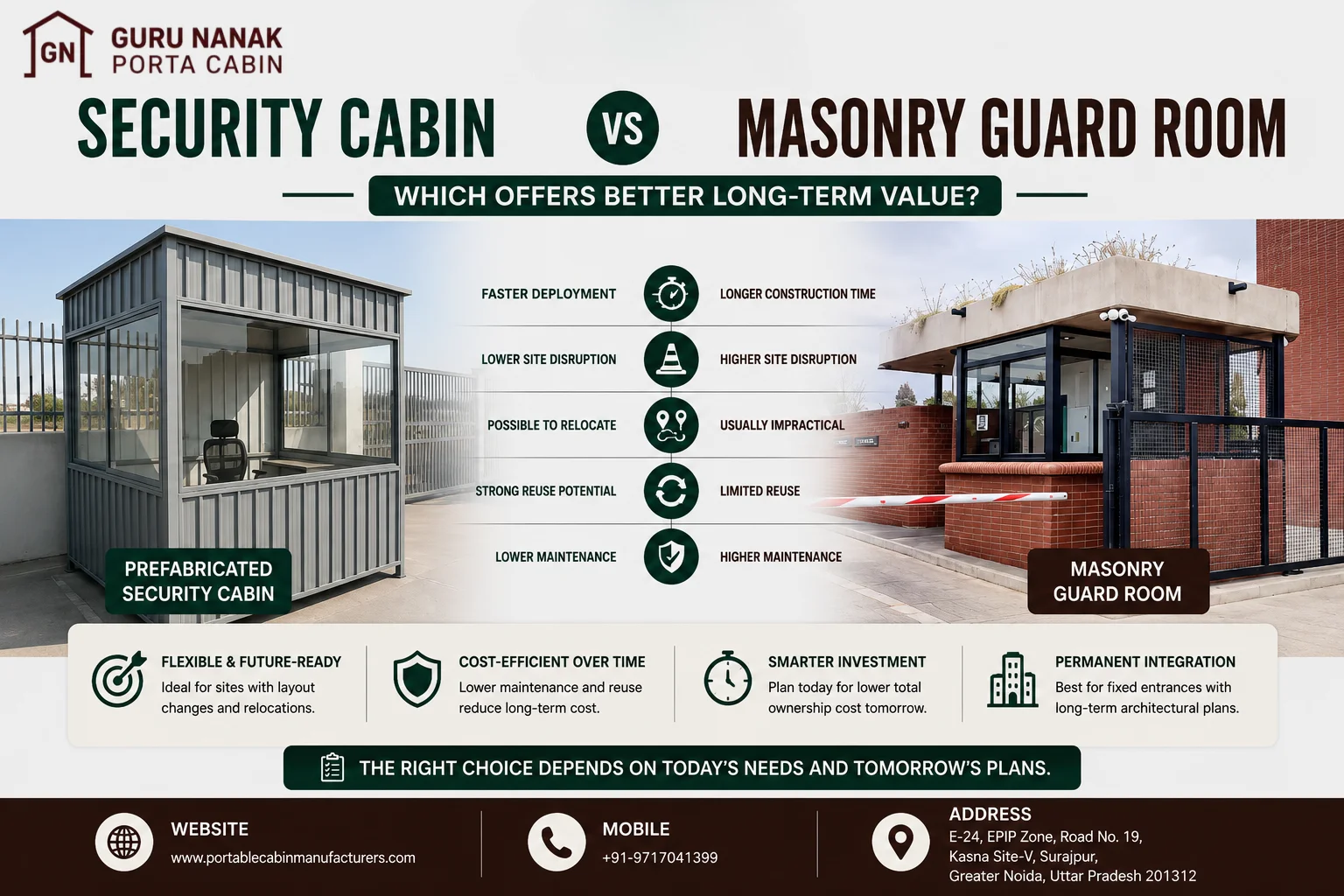
Security Cabin vs Masonry Guard Room — Which Offers Better Long-Term Value?
26 Aug, 2026
A guard station may occupy only a small area of an industrial site, but choosing the wrong construction method can create unnecessary cost, disruption and future modification problems.
A masonry guard room may feel like the more permanent option. It can integrate well with boundary walls, gate architecture and larger civil works. But it also requires foundations, masonry, roofing, plastering, finishing, electrical work and on-site labour before it becomes usable.
A prefabricated security cabin follows a different approach. Most of the structure is manufactured off-site, then delivered and installed on prepared supports. Windows, workstation position, electrical points, CCTV provisions, access-control interfaces and door locations can be coordinated before dispatch.
The cabin may also be relocated or reused if the gate, road or factory layout changes later.
Neither option is automatically better.
The right choice depends on:
- Required Deployment Time
- Certainty Of The Gate Location
- Visibility Requirements
- Acceptable Site Disruption
- Architectural Expectations
- Maintenance Strategy
- Relocation Probability
- Total Ownership Cost
For buyers, the most useful comparison is not simply: Steel cabin vs brick room
It is: Flexible prefabricated infrastructure vs permanently fixed civil construction.
Quick Comparison
| Evaluation Area | Prefabricated Security Cabin | Masonry Guard Room |
|---|---|---|
| Construction approach | Factory manufactured | Site constructed |
| Deployment speed | Generally faster | More sequential work |
| Site disruption | Usually lower | Higher |
| Custom visibility | Strong | Strong with early planning |
| Electrical/CCTV integration | Can be factory coordinated | Site-trade coordination |
| Thermal performance | Specification dependent | Specification dependent |
| Maintenance | Coating, joints, roof, hardware | Cracks, dampness, plaster, paint |
| Relocation | Possible when designed for it | Usually impractical |
| Reuse | Strong potential | Limited |
| Demolition risk | Lower | Higher |
| Architectural integration | Moderate to strong | Strong |
| Best fit | Flexible/time-sensitive sites | Permanent fixed entrances |
1. What Is a Prefabricated Security Cabin?
A prefabricated security cabin is a factory-manufactured guard station typically built around a steel structural frame with wall and roof systems, flooring, doors, windows, electrical provisions and optional insulation.
Depending on the project, it may be used at:
- Factory Entrances
- Warehouse Gates
- Logistics Facilities
- Construction Sites
- Industrial Premises
- Infrastructure Projects
- Renewable-Energy Sites
- Mining Projects
- Commercial Entrances
- Temporary Access Points
Its main advantage is that a large part of the work happens before the structure reaches the site.
Fabrication may include:
- Structural Frame
- Windows
- Doors
- Insulation
- Electrical Wiring
- Lighting
- Internal Finishes
- Cctv Provisions
- Access-Control Interfaces
The site then focuses mainly on supports, positioning, anchoring and utility connections.
2. What Is a Masonry Guard Room?
A masonry guard room is built permanently at the selected gate using conventional civil construction.
Typical work may include:
- Excavation
- Foundations
- Plinth
- Brick Or Block Walls
- Rcc Elements
- Roofing
- Plaster
- Waterproofing
- Flooring
- Doors And Windows
- Painting
- Electrical Work
- Cctv Cabling
- Drainage
Its main advantage is permanent integration.
A masonry room can become part of:
- A Boundary Wall
- A Formal Gatehouse
- A Larger Entrance Structure
- A Permanent Architectural Scheme
Its main limitation is that the structure is tied to its location.
If the gate moves later, demolition and reconstruction may be required.
3. The Real Decision: Fixed Location or Future Flexibility?
One of the most important questions is:
Is the gate location certain for the full ownership period?
If the answer is yes, both options remain viable.
If the answer is no or uncertain, the prefabricated security cabin usually offers stronger lifecycle flexibility.
Gate locations may change because of:
- Factory Expansion
- Revised Truck Routes
- Warehouse Additions
- Separate Employee Entrances
- Fire-Access Changes
- Automation
- Road Widening
- temporary construction phases
A masonry guard room can become an obstacle if the access layout changes. A relocatable security cabin may instead be disconnected, lifted, moved and reused.
That difference can materially affect long-term value.
4. Planning and Approval Requirements
Both systems require careful planning.
Security Cabin Planning
Before manufacturing, define:
- Cabin Dimensions
- Number Of Guards
- Viewing Directions
- Window Positions
- Door Position
- Workstation
- Cctv Equipment
- Electrical Load
- Boom-Barrier Controls
- Ventilation
- Hvac
- Support/Foundation
- Delivery Access
Masonry Guard Room Planning
Coordinate:
- Architectural Layout
- Foundations
- Wall System
- Roof
- Doors
- Windows
- Drainage
- Electrical Work
- Cctv Conduits
- Finishes
- Gate Integration
A prefabricated cabin usually requires earlier drawing freeze because factory manufacturing depends on approved information.
A masonry room may allow changes during construction, but those changes can create rework.
5. Construction Time and Gate Disruption
A major difference is where the work takes place.
Prefabricated Security Cabin
A simplified sequence is:
Requirement → Drawing Approval → Factory Fabrication → Site Support Preparation → Delivery → Positioning → Utility Connection
Masonry Guard Room
A simplified sequence is:
Excavation → Foundation → Plinth → Walls → Roof → Curing → Plaster → Flooring → Openings → Electrical Work → Painting → Handover
For an active industrial gate, civil work may also require:
- Temporary Security Arrangements
- Traffic Diversion
- Construction Barricades
- Material Storage
- Labour Access
- Dust Control
- Repeated Supervision
A security cabin still needs installation planning, but the disruptive site window is generally more concentrated.
Winner for fast deployment: Prefabricated security cabin.
6. Foundation and Civil Work
Portable does not mean foundation-free.
A prefabricated security cabin may require:
- Concrete Pads
- Pedestals
- Prepared Slab
- Strip Supports
- Anchoring
- Project-Specific Foundations
The exact requirement depends on size, site conditions and design.
A masonry guard room generally requires a broader civil package:
- Excavation
- Foundations
- Plinth
- Masonry
- Damp Protection
- Roof Structure
- Plaster
- Waterproofing
- Finishing
Where a larger civil package is already active, a masonry room may integrate efficiently.
Where the site needs to minimize additional construction, the prefabricated option often has the advantage.
7. Structural and Material Comparison
Neither steel nor masonry automatically guarantees better durability.
Security Cabin
Typical components include:
- Steel Frame
- Wall Panels
- Roof System
- Insulation
- Coating
- Flooring
- Doors/Windows
- Fasteners
- Sealants
Masonry Guard Room
Typical components include:
- Concrete Foundations
- Brick/Block Walls
- Rcc Components
- Plaster
- Roofing
- Waterproofing
- Flooring
- Paint
- Doors/Windows
| Parameter | Security Cabin | Masonry Guard Room |
| Main structure | Steel framed | Masonry/RCC |
| Main execution location | Factory | Site |
| Corrosion risk | Requires protective coating | Metal components still need protection |
| Crack risk | Lower in panels; joints need care | Masonry/plaster can crack |
| Dampness risk | Depends on sealing/drainage | Depends on waterproofing/DPC |
| Repair approach | Component-level replacement possible | Civil repair often required |
Durability depends on design, materials, workmanship, drainage and maintenance.
8. Visibility and Guard Operations
Visibility should be planned around the guard's actual duties.
Important viewing zones may include:
- Approaching Vehicles
- Exit Lane
- Pedestrian Gate
- Boom Barrier
- Visitor Window
- Driver Stopping Point
- Cctv-Supported Zones
A customized security cabin can be designed with:
- Wide Observation Windows
- Corner Glazing
- Transaction Windows
- Custom Sill Heights
- Cctv Monitor Provisions
- Barrier-Control Points
A masonry guard room can also provide excellent sightlines if the layout is coordinated properly from the beginning. There is no material-based visibility winner. The better design is the one based on a real sightline and workstation plan.
9. Thermal Comfort and Weather Protection
A common misconception is that steel cabins are always hot and masonry rooms are always comfortable.
Neither is automatically true.
Security Cabin Thermal Performance Depends On:
- Roof Insulation
- Wall Insulation
- Glazing Area
- Shading
- Ventilation
- Air Conditioning
- Thermal Bridging
Masonry Guard Room Performance Depends On:
- Wall Construction
- Roof Heat Gain
- Roof Insulation
- Shading
- Ventilation
- Glazing
- Dampness
- HVAC
A low-cost uninsulated steel cabin can overheat.
An exposed masonry room with an uninsulated roof can also become uncomfortable.
The complete envelope matters more than the construction label.
10. Electrical, CCTV and Access-Control Integration
A security cabin can be manufactured with internal provisions already coordinated.
These may include:
- Distribution Board
- Lighting
- Sockets
- Ac Point
- CCTV Monitor Point
- DVR/NVR Shelf
- Intercom
- Data Points
- Barrier Control
- Access-Control Panel
This can reduce:
- Surface Wiring
- Late Wall Cutting
- Equipment-Position Conflicts
- On-Site Coordination Between Trades
A masonry guard room can also integrate these systems effectively when electrical and security contractors are involved early.
Security cabin advantage: faster integrated coordination.
Masonry advantage: concealed services can be incorporated into a larger permanent civil scheme.
11. Quality-Control Differences
Prefab quality control is concentrated in the manufacturing process.
Typical checks may include:
- Frame Dimensions
- Welding
- Coating
- Panel Alignment
- Roof Sealing
- Door/Window Operation
- Electrical Functionality
- Pre-Dispatch Inspection
Masonry quality relies more heavily on site supervision.
Typical checks include:
- Foundation Dimensions
- Concrete/Mortar
- Wall Alignment
- Plaster
- Curing
- Waterproofing
- Flooring
- Conduits
- Finishing
Factory fabrication can improve consistency, but only when the manufacturer's processes are controlled.
Masonry can also perform reliably when civil workmanship and supervision are strong.
Neither method removes the need for quality inspection.
12. Maintenance and Repairs
The maintenance profile differs between the two options.
Security Cabin Maintenance
Likely areas include:
- Coating
- Corrosion
- Roof Fasteners
- Sealants
- Wall Joints
- Doors
- Windows
- Flooring
- Supports
- Electrical Equipment
Masonry Guard Room Maintenance
Likely areas include:
- Wall Cracks
- Plaster
- Paint
- Roof Waterproofing
- Dampness
- Flooring
- Drainage
- Door/Window Frames
There is no universal winner on maintenance cost. A well-coated and properly drained steel cabin may require limited structural intervention. A well-built masonry room may remain serviceable for years. Poor workmanship can make either option expensive to maintain.
13. Modification and Future Gate Changes
This is one of the strongest advantages of prefabricated cabins.
If the industrial access plan changes, a security cabin may be:
Disconnected → Lifted → Transported → Reinstalled → Reconnected
A masonry guard room may require:
Demolition → Waste Removal → New Foundation → Reconstruction → New Utilities
This matters particularly at:
- Expanding Factories
- Warehouses
- Logistics Hubs
- Construction Projects
- Infrastructure Sites
If future layout change is reasonably possible, mobility can become a genuine financial advantage rather than simply a product feature.
14. Relocation, Reuse and Residual Value
Relocation still creates cost.
Potential security-cabin relocation expenses include:
- Utility Disconnection
- Crane
- Transport
- New Supports
- Repair
- Reinstallation
- Reconnection
- Repainting
- Recommissioning
But the original unit may remain usable.
Possible future uses include:
- Relocated Guard Cabin
- Contractor Cabin
- Temporary Office
- Access-Control Point
- Secondary Security Station
A masonry guard room generally cannot be relocated as a complete asset. Once redundant, it may require demolition. This gives prefabricated cabins stronger reuse and recoverability potential.
15. Initial Cost vs Total Ownership Cost
The correct comparison should consider more than purchase price.
A useful framework is:
Total Ownership Cost = Initial Project Cost + Disruption Cost + Maintenance + Modification + End-of-Life Cost − Reuse or Residual Value
Security Cabin Cost May Include:
- Manufacturing
- Glazing
- Insulation
- Electrical Provisions
- Transport
- Crane
- Foundations
- Installation
- Maintenance
- Relocation
Masonry Guard Room Cost May Include:
- Design
- Foundations
- Walls
- Roof
- Flooring
- Plaster
- Waterproofing
- Doors/Windows
- Electrical Work
- Labour
- Supervision
- Temporary Security Arrangements
- Maintenance
- Demolition
A masonry guard room may offer stronger value where:
- The Location Is Permanent
- Civil Work Is Already Mobilized
- Architectural Integration Matters
- No Future Relocation Is Expected
A security cabin may offer stronger ownership value where:
- Deployment Is Urgent
- Gate Disruption Should Be Minimized
- Relocation Is Possible
- Reuse Has Value
- Site Labour Should Be Reduced
16. Practical Buying Scenarios
Operating Factory Gate
The entrance cannot be disrupted for extended civil work.
Usually better fit: Prefabricated security cabin.
Premium Permanent Entrance
The guard room is part of a formal architectural gatehouse.
Usually better fit: Masonry guard room.
Construction Site With Changing Access
The gate may move as work progresses.
Usually better fit: Relocatable security cabin.
Warehouse With Planned Expansion
Truck circulation may change in the future.
Usually better fit: Security cabin unless the final permanent gate is already fixed.
Large Civil Campus
Civil teams and materials are already mobilized.
Usually better fit: Masonry may integrate efficiently.
17. Advantages and Limitations
Prefabricated Security Cabin Advantages
- Fast Deployment
- Less Wet Construction
- Reduced Gate Disruption
- Lower Site-Labour Dependence
- Factory-Based Quality Control
- Custom Visibility
- Pre-Integrated Services
- Relocation Potential
- Reuse Potential
- Easier Component Replacement
Limitations
- Transportation Planning Required
- Crane Access May Be Required
- Coating Maintenance Matters
- Insulation Must Be Specified Properly
- Site Access May Limit Module Size
- Custom Finishes May Be Needed For Premium Architecture
Masonry Guard Room Advantages
- Strong Architectural Integration
- Familiar Civil Construction
- Good Fit For Permanent Gates
- Easy Integration With Boundary Walls
- Broad Finish Options
- Useful Where Civil Resources Are Already Mobilized
Limitations
- Longer Site Execution
- More Gate Disruption
- Greater Labour And Supervision
- Weather-Dependent Construction
- Difficult Relocation
- Demolition When Redundant
- Low Reuse Potential
18. Quick Recommendation
Choose a Prefabricated Security Cabin When:
- Fast Deployment Is Important
- Gate Disruption Must Be Limited
- The Location May Change
- Future Reuse Matters
- Custom Visibility Is Required
- Electrical/Cctv Integration Is Needed
- Site Labour Should Be Minimized
Choose a Masonry Guard Room When:
- The Location Is Permanently Fixed
- Architectural Integration Is Critical
- A Larger Civil Package Already Exists
- Relocation Has No Value
- Transport/Crane Access Is Impractical
Consider a Hybrid Solution When:
The project requires both speed and stronger architectural integration.
Possible options include:
- Prefab Cabin With Decorative Façade Treatment
- Steel Cabin Below A Permanent Gate Canopy
- Temporary Prefab Cabin Followed By Permanent Masonry
- Masonry Gatehouse With Secondary Relocatable Cabin
Final Decision Matrix
| Buying Priority | Security Cabin | Masonry Guard Room |
| Fast deployment | Strong | Moderate/Low |
| Low gate disruption | Strong | Low |
| Factory coordination | Strong | Not applicable |
| Permanent architecture | Moderate to strong | Strong |
| Future relocation | Strong | Weak |
| Reuse at another site | Strong | Weak |
| Visibility customization | Strong | Strong |
| Integrated electrical/CCTV | Strong | Strong with coordination |
| Low site labour | Strong | Weak |
| Difficult transport access | Weak/Moderate | Strong |
| Existing civil package | Moderate | Strong |
| Recoverability | Stronger | Limited |
Frequently Asked Questions
1.What is the main difference between a security cabin and masonry guard room?
A security cabin is manufactured largely off-site and installed as an independent unit. A masonry guard room is constructed permanently at the final location.
2. Which is faster?
A prefabricated security cabin is generally faster because much of the work happens in a factory while site supports are prepared separately.
3. Which costs less initially?
There is no universal answer. Compare equivalent foundations, electrical scope, finishes, installation and site requirements.
4. masonry more durable?
Not automatically. Durability depends on specification, workmanship, drainage, environmental exposure and maintenance.
5. Can a security cabin be used long term?
Yes, when structure, coating, insulation, supports and utilities are appropriate for the intended use.
6. Will a steel security cabin become too hot?
It can if poorly specified. Insulation, glazing control, shading, ventilation and HVAC can improve comfort.
7. Does a masonry guard room stay cooler?
Not necessarily. Roof heat gain, poor ventilation and glazing can still create thermal discomfort.
8. Which option provides better visibility?
Either can perform well. Window position, guard workstation, site orientation and gate geometry matter more than the structural material.
9. Does a security cabin need foundations?
It requires suitable stable supports or foundations based on the cabin and site conditions.
10. Can a security cabin be relocated?
Yes, where the frame, lifting points and utility interfaces support relocation.
11. Can a masonry guard room be relocated?
Normally no. Relocation generally requires demolition and reconstruction.
12. Which option needs less site labour?
A prefabricated security cabin generally requires less on-site construction labour.
13. Which has lower maintenance cost?
There is no universal winner. Maintenance depends on materials, workmanship, weather exposure and inspection.
14. is better for construction sites?
A relocatable security cabin is usually better where entrances may move as work progresses.
15. is better for a permanent factory gate?
Either may work. The final choice depends on architecture, relocation risk, disruption and lifecycle value.
Final Recommendation
For projects where speed, limited gate disruption, visibility-focused design, relocation and reuse matter, a prefabricated security cabin generally offers stronger long-term flexibility.
For projects where the entrance is permanently fixed, heavily integrated with civil architecture and unlikely to change, a masonry guard room may provide the better fit.
The final decision should therefore consider:
Deployment Time → Gate Stability → Visibility → Site Disruption → Services → Maintenance → Relocation → End-of-Life Value
The lowest initial cost does not always produce the strongest long-term value.
The better option is the one that fits how the gate will operate throughout the ownership period.
Request a Security Cabin Project Consultation
If you are comparing a prefabricated security cabin with a masonry guard room, share your gate layout, vehicle and pedestrian routes, number of guards, required dimensions, visibility requirements, glazing, electrical load, CCTV/access-control requirements, ventilation or HVAC needs, foundation status, site access, expected operating period and relocation possibility with Guru Nanak Porta Cabin.
The requirement can then be reviewed from a manufacturing, installation, operational and lifecycle perspective before a project-specific recommendation or quotation is prepared.
To discuss your security cabin requirement, contact Guru Nanak Porta Cabin through the Contact Us page.


