

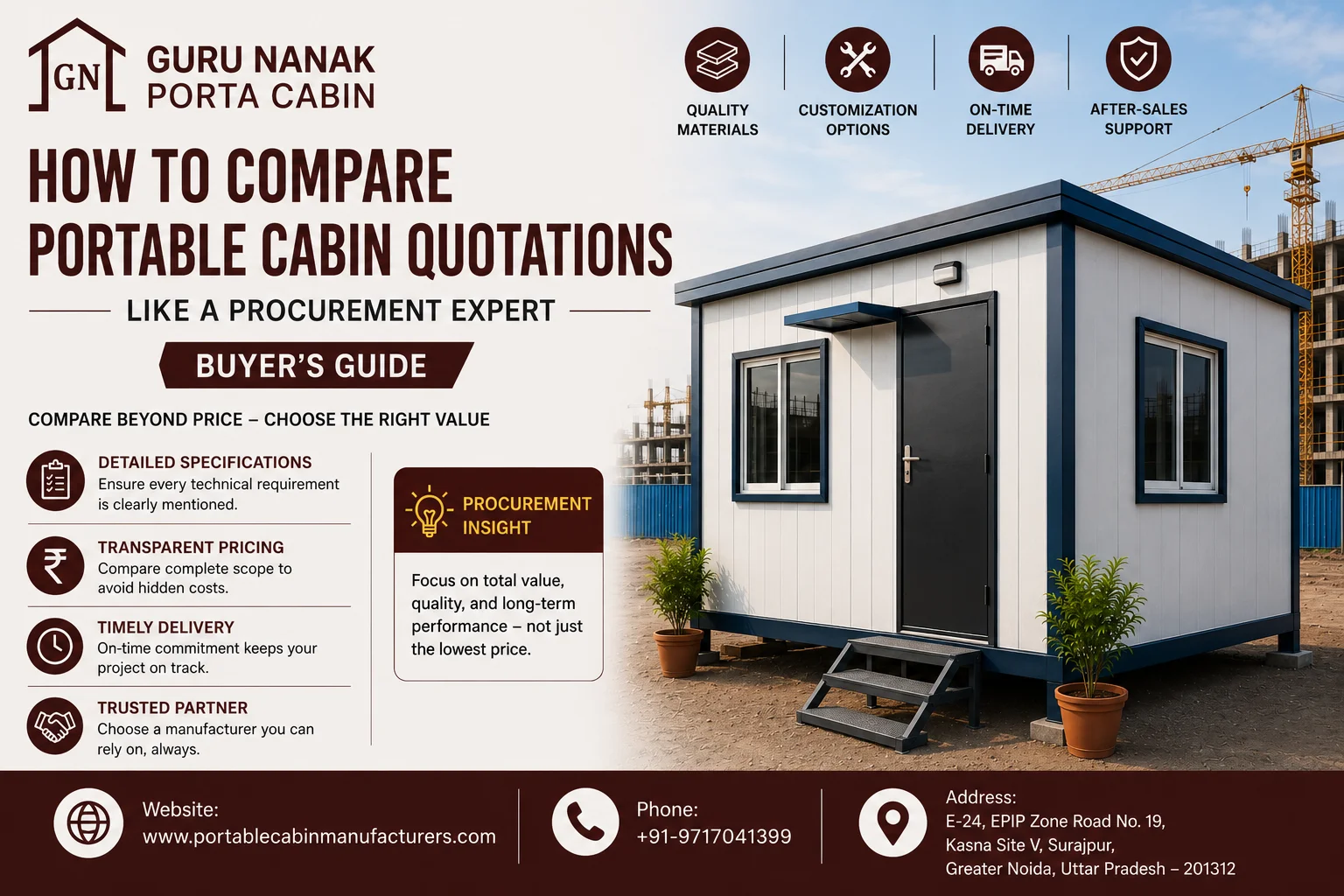
How to Compare Portable Cabin Quotations Like a Procurement Expert
23 Jul, 2026
Receiving three or four quotations for a Portable Cabin project may seem like you're close to making a purchase decision. In reality, the quotation comparison stage is where many procurement mistakes begin. Two quotations with similar prices can differ significantly in material quality, structural specifications, insulation, installation scope, warranty coverage, and after-sales support. Selecting a supplier based only on the lowest price can result in unexpected project delays, higher maintenance costs, or expensive modifications after installation.
For procurement managers, contractors, and project engineers, comparing quotations is not simply a financial exercise—it is a technical and commercial evaluation. Every quotation should answer important questions about product quality, supplier capability, delivery commitments, customization options, and long-term value. A structured comparison process helps reduce purchasing risks while ensuring the selected Portable Cabin Supplier can meet both project specifications and operational requirements.
If your project requires customized configurations, multiple units, or industrial applications, reviewing detailed Portable Cabin options before comparing quotations can help establish a consistent technical baseline. It also enables suppliers to quote against identical requirements, making commercial comparisons more accurate.
A procurement expert compares Portable Cabin quotations by evaluating much more than the quoted price. Material specifications, structural design, insulation quality, customization scope, manufacturing capability, delivery timeline, installation responsibility, warranty terms, and after-sales support all influence the overall value of a quotation. Comparing suppliers on identical technical specifications helps buyers make informed and commercially sound decisions.
Why Comparing Portable Cabin Quotations Requires More Than Price Analysis
A Portable Cabin quotation is not merely a price document—it reflects the supplier's interpretation of your project requirements. Two suppliers may quote the same cabin dimensions but use different structural materials, insulation thicknesses, flooring systems, roofing panels, or electrical components. Without examining these technical details, buyers may unknowingly compare products that are not equivalent.
For industrial projects, government tenders, infrastructure developments, and construction sites, procurement decisions often affect operational efficiency for years. A lower initial investment may lead to increased maintenance expenses or reduced service life if the cabin specifications do not match project conditions.
A Practical Example
Imagine two suppliers provide quotations for a 20-foot Portable Office Cabin.
|
Comparison Factor
|
Supplier A | Supplier B |
|---|---|---|
| Base Price | Lower | Slightly Higher |
| Wall Panel Specification | Standard | Higher Insulation |
| Structural Steel Thickness | Basic | Project-Specific |
| Installation | Extra Cost | Included |
| Transportation | Separate | Included |
| Warranty | Limited | Clearly Defined |
At first glance, Supplier A appears more economical. After including transportation, installation, and specification upgrades, Supplier B may actually deliver better long-term value.
This is why experienced procurement teams evaluate the complete commercial proposal instead of focusing solely on the headline price.
Procurement Perspective: Cost vs Value
Professional buyers rarely ask, "Which quotation is the cheapest?"
Instead, they ask:
- Does this quotation meet our technical specifications?
- Are all project requirements included?
- Can the supplier deliver within the required schedule?
- Are hidden costs likely after purchase?
- Will the cabin perform reliably throughout its expected lifecycle?
Answering these questions reduces procurement risk and improves confidence before issuing a purchase order.
Why Businesses Request Multiple Portable Cabin Quotations
Obtaining quotations from multiple Portable Cabin Manufacturers in India allows procurement teams to benchmark commercial offers, verify market pricing, and identify differences in technical proposals. However, requesting multiple quotations only adds value when each supplier receives the same project specifications.
Businesses typically compare quotations when planning:
- Construction site offices
- Temporary project offices
- Security cabins
- Labour accommodation
- Storage cabins
- Commercial office expansions
- Industrial facility support buildings
- Government infrastructure projects
Providing identical technical requirements to every supplier ensures quotations remain comparable and reduces confusion during evaluation.
Should You Always Choose the Lowest Quote?
No.
The lowest quotation is not always the most economical option over the life of the project. A slightly higher quotation may include better structural materials, improved insulation, installation services, warranty coverage, or post-installation support that reduces future operating costs and maintenance requirements.
For procurement teams, value is determined by total project cost—not simply the initial purchase price.
Common Procurement Mistakes While Comparing Portable Cabin Quotations
Many purchasing delays and budget overruns originate during quotation evaluation rather than manufacturing or installation. Recognizing these common mistakes helps buyers make more informed commercial decisions.
1. Comparing Prices Without Comparing Specifications
A quotation should never be evaluated without reviewing the detailed specifications. Differences in steel framework, insulation material, flooring, roofing, electrical fittings, and finishing can significantly affect product quality and lifecycle performance.
2. Ignoring Scope Differences
Some quotations include transportation, unloading, installation, and commissioning, while others treat these as additional services. Procurement teams should verify exactly what is included before comparing prices.
3. Assuming Every Supplier Is a Manufacturer
Not every company providing a quotation operates its own manufacturing facility. Some businesses function as dealers or intermediaries. Understanding whether the quotation comes directly from a Portable Cabin Manufacturer or a trading company can help buyers evaluate production control, customization capability, and communication efficiency.
Buyers interested in understanding a manufacturer's background, industry experience, and production approach should review the company's profile before making a shortlist.
4. Overlooking Customization Requirements
Industrial projects often require modifications such as additional windows, insulation upgrades, electrical layouts, partition walls, HVAC provisions, or specialized flooring. Confirm whether these requirements are included in the quotation rather than assumed later during production.
5. Focusing Only on Initial Investment
Procurement decisions should account for the total cost of ownership, including maintenance requirements, future relocation, durability, repair costs, and operational efficiency. A well-specified Modular Portable Cabin can offer better long-term value even if the initial quotation is slightly higher.
Procurement Tip
Before requesting revised quotations, prepare a standardized technical specification sheet and share it with every shortlisted supplier. This creates a fair comparison process and minimizes commercial misunderstandings during negotiations.
What Every Portable Cabin Quotation Should Include
A professional Portable Cabin quotation should provide complete commercial and technical clarity—not just a total price. Procurement teams should be able to understand exactly what is being supplied, the specifications offered, delivery commitments, exclusions, and commercial terms before approving a purchase order.
A quotation that lacks detailed specifications makes it difficult to compare suppliers fairly and increases the risk of unexpected costs during execution.
Essential Information Every Quotation Should Contain
Before comparing prices, verify that each quotation includes the following:
| Evaluation Item | Why It Matters |
|---|---|
| Cabin dimensions | Confirms suppliers are quoting for identical sizes |
| Structural material specifications | Determines strength and durability |
| Wall and roof panel details | Affects insulation and weather resistance |
| Flooring specifications | Impacts load-bearing capacity and maintenance |
| Doors and windows | Ensures quantity and quality match project requirements |
| Electrical provisions | Avoids additional wiring costs later |
If any of these details are missing, procurement teams should request clarification before comparing quotations.
Compare Technical Specifications Before Comparing Prices
A lower quotation often reflects differences in specifications rather than better pricing. Technical comparison helps ensure suppliers are bidding on an equivalent scope.
Structural Framework
The structural frame determines the cabin's durability, stability, and suitability for relocation. Buyers should verify:
- Steel section type
- Material thickness
- Structural design
- Corrosion protection method
- Welding quality
A quotation mentioning only "MS Structure" without further details should be clarified before evaluation.
Wall and Roof Panels
Insulation performance varies depending on the panel construction.
Compare:
- Panel thickness
- Insulation type
- External finish
- Internal finish
- Weatherproof construction
Well-defined specifications help procurement teams estimate lifecycle performance rather than only initial cost.
Flooring System
Different suppliers may quote different flooring assemblies.
Verify:
- Base frame construction
- Flooring board material
- Floor finish
- Moisture resistance
- Load capacity
Industrial applications generally require stronger flooring than temporary office use.
Electrical Package
Some quotations include only conduits, while others include complete electrical installations.
Check whether the quotation specifies:
- Wiring
- Distribution board
- Switches
- Lighting fixtures
- Power sockets
- Earthing provisions
Incomplete electrical scope frequently leads to variation orders after installation.
Doors and Windows
Cabin usability depends significantly on openings.
Compare:
- Door material
- Locking system
- Window frame material
- Glass specifications
- Ventilation arrangements
A cabin intended for continuous occupancy requires different ventilation considerations than a temporary storage cabin.
Procurement Comparison Matrix
Creating a comparison sheet makes supplier evaluation more objective.
| Evaluation Criteria | Supplier A | Supplier B | Supplier C |
|---|---|---|---|
| Technical Specifications | yes | yes | Partial |
| Manufacturing Capability | yes | yes | Verify |
| Custom Design Support | yes | Limited | yes |
| Transportation Included | Yes | No | Yes |
| Installation Included | Yes | Optional | Yes |
| Warranty Mentioned | Yes | No | Yes |
| Commercial Clarity | Excellent | Average | Good |
| Documentation Complete | Yes | Partial | Yes |
Rather than assigning weight to price alone, procurement teams should score quotations across multiple commercial parameters.
Hidden Costs That Buyers Often Miss
The quoted amount is not always the final project cost. Many additional expenses arise because buyers assume certain services are included.
Transportation Charges
Some suppliers quote the cabin price separately from freight. Transportation costs can vary depending on project location, unloading arrangements, and vehicle requirements.
Always confirm:
- Freight inclusion
- Delivery location
- Unloading responsibility
- Multiple shipment charges
Installation Charges
Installation may or may not be included.
Clarify:
- Assembly labour
- Equipment required
- Crane arrangements (if needed)
- Foundation readiness
- Site supervision
Understanding installation responsibility helps avoid project delays.
Electrical and Plumbing Completion
Certain quotations include only provisions, while others include complete installation.
Ask suppliers whether the quoted price covers:
- Internal wiring
- Electrical fittings
- Plumbing fixtures
- Water connections
- Drainage arrangements
Customization Costs
Project-specific requirements often affect pricing.
Examples include:
- Additional partitions
- Conference rooms
- Washrooms
- Pantry areas
- HVAC provisions
- Extra doors and windows
- Branding elements
- Special flooring
Request a revised quotation if these features are required rather than assuming they are included.
Taxes and Commercial Terms
Commercial comparison should also include:
- Applicable taxes
- Payment milestones
- Advance payment requirements
- Quotation validity
- Price revision clauses
Ignoring commercial terms can create budgeting issues later.
Pricing Factors That Influence Portable Cabin Quotations
There is no universal Portable Cabin Price because every project has different technical and commercial requirements. Procurement teams should understand the variables that influence pricing before comparing supplier proposals.
Key factors include:
- Cabin dimensions
- Structural design
- Steel framework specifications
- Insulation requirements
- Interior finishes
- Number of doors and windows
- Electrical and plumbing scope
- Custom layouts
- Transportation distance
- Installation requirements
- Quantity ordered
- Project location
Understanding these cost drivers helps buyers identify whether price differences are justified or require further clarification.
Quick Procurement Checklist Before Comparing Prices
Before reviewing the final quoted amount, confirm:
- Are all suppliers quoting the same cabin size?
- Are structural specifications identical?
- Is insulation comparable?
- Are transportation costs included?
- Is installation included?
- Are electrical works included?
- Are warranty terms clearly mentioned?
- Are customization requirements included?
- Are taxes shown separately?
- Are payment terms comparable?
Completing this checklist ensures procurement teams compare quotations on a like-for-like basis rather than making decisions based solely on the lowest number.
Once technical specifications and commercial inclusions have been verified, the next step is evaluating the supplier behind the quotation. Manufacturing capability, project support, delivery reliability, and after-sales service often determine the success of a Portable Cabin project as much as the quoted price itself.
How to Evaluate a Portable Cabin Supplier Beyond the Quotation
A competitive quotation is only one part of the purchasing decision. The supplier behind the quotation determines whether your project is delivered on time, built according to specifications, and supported after installation. Procurement teams should therefore evaluate the supplier's capability with the same level of scrutiny as the quoted price.
A reliable Portable Cabin Supplier should demonstrate transparency in manufacturing, communication, documentation, customization, and post-sales support rather than relying solely on attractive pricing.
Supplier Evaluation Framework for Procurement Teams
Use the following framework while reviewing shortlisted suppliers.
| Evaluation Area | What to Verify | Why It Matters |
|---|---|---|
| Business Credentials | GST, ISO, MSME and legal business documents | Builds procurement confidence |
| Manufacturing Capability | Whether the company manufactures its own cabins | Supports quality control and customization |
| Product Range | Office, Security, Site Office, Toilet and Modular Cabins | Indicates broader project capability |
| Technical Support | Ability to discuss project specifications | Reduces design errors |
| Customization | Layout and size flexibility | Supports project-specific needs |
| Delivery Planning | Production and dispatch coordination | Helps meet project schedules |
| Installation Support | Scope of installation services | Minimizes execution delays |
| Warranty & After-Sales | Service commitments after delivery | Protects long-term investment |
Rather than treating each factor independently, procurement teams should evaluate how these capabilities align with the project's technical and operational requirements.
Manufacturer vs Trader vs Dealer: Why It Matters
One of the most overlooked aspects of quotation comparison is understanding who is actually supplying the cabin.
Not every company providing a quotation manufactures the product. Some businesses operate as dealers or trading companies that source cabins from third-party manufacturers.
Understanding this distinction helps buyers assess customization capability, communication efficiency, and production control.
Comparison Table
| Evaluation Factor | Manufacturer | Trader/Dealer |
|---|---|---|
| Direct Production Control | yes | Usually Limited |
| Custom Design Capability | High | Depends on Manufacturer |
| Technical Discussions | Direct with Production Team | Through Intermediary |
| Design Modifications | Faster | May Require Additional Coordination |
| Quality Monitoring | Direct | Depends on Supplier Network |
| Production Updates | Easier | Indirect Communication |
This does not mean every trader provides poor service. However, procurement teams should clearly understand who is responsible for manufacturing, quality assurance, and project execution before approving a purchase order.
Questions Procurement Teams Should Ask Every Supplier
A quotation provides numbers, but discussions with suppliers reveal their ability to execute the project successfully.
Consider asking:
Technical Questions
- Can the cabin be customized to suit our layout?
- Which structural materials are being used?
- Can insulation specifications be modified?
- Are electrical and plumbing provisions included?
Commercial Questions
- Does the quotation include transportation?
- Is installation part of the quoted scope?
- What items are specifically excluded?
- How long is the quotation valid?
Manufacturing Questions
- Is the cabin manufactured in-house?
- Can production progress be shared during manufacturing?
- How are design changes handled once production begins?
Support Questions
- What warranty is provided?
- How are service requests managed after installation?
- Are replacement components available if required?
The quality of a supplier's responses often indicates their level of project understanding and customer support.
Delivery Planning: A Critical Procurement Consideration
Even a technically superior cabin loses value if it arrives after the project deadline.
Delivery planning should therefore be evaluated as part of quotation comparison rather than after supplier selection.
Procurement teams should discuss:
- Estimated production schedule
- Dispatch planning
- Transportation arrangements
- Site accessibility
- Unloading responsibilities
- Installation sequence
- Coordination with other contractors
Projects involving infrastructure, industrial expansion, or temporary site offices often have strict timelines where delayed cabin delivery can affect multiple project activities.
Procurement Tip
Always align the supplier's delivery commitment with your overall project schedule instead of considering it as a separate activity.
Installation Evaluation Checklist
Installation scope differs significantly between suppliers.
Before final approval, verify whether the quotation includes:
- Site inspection (if applicable)
- Installation labour
- Assembly of modular sections
- Electrical connection support
- Plumbing connection support (where applicable)
- Final inspection
- Handover documentation
Clarifying installation responsibilities prevents disputes once the cabin reaches the project site.
Warranty and After-Sales Support
A warranty should not be viewed merely as a document—it reflects the supplier's willingness to support the product after delivery.
When comparing quotations, buyers should understand:
- Warranty duration
- Components covered
- Exclusions
- Service request process
- Availability of replacement parts
- Technical assistance for future modifications
After-sales support becomes particularly valuable for Portable Office Cabins, Site Office Cabins, and modular units expected to be relocated or expanded in the future.
Commercial Buying Checklist Before Final Approval
Before issuing the purchase order, procurement teams should complete the following checklist.
Technical Verification
- Dimensions verified
- Layout approved
- Structural specifications confirmed
- Insulation specifications reviewed
- Flooring confirmed
- Electrical scope verified
- Plumbing scope confirmed (if applicable)
Commercial Verification
- Transportation included
- Installation scope confirmed
- Taxes understood
- Payment milestones agreed
- Quotation validity checked
- Warranty documented
Supplier Verification
- Business credentials reviewed
- Manufacturing capability understood
- Customization discussed
- Communication responsiveness evaluated
- Delivery schedule confirmed
- After-sales support clarified
Completing this checklist helps procurement teams reduce commercial uncertainty and make decisions based on documented facts rather than assumptions.
Procurement Scenario: Comparing Two Similar Quotations
Scenario
A construction company requires multiple Portable Office Cabins for a new project site in Delhi NCR.
Supplier A submits the lowest quotation. Supplier B's quotation is approximately 7% higher.
Instead of selecting Supplier A immediately, the procurement team performs a structured comparison.
Evaluation Findings
| Comparison Area | Supplier A | Supplier B |
|---|---|---|
| Cabin Specifications | Basic | Detailed |
| Custom Layout Support | Limited | Available |
| Transportation | Additional Cost | Included |
| Installation | Extra | Included |
| Warranty | Brief Mention | Clearly Defined |
| Commercial Documentation | Basic | Comprehensive |
Although Supplier B's initial quotation is higher, the total evaluated project cost becomes more competitive after factoring in transportation, installation, and reduced coordination effort.
The procurement team selects the quotation that delivers better commercial value rather than simply the lowest upfront price.
Mid-Blog Buyer Tip
If your procurement team has finalized the required specifications, reviewing detailed Portable Cabin configurations before requesting revised quotations can help suppliers prepare more accurate commercial proposals. Similarly, understanding the manufacturer's background and technical approach provides additional confidence during supplier evaluation before moving to the final negotiation stage.
What's Next?
Once the supplier evaluation is complete, the final step is turning your findings into a confident purchasing decision. The concluding section covers why buyers often prefer working directly with experienced manufacturers, answers the most common procurement FAQs, and provides a practical call-to-action for requesting a project-specific quotation.
Why Procurement Teams Consider Guru Nanak Porta Cabin During Supplier Evaluation
Selecting a Portable Cabin Manufacturer in India is not only about comparing prices—it is also about choosing a supplier that can support your project from design discussions to installation and after-sales assistance.
When procurement teams evaluate suppliers, they generally look for manufacturers that offer transparency, customization, responsive communication, and the ability to handle project-specific requirements.
Guru Nanak Porta Cabin aligns with these expectations by offering:
- Manufacturer of Portable, Prefabricated & Modular Cabins
- Custom size and custom design solutions
- Mild Steel and PUF panel construction options
- Weatherproof and insulated cabin solutions
- Portable Office Cabins, Security Cabins, Site Office Cabins, Portable Toilet Cabins and other modular structures
- Quick installation and easy relocation
- Low-maintenance portable structures
- Solutions for industrial, commercial and construction projects
- Pan India supply
- GST, ISO and MSME certifications
- More than 15 years of industry experience
- After-sales support and warranty
Rather than selecting a supplier based solely on the lowest quotation, procurement teams often evaluate whether the manufacturer can consistently support project requirements before, during, and after delivery.
If you would like to understand available cabin configurations, customization possibilities, or application-specific solutions, explore the Portable Cabin product page before requesting a project quotation.
Frequently Asked Questions
1. How many Portable Cabin quotations should procurement teams compare?
Comparing three to five quotations generally provides sufficient market visibility without making the evaluation process unnecessarily complex. The key is ensuring every supplier receives identical technical specifications.
2. Why do Portable Cabin quotations vary significantly?
Differences usually arise from structural materials, insulation quality, flooring systems, electrical scope, transportation, installation, customization, and warranty terms rather than pricing strategy alone.
3. Should buyers always select the lowest quotation?
Not necessarily. A quotation with a slightly higher price may include additional services or better specifications that reduce long-term operational costs and project risks.
4. What is the biggest mistake while comparing Portable Cabin quotations?
The most common mistake is comparing prices without verifying whether all suppliers are quoting for the same specifications and project scope.
5. How can buyers identify a genuine Portable Cabin manufacturer?
Buyers should verify business credentials, manufacturing capability, product range, technical discussions, and company background instead of relying only on marketing material or pricing.
6. What documents should procurement teams request before placing an order?
Typical documents may include:
- GST registration
- ISO certification (if applicable)
- MSME registration (if applicable)
- Detailed quotation
- Technical specifications
- Warranty information
- Commercial terms
The exact requirements depend on the buyer's procurement policy.
7. What factors influence Portable Cabin Price?
Pricing depends on:
- Cabin dimensions
- Structural specifications
- Insulation
- Interior finishes
- Customization
- Quantity
- Transportation
- Installation
- Project location
Comparing these variables helps explain price differences between quotations.
8. Is customization possible in a Modular Portable Cabin?
Yes. Many projects require customized layouts, additional partitions, windows, doors, washrooms, meeting rooms, electrical layouts, or insulation upgrades based on operational needs.
9. Should transportation be included in the quotation?
Transportation should always be clarified. Procurement teams should confirm whether freight, unloading, and logistics are included or charged separately.
10. Is installation normally included?
Installation policies vary between suppliers. Buyers should confirm installation scope, labour responsibility, and site preparation requirements before approving the quotation.
11. How important is after-sales support?
After-sales support becomes increasingly valuable for cabins that may require relocation, expansion, maintenance, or future modifications during their service life.
12. Can Portable Cabins be relocated after installation?
Many modular and prefabricated cabins are designed for relocation. However, relocation capability depends on the original design and installation method.
13. What should buyers verify before approving a customized cabin design?
Buyers should confirm dimensions, internal layout, electrical provisions, doors, windows, insulation, flooring, and any project-specific modifications before production begins.
14. Why should procurement teams compare total project value instead of only price?
Total project value considers product quality, installation, delivery, maintenance requirements, warranty, and lifecycle performance rather than just the initial purchase cost.
15. What should be included in a final purchase approval checklist?
A final review should confirm:
- Technical specifications
- Commercial scope
- Delivery schedule
- Installation responsibilities
- Payment terms
- Warranty
- Supplier documentation
- Customization approvals
Completing this verification reduces procurement risks before issuing the purchase order.
Final Buying Perspective
Comparing Portable Cabin quotations is not about identifying the cheapest supplier—it is about selecting the proposal that delivers the best balance of quality, technical compliance, commercial transparency, and long-term value.
Procurement teams that evaluate quotations systematically are better positioned to avoid hidden costs, reduce project delays, and build long-term relationships with reliable manufacturing partners. Reviewing technical specifications, supplier capability, installation responsibilities, warranty terms, and commercial conditions together creates a more confident purchasing decision than comparing prices in isolation.
Whether your requirement involves a Portable Office Cabin, Site Office Cabin, Security Cabin, or another Prefabricated Portable Cabin solution, a structured quotation evaluation process will help ensure the selected supplier aligns with your operational and project objectives.
Request a Project-Specific Quotation
If your procurement team is preparing to compare quotations for an upcoming industrial, commercial, infrastructure, or construction project, the next step is to establish a clear technical specification before inviting supplier bids.
Guru Nanak Porta Cabin offers customized portable and modular cabin solutions for a wide range of project requirements across India. You can:
- Explore detailed Portable Cabin configurations to define your project scope.
- Review the company's About Us page to understand its manufacturing background and industry experience.
- Examine related solutions such as Portable Office Cabin, Security Cabin, Site Office Cabin, and Portable Toilet Cabin for application-specific needs.
- Contact the team to discuss your technical requirements and request a customized quotation based on your project specifications.
A well-prepared enquiry leads to more accurate quotations, easier supplier comparison, and a smoother procurement process.


