

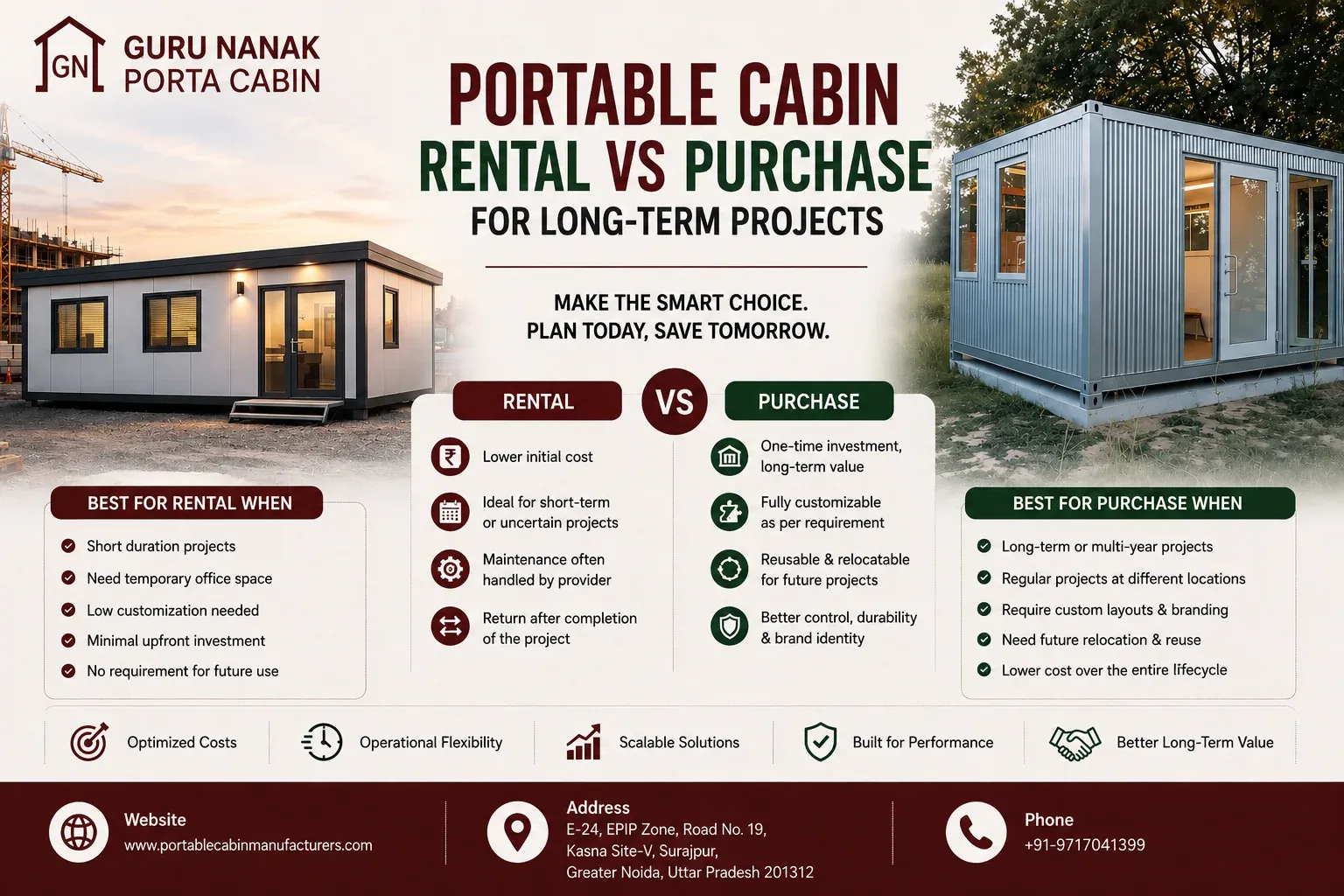
Portable Cabin Rental vs Purchase for Long-Term Projects
12 Aug, 2026
A portable cabin may initially appear to be a straightforward site-infrastructure requirement. However, the decision to rent or purchase becomes more complex when the project will continue for several years, the cabin requires customization, or the organization intends to reuse it at future locations.
Rental reduces the initial capital commitment and may work well for temporary deployments. Purchase creates an owned asset that can be customized, relocated and reused, but it requires a higher upfront investment and greater responsibility for transportation, storage and maintenance.
The cheaper option is therefore not determined only by the monthly rental amount or initial purchase price. Procurement teams must compare total lifecycle cost, project duration, cabin configuration, future deployment plans, residual value and operational flexibility.
This comparison explains how project managers, EPC contractors, construction companies and industrial buyers can evaluate portable cabin rental versus purchase before issuing an RFQ.
Portable cabin rental is generally more suitable for short-duration, one-time or low-customization projects where preserving capital is the priority. Portable cabin purchase is usually more appropriate for multi-year projects, recurring deployments and customized office requirements. The correct decision depends on lifecycle cost, future reuse, relocation needs, maintenance responsibility and the organization’s CAPEX-versus-OPEX preference.
Portable Cabin Rental vs Purchase at a Glance
Neither rental nor purchase is universally better. Each procurement model solves a different commercial requirement.
| Evaluation Factor | Portable Cabin Rental | Portable Cabin Purchase |
|---|---|---|
| Initial cash requirement | Lower | Higher |
| Cost structure | Recurring operating expense | Capital investment plus lifecycle costs |
| Best project duration | Short or uncertain duration | Long-term or recurring use |
| Ownership | Rental provider retains ownership | Buyer owns the asset |
| Customization | Usually limited or controlled | Broad project-specific customization |
| Relocation | Subject to rental agreement | Controlled by the owner |
| Future reuse | Normally unavailable after return | Can be deployed across future projects |
| Maintenance responsibility | Often shared or provider-dependent | Primarily the owner’s responsibility |
| Residual value | None for the renter | Possible resale or retained-use value |
| Expansion flexibility | Depends on rental availability | Additional compatible units can be planned |
| Brand and layout control | Limited | Greater control |
| Long-term cost predictability | Can reduce over extended rental periods | Higher initial clarity when specifications are fixed |
| Suitable for trial deployment | Yes | Less suitable unless future reuse is expected |
| Suitable for permanent project-office systems | Sometimes | Often more suitable |
Quick Recommendation
Consider rental when:
- Project duration is short or uncertain.
- The organization wants to minimize upfront capital expenditure.
- The cabin requires little or no customization.
- The requirement is limited to one project.
- The buyer does not want responsibility for long-term storage.
- The administrative office will be removed after project completion.
Consider purchase when:
- The project will continue for several years.
- The organization regularly executes projects at different locations.
- The office container needs a customized layout.
- The unit may be relocated and reused.
- Expansion, branding or technical integration is important.
- Lifecycle cost matters more than the lowest initial expenditure.
Why Long-Term Projects Change the Rental-versus-Purchase Decision
Project duration changes how every cost component behaves.
For a short project, rental payments may remain lower than the purchase investment. For a long-term project, however, recurring rent can accumulate while the buyer still does not own the cabin at the end of the contract.
Long-term projects also introduce requirements that may not be obvious during initial procurement:
- Departments may expand.
- Additional workstations may be required.
- Cabins may need to be connected.
- Electrical loads may increase.
- HVAC provisions may change.
- Internal partitions may need modification.
- The project office may later move to another work front.
- The same cabin may be useful on a future project.
A rental arrangement that looks convenient during the first year can become restrictive if layout changes, extensions or multiple relocations are required. Conversely, purchasing may not be economical if the project ends early and the organization has no reuse or storage plan.
The decision should therefore be based on the expected deployment lifecycle rather than only the initial project schedule.
The Real Comparison Is Lifecycle Cost, Not Monthly Rent Versus Purchase Price
A common procurement mistake is comparing monthly rent directly with the supplier’s purchase quotation.
This comparison is incomplete because rental and ownership create different cost responsibilities.
Portable Cabin Rental Cost Components
Rental cost may include or be affected by:
- Monthly or quarterly rental charge
- Security deposit
- Initial transportation
- Return transportation
- Loading and unloading
- Crane or hydra charges
- Site preparation
- Utility connections
- Installation and dismantling
- Relocation fees
- Repair charges
- Damage recovery
- Modification restrictions
- Rental escalation
- Extension charges
- Minimum rental period
- Cleaning or refurbishment charges
- Early termination conditions
Portable Cabin Purchase Cost Components
Purchase cost may include or be affected by:
- Cabin dimensions
- Number of units
- Structural frame specifications
- Steel grade and section design
- Wall and roof construction
- Insulation type and thickness
- Flooring system
- Doors and windows
- Electrical integration
- Lighting
- HVAC provisions
- Plumbing scope
- Internal partitions
- Furniture requirements
- Coating system
- Factory testing
- Transportation
- Unloading
- Installation
- Anchoring
- Maintenance
- Future relocation
- Storage between projects
The purchase quotation may be higher at the beginning, but the asset continues to provide operational value after the first project. Rental may be cheaper initially, but the buyer gains no ownership or residual value.
A Practical Lifecycle Cost Formula
Procurement teams can compare the two options using the following simplified model.
Rental Lifecycle Cost
Total rental cost =
Rental payments
- security and administration charges
- transportation to site
- installation
- relocation charges
- extension charges
- repair or damage recovery
- dismantling and return transportation
Purchase Lifecycle Cost
Net ownership cost =
Purchase price
- transportation and installation
- maintenance
- relocation
- storage
− estimated residual value
− value recovered through future reuse
This calculation should be completed using the same evaluation period for both options.
For example, a three-year rental should not be compared only with the factory price of a purchased cabin. The comparison should include installation, transportation, maintenance, relocation and end-of-project handling for both alternatives.
How to Think About the Break-Even Period
The break-even period is the point at which accumulated rental expenditure approaches the net cost of ownership.
There is no universal break-even duration. It changes with cabin size, rental rates, specifications, transportation distance, customization and future reuse.
A standard rental unit with limited fit-out may remain economical longer than a highly customized rental unit. A purchased office container that is reused on two or three projects may recover its investment faster than a cabin used once and stored indefinitely.
Calculate Break-Even Using Project-Specific Data
Ask suppliers or rental providers to quote:
- Total rental cost for the expected project duration
- Rental escalation after the initial contract term
- Cost of extension beyond the planned completion date
- Delivery and return logistics
- Installation and dismantling
- Permitted modifications
- Damage and repair obligations
- Purchase cost for an equivalent specification
- Relocation cost for the purchased unit
- Expected usable life and potential future deployment
Decision Checkpoint
Purchase becomes more commercially attractive when:
- Cumulative rental cost approaches the ownership cost.
- The cabin is likely to be used after the current project.
- The buyer needs significant modifications.
- Multiple relocations are expected.
- The asset can replace repeated site-office procurement.
Rental remains more attractive when:
- Project duration is uncertain.
- Early termination is possible.
- No future requirement exists.
- The rented cabin can be returned without major restoration cost.
- The organization prefers operating expenditure over capital expenditure.
Rental as an Operating Expense
Rental is commonly treated as a recurring project operating cost. This may help organizations preserve capital for machinery, civil work, raw materials or project execution.
Rental can also make internal approval easier when:
- The project has a temporary budget.
- Capital allocation is restricted.
- The site office is not considered a strategic asset.
- The project duration is uncertain.
- The organization does not want to maintain an asset register for the cabin.
However, lower initial expenditure should not be confused with lower total cost.
Purchase as a Capital Investment
Purchase requires a larger upfront commitment, but the organization acquires a reusable asset.
Ownership may be commercially useful where the company:
- Executes projects continuously.
- Operates multiple industrial sites.
- Requires a standard project-office configuration.
- Wants control over relocation.
- Plans to depreciate the asset according to applicable accounting policies.
- Expects residual or resale value.
Tax treatment, depreciation and accounting classification should be reviewed by the buyer’s finance or tax team. These factors vary by organization, jurisdiction and asset treatment and should not be assumed by the supplier.
Customization Is Often the Deciding Factor
Rental cabins generally offer less customization than purchased cabins.
Rental providers need to recover and redeploy their units. They may therefore restrict permanent alterations, structural changes, branding, specialized electrical work, plumbing, partitions or heavy interior modification.
A purchased portable office cabin can be engineered around the buyer’s actual workflow.
Customization may include:
- Reception and waiting area
- Project manager cabin
- Engineer workstations
- Meeting room
- Drawing and document area
- Pantry
- Washroom
- Record storage
- Electrical distribution
- Network provisions
- HVAC-ready openings
- Internal partitions
- Additional doors
- Window positioning
- External branding
- Furniture integration
For buyers evaluating a customized office container, the commercial value does not come only from owning the structure. It also comes from reducing operational compromises.
A poorly configured rental cabin can create hidden inefficiencies: overcrowded workstations, insufficient electrical capacity, difficult movement, poor meeting privacy or repeated temporary modifications.
Buyers planning a project-specific office arrangement can review the available portable cabin configurations and manufacturing options before deciding whether a standard rental unit will be sufficient.
Which Option Provides Better Layout Flexibility?
Purchase provides greater layout flexibility when the office must be designed around a specific team, process or technical requirement. Rental is more suitable when a standard open-office or basic administrative layout is acceptable.
Rental Is Usually Sufficient For:
- Temporary site administration
- Small engineering teams
- Short-term supervision offices
- Basic document-control areas
- Trial site mobilization
- Temporary sales or coordination offices
Purchase Is Usually Better For
- Multi-department project offices
- Long-term site management teams
- Meeting and planning rooms
- Customized electrical or HVAC requirements
- Branded sales or project offices
- Factory administration offices
- Reusable project-management offices
- Connected modular office systems
Transportation and Relocation: Compare Control, Not Just Cost
Both rented and purchased cabins can be transported, but the commercial process is different.
Relocating a Rental Cabin
The renter may need approval from the rental provider before moving the unit. The provider may require its own transport contractor, lifting arrangement or inspection process.
Relocation can trigger:
- Additional transport charges
- Revised rental terms
- Reinstallation charges
- Damage assessment
- New security deposits
- Extended contract periods
- Location restrictions
Relocating a Purchased Cabin
The owner controls when and where the cabin is relocated, subject to its design, structural condition, road access and lifting requirements.
Ownership does not make relocation free. The buyer still needs to consider:
- Lifting points
- Crane or hydra requirement
- Trailer availability
- Route restrictions
- Cabin dimensions
- Overhead obstructions
- Site access
- New foundations or supports
- Utility disconnection and reconnection
- Inspection before reuse
The advantage of purchase is operational control. The organization can schedule relocation according to project requirements without renegotiating the right to move the asset.
Reuse Across Multiple Projects Can Change the Entire ROI Calculation
A purchased office container becomes more economical when its cost is spread across several projects.
Consider an EPC contractor that regularly mobilizes teams for infrastructure, power, solar, manufacturing or warehouse projects. Instead of arranging a different rental office at every location, the contractor may standardize a portable container office configuration and move it between projects.
This approach can support:
- Faster mobilization
- Consistent office layout
- Predictable workstation capacity
- Reusable electrical systems
- Standard safety and access planning
- Familiarity for project teams
- Reduced repeat procurement
- Brand consistency
- Better lifecycle utilization
A company executing only one project may not realize these benefits. For that buyer, rental may remain the more practical route.
Multi-Project Decision Rule
Purchase should receive stronger consideration when the buyer can identify at least one credible future use before approving the investment.
That future use may be:
- Another construction site
- A new industrial plant
- A warehouse expansion
- A temporary factory office
- A solar or power project
- A project-management office
- A shutdown or maintenance office
- An additional administration block
Without a future deployment plan, ownership can create storage and asset-management problems after the project ends.
Maintenance Responsibility: Rental Reduces Ownership Burden, but Read the Contract
Rental is often assumed to be maintenance-free. That assumption can lead to disputes.
The rental provider may remain responsible for structural or age-related repairs, while the renter may be responsible for:
- Damage caused at site
- Broken doors or windows
- Electrical misuse
- Interior damage
- Unauthorized modifications
- Corrosion caused by chemical exposure
- Improper lifting
- Damage during renter-managed relocation
- Poor foundation support
- Water ingress caused by site alterations
The contract should clearly divide maintenance obligations.
Purchased Cabin Maintenance
An owned cabin requires the buyer to plan:
- Periodic coating inspection
- Roof and seal inspection
- Door and window adjustment
- Electrical checks
- HVAC servicing
- Plumbing maintenance
- Flooring repairs
- Corrosion treatment
- Structural inspection before relocation
- Refurbishment between projects
Purchased cabins may offer long service life when constructed, transported and maintained appropriately, but service life should not be assumed without examining material specifications, site conditions and maintenance practices.
Rental Offers Flexibility—But Contract Terms Can Reduce It
Rental is often selected because it appears flexible. Operational flexibility, however, depends on the agreement.
Before signing, procurement teams should check:
- Minimum rental period
- Lock-in period
- Notice required for return
- Extension pricing
- Rental escalation
- Relocation permissions
- Modification restrictions
- Damage assessment procedure
- Insurance responsibility
- Maintenance response time
- Downtime responsibility
- Return-condition requirements
- Transportation responsibility
- Security deposit recovery
- Early termination charges
A low monthly quote may become expensive if the project is delayed or the cabin is returned with disputed damage.
Warning: Avoid Comparing Base Rent Alone
Request a full commercial schedule showing:
- Rental amount
- Contract duration
- Deposit
- Logistics
- installation
- taxes
- maintenance
- modification charges
- extension rates
- return charges
- damage conditions
This creates a more accurate comparison with the purchase quotation.
Purchase Provides Control—But Only When the Specification Is Right
Ownership is not automatically valuable. A poorly specified purchased cabin can become an inflexible asset.
Common specification mistakes include:
- Selecting a cabin that is too small
- Underestimating future team size
- Ignoring insulation requirements
- Providing insufficient electrical load
- Choosing the wrong floor design
- Poor door and window placement
- No allowance for HVAC
- Inadequate lifting arrangements
- Limited expansion capability
- No transport-access assessment
- Over-customizing for one site only
A reusable office container should balance current needs with future adaptability.
For example, fixed partitions may support privacy on the current project but reduce flexibility later. Modular partitions, planned cable routes and standardized utility connections may improve reuse.
A capable office container manufacturer should therefore ask where the unit will operate, how many people will use it, whether it will move, and what future applications are expected.
Site Preparation and Foundation Requirements
Both rental and purchased portable cabins require a prepared deployment area.
The difference is not necessarily in foundation complexity. It is in who defines, approves and accepts the site conditions.
Typical site-preparation considerations include:
- Ground bearing condition
- Levelled supports
- RCC blocks or suitable foundation system
- Drainage
- Access for delivery vehicle
- Crane or hydra positioning
- Overhead clearance
- Utility connection points
- Earthing
- Rainwater flow
- Safe entry steps
- Anchoring requirement
- Wind exposure
- Space for future expansion
A rental provider may issue standard site-readiness conditions. The renter may become responsible for damage caused by inadequate support or settlement.
A purchased unit can be planned around the project site, but the buyer must ensure that the supplier receives correct information before fabrication and dispatch.
Delivery Time and Project Mobilization
Rental may be faster when a suitable standard cabin is immediately available. Purchase may require design finalization, engineering, fabrication, interior work, inspection and dispatch.
However, availability is the key condition.
A rental cabin that does not match the required size or location may take longer to mobilize than expected. A custom-manufactured cabin can also face delays if drawings, approvals, electrical requirements or site information are not finalized.
Rental May Mobilize Faster When
- A standard unit is available nearby.
- No major modification is needed.
- The site is ready.
- The rental agreement is approved.
- Transport can be scheduled immediately.
Purchase Can Remain Time-Efficient When
- Requirements are frozen early.
- Layout approval is not delayed.
- Specifications are complete.
- The supplier has in-house fabrication capability.
- Site preparation runs in parallel with manufacturing.
- Transport and unloading are planned before dispatch.
Guru Nanak Porta Cabin provides in-house fabrication, custom engineering, interior fit-out, electrical integration, dispatch planning and installation coordination for project-specific portable cabin requirements. Buyers should still confirm the agreed production and delivery schedule in the final quotation rather than relying on general turnaround assumptions.
Expansion Capability for Growing Project Teams
Long-term projects rarely maintain the same team size from mobilization to completion.
Engineering, planning, commercial, safety, quality and client-representative teams may grow during peak execution.
Rental expansion depends on the provider’s inventory. Matching dimensions, finishes and connection details may not always be available.
Ownership allows the buyer to plan an expandable system from the beginning.
Expansion options may include:
- Additional connected cabins
- Side-by-side modules
- Separate meeting units
- Additional project-manager cabins
- Dedicated documentation rooms
- Pantry or utility modules
- Security or reception units
- Future internal reconfiguration
Buyers expecting phased expansion should ask whether the original cabin can be integrated with future units without major structural changes.
Rental Versus Purchase Risk Matrix
| Procurement Risk | Rental Exposure | Purchase Exposure | Risk-Control Action |
|---|---|---|---|
| Project extension | Rental cost continues and may escalate | No additional ownership charge, but maintenance continues | Model delayed-completion scenarios |
| Early project closure | Possible lock-in or termination charges | Asset may remain unused | Confirm exit terms or reuse plan |
| Customization mismatch | High if rental modifications are restricted | High if initial design is incorrect | Freeze layout and technical scope |
| Damage dispute | Possible return deduction | Owner absorbs repair cost | Document condition and responsibilities |
| Relocation | Provider approval and extra charges may apply | Owner manages logistics and risk | Obtain relocation cost assumptions |
| Maintenance delay | Dependent on provider response | Dependent on buyer’s maintenance plan | Define response responsibility |
| Storage after project | Usually avoided after return | Buyer must arrange storage or reuse | Create post-project deployment plan |
| Future expansion | Dependent on rental inventory | Requires additional purchased units | Plan modular compatibility |
| Cost escalation | Rental rate can increase | Maintenance and logistics can increase | Compare lifecycle scenarios |
| Asset obsolescence | Low for renter | Buyer may own an unsuitable configuration | Select adaptable specifications |
Pros and Cons of Portable Cabin Rental
Advantages of Rental
- Lower initial capital requirement
- Suitable for temporary or uncertain projects
- No long-term asset storage requirement
- Easier exit after project completion
- Standard cabins may be available quickly
- Limited asset-management responsibility
- Useful for trial or interim deployments
- Can align with an operating-expense budget
Limitations of Rental
- Recurring payments continue throughout the contract
- No ownership at the end of the rental period
- Customization may be restricted
- Relocation may require approval
- Extension charges may affect project cost
- Damage and return-condition disputes are possible
- Matching expansion units may be unavailable
- Brand, layout and technical control may be limited
- Long-duration rental can reduce lifecycle value
Pros and Cons of Portable Cabin Purchase
Advantages of Purchase
- Full asset ownership
- Greater customization flexibility
- Potential for multi-project reuse
- Better control over relocation
- Possible residual or resale value
- Standardized office deployment across sites
- Easier integration of branding and technical provisions
- Stronger long-term value when utilization remains high
- Can support modular expansion
Limitations of Purchase
- Higher initial capital commitment
- Buyer handles maintenance
- Storage may be required between projects
- Transportation and relocation remain buyer costs
- Poor specifications can create a difficult-to-reuse asset
- Internal asset approvals may take longer
- Refurbishment may be required before redeployment
- Ownership may not be economical for a one-time requirement
Which Option Is Better for Different Industrial Buyers?
EPC Contractors
Purchase is often more suitable for EPC contractors with a continuous project pipeline. A reusable project office can move across infrastructure, power, manufacturing and industrial sites.
Rental may remain appropriate for isolated projects, temporary mobilization or uncertain contract durations.
Construction Companies
Construction companies should compare the project pipeline, expected cabin use and site duration.
A purchased site office container may deliver better lifecycle value when the company regularly mobilizes new sites. Rental may work better for a single short-duration contract.
Industrial Manufacturers
Manufacturing companies may purchase cabins for factory offices, expansion projects, shutdown teams or temporary administration blocks.
Rental is useful where the requirement is temporary and the cabin will not be needed after commissioning.
Infrastructure Developers
Long project timelines and phased execution may support purchase, especially where offices must expand or relocate along the project corridor.
Rental can be considered for early surveys, temporary coordination centres or pre-construction activity.
Government Contractors
The correct model depends on tender conditions, project duration, reimbursement structure, asset ownership rules and budget classification.
Procurement teams should align the decision with contract provisions rather than assuming one model is preferable.
Warehousing and Logistics Projects
Purchase may suit long-term warehouse expansion, administration and recurring facility projects. Rental may suit interim offices during construction or transition.
Mining and Remote Projects
Remote projects require special attention to transportation, insulation, maintenance response and relocation.
A purchased unit can provide stronger control, but rental may transfer some asset responsibility where reliable support is available.
Renewable Energy Projects
Solar and power projects may use portable cabins as project offices, engineering offices and temporary coordination centres.
Organizations executing repeated projects can gain value from ownership. One-time developers may prefer rental to avoid post-project storage.
Decision Matrix: Rental or Purchase?
Score each criterion according to the project requirement.
| Buyer Condition | Rental Preference | Purchase Preference |
|---|---|---|
| Project duration below one year | Strong | Low |
| Project duration uncertain | Strong | Moderate |
| Multi-year deployment | Moderate | Strong |
| One-time project | Strong | Moderate |
| Multiple future projects | Low | Strong |
| Limited customization | Strong | Moderate |
| Extensive customization | Low | Strong |
| Low initial budget | Strong | Low |
| Lifecycle-cost priority | Moderate | Strong |
| Frequent relocation | Moderate | Strong |
| No storage facility | Strong | Moderate |
| Asset ownership preferred | Low | Strong |
| OPEX budget available | Strong | Low |
| CAPEX approval available | Moderate | Strong |
| Rapid standard deployment | Strong | Moderate |
| Modular expansion expected | Moderate | Strong |
Winner Logic
Rental is the recommended option when the project is temporary, the end date is uncertain, customization is minimal and the buyer wants to avoid asset ownership.
Purchase is the recommended option when the cabin will be used for several years, relocated to future projects, customized extensively or treated as a reusable project asset.
No universal winner exists. The commercial winner is the option with the lower risk-adjusted lifecycle cost for the buyer’s actual deployment plan.
Who Should Choose Portable Cabin Rental?
Choose rental when your organization:
- Requires a cabin for a short-duration project.
- Has no confirmed future use.
- Wants to conserve capital.
- Needs a basic office arrangement.
- Expects the site requirement to change.
- Does not want storage responsibility.
- Can accept the rental provider’s standard configuration.
- Has reviewed extension and damage terms carefully.
Who Should Choose Portable Cabin Purchase?
Choose purchase when your organization:
- Manages long-term or recurring projects.
- Needs a customized layout.
- Plans to relocate the unit.
- Wants ownership and deployment control.
- Requires consistent specifications across sites.
- Expects the team or layout to expand.
- Can maintain and store the asset.
- Has a credible future-use plan.
Who Should Avoid Both Standard Rental and Standard Purchase?
A buyer should avoid selecting a standard unit without further technical evaluation when:
- Occupancy requirements are unusually high.
- The site has severe environmental exposure.
- The office needs complex MEP integration.
- Local restrictions affect transport or installation.
- The cabin must integrate with an existing permanent building.
- The project requires a large multi-storey facility.
- The layout will change frequently.
- Neither a standard rental cabin nor a single purchased unit can meet the operational requirement.
In these situations, the buyer may need a larger modular office system, prefabricated structure, PEB building or project-specific hybrid solution.
Alternative Solutions to Consider
Rental and purchase are not the only possible choices.
Lease-to-Own Arrangement
A lease-to-own structure may suit buyers who want to distribute the initial investment while working toward ownership. Commercial terms, total payable amount and ownership-transfer conditions must be reviewed carefully.
Buyback Arrangement
Some buyers may explore a purchase with a future buyback condition. The actual feasibility depends on supplier policy, cabin condition, specification and resale demand.
Refurbished Purchased Cabin
A refurbished cabin may reduce initial cost, but buyers should inspect structural condition, corrosion, electrical systems, insulation, flooring and previous modifications.
Larger Prefab Structure
A prefab structure may be more appropriate when the project requires a larger office footprint, more complex room planning or a semi-permanent administrative facility.
PEB Building
A PEB building can be evaluated where the project requires a larger permanent or long-duration operational building rather than a relocatable cabin.
Mixed Procurement Model
Large projects can use a combination of purchased and rented units.
For example:
- Purchase the core project-management office.
- Rent temporary cabins for peak manpower.
- Purchase reusable meeting and engineering modules.
- Rent additional administration units during commissioning.
A mixed model can balance ownership, flexibility and project cash flow.
Procurement Questions to Ask Before Requesting Quotations
A useful RFQ should make rental and purchase quotations directly comparable.
Ask the supplier or rental provider:
- What are the external and internal dimensions?
- What structural materials and sections are proposed?
- What wall and roof construction is included?
- What insulation type and thickness are offered?
- What is the floor construction and design basis?
- What doors and windows are included?
- What electrical load and distribution system are provided?
- Is HVAC included or only provisioned?
- Is plumbing required?
- What furniture or interior fit-out is included?
- What foundation or support arrangement is required?
- Who manages transportation and unloading?
- What lifting arrangement is provided?
- What anchoring is required?
- What site-preparation work is excluded?
- What maintenance is included?
- What changes are permitted during use?
- What is the relocation process?
- What are the rental extension or purchase warranty terms?
- What technical deviations exist from the RFQ?
Portable Cabin Rental vs Purchase Procurement Checklist
Before approving either option, confirm the following.
Project Requirement
- Expected project duration
- Possible extension period
- Number of users
- Departmental layout
- Working hours
- Site climate
- Expansion requirement
- Future relocation
- Post-project plan
Commercial Requirement
- CAPEX or OPEX preference
- Total evaluation period
- Rental escalation
- Security deposit
- Purchase payment schedule
- Transportation cost
- Installation cost
- Maintenance responsibility
- Insurance requirement
- Residual value assumption
Technical Requirement
- Dimensions
- Steel construction
- Insulation
- Flooring
- Internal partitions
- Electrical scope
- HVAC
- Plumbing
- Furniture
- Coating
- Lifting points
- Foundation details
- Utility connections
Supplier Evaluation
- In-house manufacturing or third-party sourcing
- Ability to customize
- Drawing-approval process
- Inspection checkpoints
- Quality documentation
- Dispatch planning
- Installation coordination
- Relocation guidance
- Warranty terms
- Technical exclusions
Information about Guru Nanak Porta Cabin’s manufacturing approach, experience and project capabilities is available on the company profile page.
Common Mistakes That Distort the Comparison
Mistake 1: Comparing Rent With Only the Basic Purchase Price
Include logistics, installation, maintenance, relocation, return charges and residual value.
Mistake 2: Ignoring Project Delays
Long-term industrial projects often extend beyond the original completion date. Model at least one delayed-completion scenario.
Mistake 3: Assuming Every Purchased Cabin Can Be Reused
Reuse depends on condition, dimensions, layout, transportability and future project requirements.
Mistake 4: Assuming Rental Allows Free Modification
Check written permissions before changing partitions, electrical systems, openings, plumbing or branding.
Mistake 5: Ignoring the Post-Project Plan
A purchased unit without a future use may become a storage and maintenance burden.
Mistake 6: Selecting the Wrong Size to Reduce Initial Cost
Undersized offices create operational problems that can continue throughout the project.
Mistake 7: Treating All Cabin Specifications as Equivalent
Two quotations with the same cabin dimensions can differ significantly in steel construction, insulation, flooring, electrical scope, coating and interior fit-out.
Mistake 8: Forgetting Return-Condition Costs
Rental return charges can reduce the apparent saving if the cabin requires repair, repainting or restoration.
Final Decision Framework
Evaluate rental versus purchase in this order:
1. Confirm the Real Project Duration
Include probable extensions rather than relying only on the contractual completion date.
2. Decide Whether the Budget Should Be CAPEX or OPEX
Coordinate with finance and project leadership.
3. Identify Future Projects
A confirmed reuse opportunity materially strengthens the purchase case.
4. Define Relocation Requirements
Clarify how often the cabin may move and who will manage logistics.
5. Freeze the Customization Scope
Standard requirements favour rental. Extensive project-specific requirements favour purchase.
6. Assess Expansion Needs
Consider peak manpower rather than only initial occupancy.
7. Allocate Maintenance Responsibility
Compare supplier support, buyer capability and site conditions.
8. Decide Whether Ownership Has Operational Value
Ownership is useful only when the organization can deploy, maintain or dispose of the asset effectively.
9. Calculate Lifecycle Cost
Use the same period and scope for both options.
10. Review Risk-Adjusted ROI
Select the option that balances cost, operational control and deployment risk—not merely the lowest starting price.
Text Decision Flowchart
Is the project duration short or uncertain?
- Yes: Start with rental evaluation.
- No: Continue to the next question.
Will the cabin be used on future projects?
- Yes: Purchase deserves stronger consideration.
- No: Continue comparing rental and purchase costs.
Is extensive customization required?
- Yes: Purchase is usually more suitable.
- No: Rental may remain practical.
Does the organization need to minimize initial capital expenditure?
- Yes: Rental may align better with the budget model.
- No: Continue to lifecycle-cost analysis.
Will the cabin be relocated several times?
- Yes: Compare ownership control against rental relocation charges.
- No: Both options remain viable.
Does accumulated rental cost approach net ownership cost?
- Yes: Purchase may provide better lifecycle value.
- No: Rental may remain more economical.
Practical Recommendation for Long-Term Projects
For a genuine multi-year requirement, portable cabin purchase should be evaluated seriously rather than rejected because of the higher initial quotation.
Ownership becomes increasingly relevant where the buyer needs a customized office cabin, expects future projects, requires relocation control or wants to standardize project-office infrastructure.
Rental should still be selected when the organization has no continuing requirement, needs a basic temporary office or cannot justify asset ownership.
The final decision should be documented through a side-by-side lifecycle-cost sheet covering duration, escalation, customization, logistics, maintenance, relocation, storage, reuse and residual value.
Project teams evaluating a purchased solution can review portable cabin product details and obtain a quotation based on the required dimensions, layout, insulation, electrical scope, HVAC provisions, location and installation conditions.
Frequently Asked Questions
1. Is renting a portable cabin cheaper than buying one?
Rental usually requires less initial expenditure. However, it may not remain cheaper over a long project because recurring payments, extensions, transportation and return costs accumulate. The correct comparison is total rental expenditure versus net ownership cost over the same period.
2. Which option is better for a three-year construction project?
Purchase may provide stronger lifecycle value for a three-year project, especially when customization or future reuse is expected. Rental can still be appropriate where the project end date is uncertain, capital expenditure is restricted or no future deployment is planned.
3. When does portable cabin ownership become economical?
Ownership becomes more economical when accumulated rent approaches the purchase and lifecycle cost, or when the cabin can be used on additional projects. The break-even period must be calculated using actual quotations rather than a general industry assumption.
4. Can a purchased portable cabin be relocated?
Yes, a properly designed portable cabin can generally be relocated. The buyer must plan lifting, transport, route access, structural inspection, utility disconnection, unloading, new supports and reinstallation.
5. Can a rental cabin be moved to another site?
A rental cabin may be movable, but relocation normally requires the provider’s permission. Additional transport, inspection, installation or contract charges may apply.
6. Are rental portable cabins customizable?
Some rental cabins allow minor changes, while permanent modifications may be restricted. Buyers should obtain written approval before altering partitions, doors, windows, electrical systems, plumbing, HVAC openings or external finishes.
7. What happens to a purchased cabin after project completion?
The buyer can relocate, reuse, store, refurbish or resell the cabin. Procurement teams should establish the post-project plan before purchase to avoid underutilized assets.
8. Who is responsible for maintenance in a rental arrangement?
Responsibility depends on the rental contract. The provider may handle normal structural maintenance, while the renter may remain liable for site damage, misuse, unauthorized modifications and return-condition repairs.
9. Are maintenance costs high for purchased cabins?
Maintenance cost depends on material quality, environment, use, transportation and inspection frequency. Regular attention to coating, seals, electrical systems, roofing, flooring and corrosion can reduce major repairs.
10. Does a purchased office container have residual value?
A purchased office container may retain reuse or resale value, depending on condition, specification, age, transportability and market demand. Residual value should be treated as an estimate rather than a guaranteed recovery.
CTA: Discuss Your Long-Term Site Office Requirement
Portable cabin rental and purchase should be compared using the complete project lifecycle—not only the first invoice.
For a long-term requirement, prepare an RFQ that defines project duration, cabin size, internal layout, team strength, structural expectations, insulation, electrical load, HVAC, plumbing, transportation, installation and future relocation plans.
Guru Nanak Porta Cabin can review project-specific requirements for office cabins, project offices and portable cabin systems and provide a customized quotation based on the required scope.
Discuss your requirement with the Guru Nanak Porta Cabin team before finalizing the rental-versus-purchase decision.


