

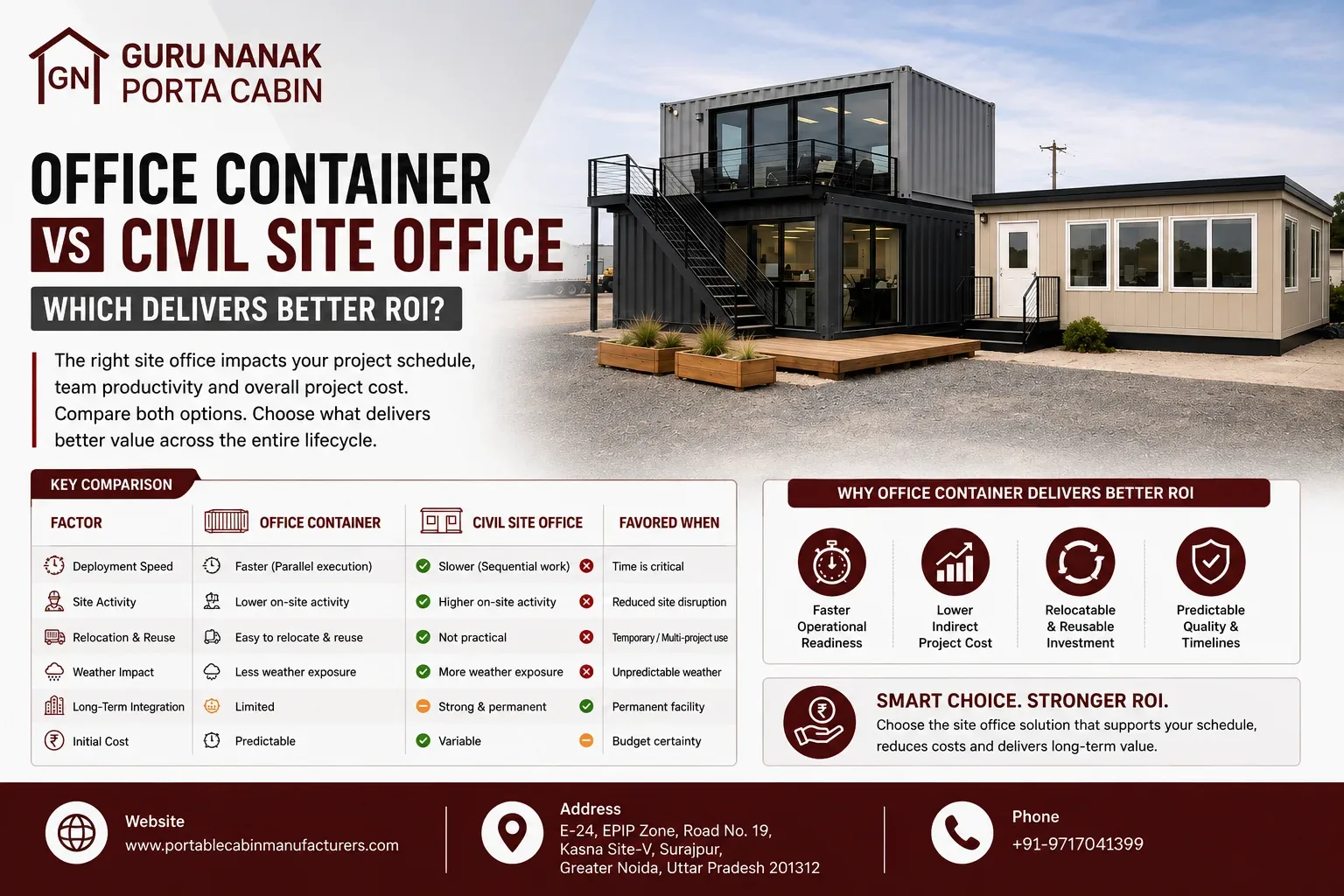
Office Container vs Civil Site Office: Which Delivers Better ROI?
07 Aug, 2026
For a project manager, the real cost of a site office is rarely limited to the amount shown on the quotation or civil contractor’s estimate.
A site office has to become operational at the right time. It needs adequate space, electrical services, ventilation or HVAC provisions, suitable insulation, internal partitions and access for the project team. More importantly, the office should not become another activity delaying project mobilization.
That is where the comparison between an office container and a conventional civil-built site office becomes commercially important.
A civil office can be appropriate when the facility is permanent and its construction schedule can be absorbed into the overall project. A portable or modular office container becomes more attractive when deployment speed, predictable execution, relocation and reuse influence the business case.
For EPC contractors, construction companies, infrastructure developers and industrial project owners, the better ROI therefore depends on total deployment time and
lifecycle value—not simply initial purchase or construction cost.
An office container generally delivers stronger ROI for temporary and relocatable project offices because fabrication can occur away from the site, site preparation can progress simultaneously, and the completed unit can potentially be relocated and reused. A civil site office can offer better value for permanent facilities where relocation is unnecessary and longer construction schedules are acceptable.
1. What Are You Actually Comparing?
An office container is a factory-fabricated or modular workspace intended to provide functional office infrastructure at a project, industrial or construction location. Depending on requirements, the unit can incorporate partitions, doors, windows, insulation, flooring, electrical provisions, lighting, HVAC provisions and other project-specific features.
A civil site office is constructed substantially at the project location using conventional civil construction activities. Its execution may involve site preparation, foundations, structural or masonry work, curing, roofing, doors and windows, electrical work, plumbing where required, internal finishing and final commissioning.
Both can perform the same basic role: giving engineers, supervisors, managers, administrative teams and contractors a usable workplace.
The difference is how that workplace reaches operational readiness and what happens to the investment when the project ends.
2. Office Container vs Civil Site Office: Quick Comparison
| Evaluation Factor | Office Container / Portable Office Cabin | Civil-Built Site Office | Usually Favored When |
|---|---|---|---|
| Deployment model | Factory fabrication plus site preparation | Predominantly sequential site construction | Office container for schedule-sensitive projects |
| Site activity | Comparatively lower | Higher | Office container |
| Weather exposure during execution | Factory activities can reduce site exposure | More construction activities exposed to site conditions | Office container |
| Labour dependency at project site | Lower for main fabrication | Higher | Office container |
| Relocation | Designed around transportability where specified | Generally impractical | Office container |
| Reuse | Potentially reusable across projects | Usually tied to original site | Office container |
| Permanent integration | Limited compared with purpose-built civil architecture | Strong | Civil office |
| Architectural freedom | Good within modular/design constraints | Extensive | Civil office |
| Expansion | Additional modular units may be possible | Requires further construction | Depends on project |
| Demobilization | Unit may be shifted or redeployed | Demolition or alternate permanent use may be required | Office container |
| Long-term fixed use | Possible with appropriate specification | Well suited | Depends on design life and requirement |
| Schedule predictability | Generally easier to control through factory fabrication | More exposed to site sequencing | Office container |
| Lifecycle ROI | Strong where relocation/reuse is valuable | Strong where permanent utilization is high | Project-specific |
Quick Recommendation
Choose an office container when: operational readiness, project mobilization, reduced site construction, relocation, phased expansion or reuse matter.
Choose a civil site office when: the office is permanent, substantial architectural integration is required, relocation has no value and construction time is not a major constraint.
3. Why Deployment Time Changes the ROI Calculation
The biggest mistake in this comparison is asking only:
“Which option costs less to build?”
A procurement team should instead ask:
“How much does each option cost us by the time the required workspace becomes operational—and what value remains after the project?”
For a time-sensitive construction or EPC project, an office that is cheaper but becomes operational too late may create indirect project costs.
Site management teams may temporarily operate from unsuitable spaces. Meetings, documentation, engineering coordination, contractor management and administrative functions can become fragmented.
This makes time to operational readiness an ROI variable.
The Core Difference: Parallel vs Sequential Execution
A customized office container can allow two workstreams to move simultaneously:
Workstream 1: Factory fabrication of the office unit.
Workstream 2: Site access planning, support/foundation preparation and utility readiness.
Once both workstreams are ready, transportation, placement, connections and commissioning can follow.
Conventional site construction is typically more dependent on sequential activities:
Site preparation → foundation → structural/civil work → curing where applicable → enclosure → services → finishing → commissioning.
The exact sequence varies by building design, but the commercial principle remains: more activities have to occur at the final project site.
That distinction can become critical when the project has a strict mobilization date.
4. Where Is Project Time Actually Saved?
Saying that a portable office cabin is “fast to install” does not explain enough for a procurement decision.
The better question is where schedule compression occurs across the entire deployment lifecycle.
| Deployment Stage | Office Container | Civil Site Office | Schedule Impact |
|---|---|---|---|
| Requirement finalization | Required | Required | Similar dependency |
| Layout approval | Required before fabrication | Required before construction | Similar |
| Procurement | Supplier/manufacturer selection | Material + contractor/vendor coordination | Project-specific |
| Site preparation | Can progress during fabrication | Often part of construction sequence | Potential container advantage |
| Foundation/supports | Usually based on unit/site requirements | Civil foundation based on building design | Project-specific |
| Main construction | Factory fabrication | Site-based construction | Different execution model |
| Weather exposure | Lower for factory-controlled activities | Higher for site construction activities | Potential container advantage |
| Site labour | Primarily unloading, placement and connections after delivery | Multiple construction trades required | Potential container advantage |
| Finishing | Can be integrated into fabrication scope | Completed at site | Potential container advantage |
| Utility integration | Planned during manufacturing and connected on site | Installed through construction stages | Depends on scope |
| Handover | Placement, connections and checks | Completion, services and final checks | Project-specific |
| Future relocation | Possible when designed accordingly | Generally not economical | Container advantage |
The time benefit therefore comes from changing the construction process, not merely from faster installation on the final day.
Decision Checkpoint
If your project cannot afford prolonged site-office construction after mobilization begins, compare vendors based on the complete delivery-to-operational-readiness plan, rather than fabrication time alone.
5. Cost Comparison: Purchase Price Is Only One Variable
There is no responsible universal answer to whether an office container price will always be lower than a civil office.
Specifications matter too much.
An office container budget can change according to:
- overall dimensions and number of units
- structural and steel specifications
- insulation system
- flooring
- partitions
- door and window configuration
- electrical requirements
- lighting
- HVAC provisions
- plumbing requirements
- furniture requirements
- internal finishes
- external coating
- customization
- transportation distance
- unloading and placement requirements
- site accessibility
A civil site office also has multiple cost components including materials, site labour, foundations, services, finishing, supervision and eventual demolition or repurposing.
A Better ROI Formula
Procurement teams can think about the comparison as:
Lifecycle Site Office Cost = Initial Cost + Deployment Cost + Delay Exposure + Maintenance + Modification/Expansion + Demobilization − Residual Reuse Value
The formula is not intended as an accounting standard. It is a practical procurement framework.
It forces the buyer to evaluate what happens before, during and after the office is used.
Why the Lowest Quotation Can Mislead
Suppose one option appears cheaper initially but cannot move to the contractor's next site.
Another option has a higher upfront procurement value but can potentially support multiple project cycles.
The correct comparison is no longer:
Cost of Office A vs Cost of Office B
It becomes:
Cost per useful project deployment.
That is why reuse can materially change the ROI discussion for contractors managing sequential sites.
6. Relocation and Reuse: The Often-Missed ROI Factor
Relocation is one of the clearest commercial differences between a portable container office and a civil-built facility.
A civil office creates value primarily at its original location. Once the temporary project requirement ends, the buyer must determine whether the structure has a permanent use or whether removal, demolition or repurposing is required.
A portable office container may retain operational value because it can potentially be transported to another site, subject to its condition, structural suitability, transport requirements and future project needs.
For contractors with recurring projects, this changes the procurement question.
Instead of:
“What will this site office cost for Project A?”
Ask:
“Could the same office infrastructure serve Project A, Project B and a later site?”
Reuse should never be assumed automatically. Transportation, lifting, handling, refurbishment and changing site requirements must be considered.
But where reuse is practical, the original procurement becomes an asset that can support more than one mobilization.
7. Durability: Does Civil Construction Automatically Last Longer?
Civil construction is generally well suited to permanent facilities, but buyers should avoid turning “civil versus container” into an oversimplified durability argument.
The useful service life of an office container depends heavily on specification, fabrication quality, corrosion protection, environmental exposure, handling, maintenance and relocation frequency.
For industrial procurement, inspect factors such as:
- structural material specification
- wall and roof construction
- coating system
- insulation
- flooring and expected loading
- water ingress protection
- door and window quality
- electrical protection
- lifting arrangements
- installation and anchoring requirements
A poorly specified portable office cabin should not be expected to deliver the same lifecycle performance as a properly engineered unit.
Equally, a permanent civil building may be unnecessarily capital-intensive if the project only requires temporary site-office infrastructure.
Durability should be matched to the intended usage period—not maximized without considering the business requirement.
8. Can an Office Container Provide a Proper Functional Workspace?
Yes, a properly planned modular office container can provide a functional project workspace, but layout planning should begin with team operations rather than external dimensions alone.
Depending on the project requirement, a customized office container may be configured around:
- manager cabins
- engineer workstations
- meeting areas
- document/storage space
- internal partitions
- electrical points
- lighting
- ventilation
- HVAC provisions
- plumbing provisions where required
- doors and windows
- furniture planning
This is particularly relevant for an office container for construction site applications where the team composition may change as the project moves from mobilization to peak execution.
Avoid This Procurement Mistake
Do not finalize the cabin size before confirming:
Number of users → roles → workstation requirement → meeting requirement → storage → utilities → circulation → future expansion.
Buying a unit based only on external dimensions can create congestion and lead to modifications later.
9. Which Option Has Greater Project Execution Risk?
Neither solution is risk-free. The risks simply occur in different places.
| Risk | Office Container | Civil Site Office |
|---|---|---|
| Late design changes | Can disrupt fabrication | Can disrupt construction |
| Site access problems | Can prevent vehicle/crane placement | Can delay material and labour movement |
| Weather | Lower impact on factory work; site installation still exposed | Greater exposure during site construction |
| Labour availability | Lower site fabrication dependency | Greater dependency on construction trades |
| Utility readiness | Can delay commissioning | Can delay completion/commissioning |
| Transportation | Important project risk | Usually less relevant to completed building |
| Lifting/unloading | Must be planned | Generally not applicable in same manner |
| Foundation/support mismatch | Can prevent correct placement | Construction issue addressed during building work |
| Future relocation | Must be engineered and planned | Generally not practical |
| Permanent integration | More limited | Stronger |
For an office container in Noida, Ghaziabad, Delhi NCR or another project location, logistics planning should be completed before dispatch—not after the unit reaches the gate.
Check access width, turning space, overhead obstructions, unloading location, lifting arrangements, ground conditions and final placement before delivery.
10. When Does an Office Container Deliver Better ROI?
An office container is generally better suited when the value of time, mobility and reuse is high.
Typical situations include:
Time-Critical EPC Mobilization
Project teams that need office infrastructure early in the mobilization cycle can benefit from factory fabrication occurring while site preparation progresses.
Construction Projects with Temporary Office Requirements
If the office is only required for the project duration, investing in permanent civil infrastructure may provide limited post-project value.
Contractors Managing Sequential Projects
A relocatable site office container may potentially move with the organization from one project to another.
Remote Infrastructure and Mining Sites
Reducing the amount of construction activity required at the final location can simplify project-office deployment.
Renewable Energy and Power Projects
Projects spread across changing or remote sites may value mobility and repeat use.
Projects Requiring Phased Expansion
A modular approach can make it easier to plan additional units as the project team expands, provided the site layout and utilities are prepared accordingly.
Sites Where Civil Activity Should Be Minimized
Factory fabrication can reduce the volume of work that must be executed at the operational project location.
11. When Does a Civil Site Office Make More Sense?
A civil office becomes more commercially logical when permanence matters more than mobility.
Consider conventional construction for:
- permanent administrative buildings
- long-term fixed-location offices
- large office complexes
- facilities requiring extensive architectural integration
- buildings forming part of permanent project infrastructure
- projects where future relocation has no value
- facilities requiring substantial permanent civil works
- sites where construction duration does not affect mobilization
A factory owner planning a permanent administration building, for example, has a very different ROI calculation from an EPC contractor establishing an 18- or 24-month project office.
This is why project duration alone should not determine the answer. The post-project role of the building matters just as much.
12. Pros and Cons Summary
Office Container / Portable Office Cabin
Advantages
- factory fabrication can run alongside site preparation
- reduced dependence on extensive site construction
- relocatable when designed and handled appropriately
- potential reuse across projects
- project-specific internal configuration
- suitable for temporary and semi-permanent project operations
- modular expansion can be considered
- useful where mobilization schedules are tight
Limitations
- transportation must be planned
- unloading and lifting access may be required
- dimensional constraints influence layouts
- relocation introduces handling and logistics costs
- poorly defined specifications can reduce performance
- highly architectural permanent buildings may be better served by civil construction
Civil Site Office
Advantages
- suitable for permanent use
- extensive architectural flexibility
- can integrate directly into permanent site infrastructure
- appropriate for large fixed facilities
- no future transportation of completed building required
Limitations
- greater on-site construction dependency
- more construction activities exposed to site conditions
- difficult to relocate
- limited residual value as a movable project asset
- temporary buildings may require demolition or repurposing
- schedule may depend on several sequential construction activities
13. Procurement Decision Matrix
Score each criterion according to your project instead of beginning with a preferred construction method.
<| Project Requirement | Office Container | Civil Site Office |
|---|---|---|
| Urgent operational date | Strong fit | Moderate/weak fit depending on construction schedule |
| Temporary requirement | Strong fit | Often less efficient |
| Permanent requirement | Possible, specification-dependent | Strong fit |
| Relocation expected | Strong fit | Weak fit |
| Reuse across sites | Strong fit | Weak fit |
| Minimal site construction | Strong fit | Weak fit |
| Extensive architecture | Moderate | Strong fit |
| Modular expansion | Strong fit | Possible through construction |
| Remote deployment | Strong potential fit | Site-dependent |
| Permanent infrastructure integration | Moderate | Strong fit |
| Predictable fabrication process | Strong potential fit | More site-dependent |
| Low logistics complexity | Site-dependent | Strong after construction begins |
| Multiple project cycles | Strong potential fit | Weak fit |
14. Five Procurement Mistakes That Can Destroy the Expected ROI
Mistake 1: Comparing Only Initial Prices
A quotation comparison that ignores foundations, transportation, unloading, utilities, commissioning, future relocation and demobilization is incomplete.
Mistake 2: Ordering Before Freezing the Layout
Late partition, electrical or HVAC changes can affect both cost and schedule.
Mistake 3: Ignoring Thermal Performance
Poor insulation can reduce workplace comfort and increase the burden on cooling or heating systems.
Mistake 4: Treating Transportation as an Afterthought
A portable office only delivers its mobility advantage if the site can receive, unload and position the unit safely.
Mistake 5: Buying for One Project When Reuse Is Likely
Contractors should evaluate future project requirements before specifying the first unit. Standardized or adaptable layouts may improve redeployment potential.
15. What Should Procurement Teams Ask Before Requesting a Quotation?
A useful RFQ gives an office container manufacturer enough information to understand the actual project rather than quote an undefined shell.
Confirm:
- What is the required operational date?
- How long will the office remain at the site?
- How many people will use it?
- What internal rooms or partitions are required?
- What electrical load is expected?
- Is HVAC required or only provision for HVAC?
- Is plumbing required?
- What insulation performance is expected?
- What doors and windows are needed?
- What furniture is in the supplier's scope?
- What are the final site conditions?
- Can the delivery vehicle reach the installation point?
- Who is responsible for unloading?
- What foundation or supports are required?
- Who connects electrical and plumbing services?
- Will the unit be relocated later?
- What inspection documentation is expected?
- What is included and excluded from the quotation?
The clearer the RFQ, the easier it becomes to compare competing office container suppliers on an equivalent scope.
16. Office Container vs Civil Site Office: Who Should Choose Which?
Choose an Office Container If You Are:
- an EPC contractor facing an early mobilization deadline
- a construction company needing a temporary site office
- a project manager trying to reduce site construction activity
- an infrastructure contractor moving between project locations
- a procurement manager expecting future redeployment
- a renewable-energy contractor operating across multiple sites
- a mining or remote-project operator requiring movable infrastructure
- an industrial organization needing temporary project-office capacity
Choose a Civil Site Office If You Are:
- developing permanent administrative infrastructure
- planning a long-term fixed office
- integrating the building into a permanent facility
- requiring extensive architectural freedom
- building a large permanent office complex
- operating at a location where relocation will never be required
Who Should Avoid Deciding Between Either Option Yet?
Do not finalize either approach if you have not confirmed:
- operational deadline
- expected usage period
- headcount
- site conditions
- utilities
- future relocation probability
- permanent versus temporary requirement
The infrastructure method should follow the requirement—not the other way around.
17. Final ROI Decision Framework
Use this sequence before approving the procurement route:
Required Operational Date
↓
Expected Usage Period
↓
Permanent or Temporary Requirement?
↓
Site Conditions and Access
↓
Civil-Work Dependency
↓
Required Team Capacity
↓
Layout and Customization
↓
Electrical / HVAC / Plumbing Requirements
↓
Future Expansion Requirement
↓
Relocation Probability
↓
Reuse Potential
↓
Total Deployment Cost and Time
↓
Lifecycle Value
If speed + mobility + reuse dominate:
Shortlist a portable or modular office container.
If permanence + architectural integration dominate:
Evaluate a civil-built site office.
If neither clearly dominates:
Obtain comparable technical scopes for both options and calculate the expected lifecycle cost against the actual project duration.
18. Where Guru Nanak Porta Cabin Fits into the Evaluation
For organizations that determine that a portable solution fits their project, Guru Nanak Porta Cabin can be evaluated as an office container manufacturer for customized project requirements.
The company states capabilities including custom design, modular assembly and in-house fabrication, with project applications covering construction sites, industrial plants, infrastructure, mining and government projects.
Its stated service coverage includes Delhi NCR and Pan-India project requirements, including buyers evaluating an office container in Noida, office container in Ghaziabad, Greater Noida and other locations.
Rather than requesting only an office container price, buyers should provide the intended layout, project location, required utilities, installation conditions, expected usage period and relocation requirements so that the quotation reflects the actual project scope.
Buyer FAQs
1. Is an office container more cost-effective than a civil site office?
It can be, particularly for temporary projects where faster deployment, relocation and reuse have financial value. Initial price alone cannot determine the answer. Compare site preparation, utilities, transportation, installation, maintenance, demobilization and future reuse.
2. Which delivers better ROI: an office container or a civil site office?
An office container generally has stronger ROI where project duration is temporary, deployment is urgent and the unit can be reused. A civil office can provide stronger value when the facility will remain permanently at one location.
3. What is the main difference between an office container and a civil site office?
The main difference is the execution model. An office container is primarily fabricated before final placement at the project location, whereas a civil office is substantially constructed at the final site.
4. Is an office container faster to deploy?
Generally, an office container can reduce deployment time because factory fabrication and site preparation may occur in parallel. Actual project duration still depends on design approval, manufacturing scope, logistics, site readiness and utility connections.
5. Can an office container be relocated?
Yes, relocation is one of the main reasons project-based organizations consider portable container offices. The feasibility and cost depend on unit design, condition, transport route, lifting requirements and the receiving site's conditions.
6. Can the same office container be used on multiple construction projects?
Potentially, yes. Reuse depends on structural condition, dimensions, future layout requirements, transportation feasibility and maintenance between deployments.
7. Is a civil office better for a long-duration project?
Not automatically. A long project may still benefit from a modular office if future relocation or reuse is expected. Civil construction becomes more compelling when the office is intended to remain permanently at the location.
8. Are transportation costs significant for office containers?
They can be. Transportation distance, unit dimensions, access restrictions and unloading arrangements should be included in the landed project cost rather than treated as an incidental expense.
9. What affects office container price?
Dimensions, structural specification, insulation, flooring, partitions, doors, windows, electrical scope, HVAC, plumbing, furniture, finishes, customization, quantity and logistics can all influence pricing.
10. Can an office container have air conditioning?
Office containers can be planned with HVAC provisions or HVAC systems depending on the agreed project scope. Requirements should be defined before fabrication.
11. Can office containers include electrical wiring?
Electrical provisions can form part of a customized office container specification. Buyers should define expected connected load, sockets, lighting, distribution and protection requirements during technical finalization.
12. What insulation should be specified?
The appropriate insulation depends on climate, occupancy, HVAC strategy, operating hours and required thermal performance. Procurement teams should compare insulation type and thickness rather than accepting the term “insulated cabin” without specification.
13. Does an office container require a foundation?
The required support or foundation arrangement depends on the unit, loading and site conditions. The manufacturer or relevant project engineer should define placement requirements before delivery.
14. Can office containers be customized internally?
Yes, customized office container requirements may include partitions, cabins, meeting spaces, workstations, doors, windows, electrical provisions and other internal arrangements subject to structural and dimensional constraints.
15. Is maintenance higher for a portable office?
Maintenance depends on construction quality, coatings, environmental exposure, handling and usage. Units relocated frequently should also be inspected after transport and placement.
16. What should be compared between office container manufacturers?
Compare structural specifications, materials, insulation, flooring, electrical scope, HVAC/plumbing provisions, coating, lifting arrangements, installation responsibilities, inspection documentation, exclusions, warranty terms and delivery scope.
17. Is an office container suitable for Delhi NCR construction sites?
Office containers can suit temporary and project-based office requirements in Delhi NCR where site access, placement conditions, utilities and project specifications permit their use.
18. Should procurement select the lowest-priced office container supplier?
Not without comparing technical scope. A lower quotation may exclude insulation, electrical components, transportation, unloading, installation or other requirements included by another supplier.
Practical Buying Decision
For project-based organizations, the ROI advantage of an office container usually comes from a combination of deployment speed, reduced site construction dependency, relocation and potential reuse.
For permanent facilities, civil construction remains a logical option because mobility provides little value and the building can be designed as a permanent part of the site.
Before deciding, procurement teams should therefore avoid asking only, “Which option is cheaper?”
Ask instead:
When must the office become operational, how long will we use it, what will happen to it after this project, and what is the total cost across that lifecycle?
Those four questions usually make the better investment route much clearer.
Request a Project-Specific Office Container Quotation
If your project requires a customized office container with installation planning tailored to site conditions, discuss your layout, foundation details, utility availability and execution schedule with the engineering team at Guru Nanak Porta Cabin.
Share the required dimensions, number of users, partitions, insulation, electrical requirements, HVAC/plumbing scope, project location and required operational date to obtain a quotation based on your actual project requirement rather than a generic cabin specification.
Request a Customized Office Container / Portable Cabin Quotation
Discuss Your Site Office Requirement with Guru Nanak Porta Cabin


