

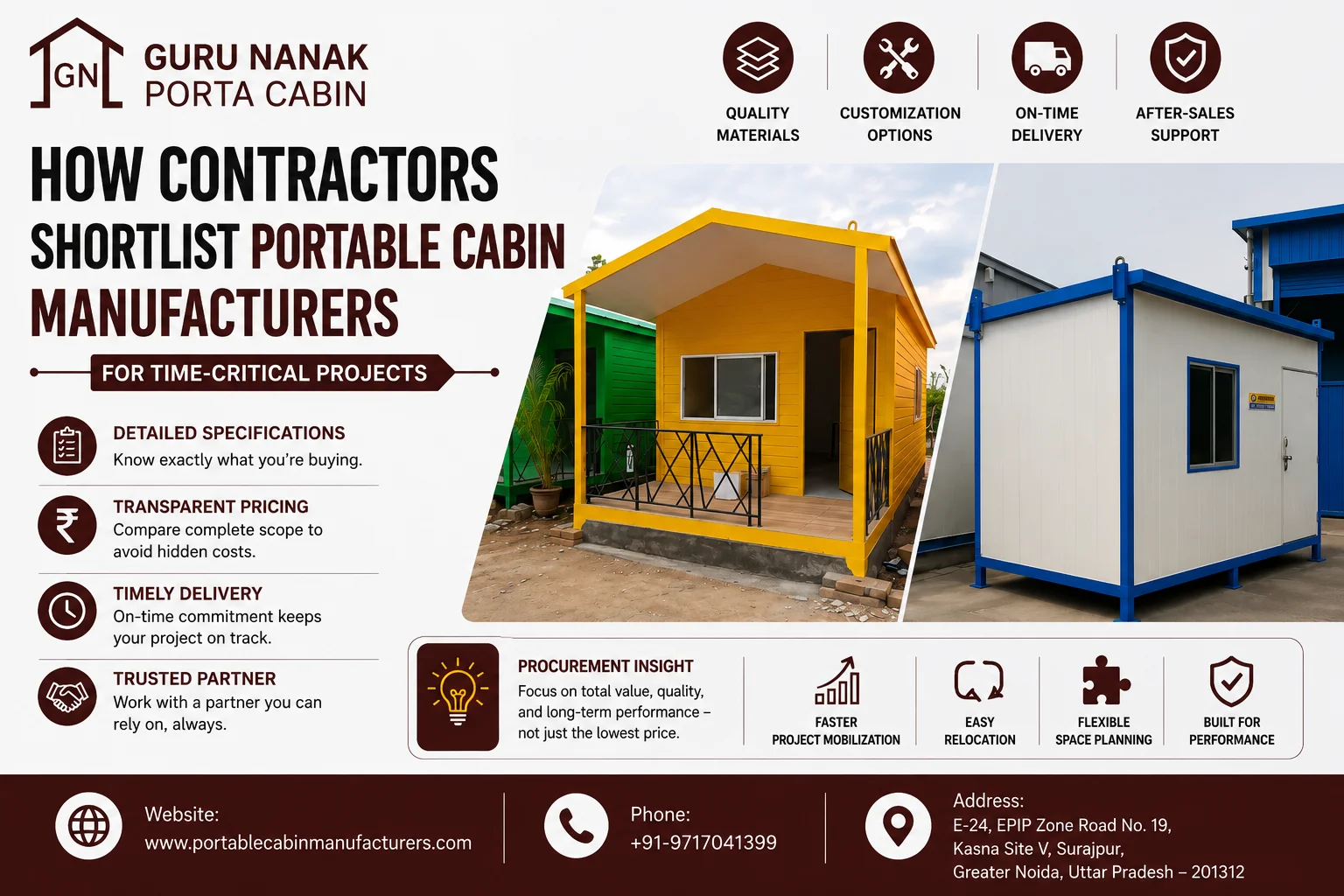
How Contractors Shortlist Portable Cabin Manufacturers for Time-Critical Projects
22 Jul, 2026
When project timelines are tight, contractors don't shortlist a Portable Cabin Manufacturer based on price alone. They evaluate manufacturing capability, customization options, delivery planning, product quality, installation support, and supplier reliability. Choosing the right Portable Cabin Supplier can reduce project delays, improve operational efficiency, and simplify site management.
Introduction
Every construction or infrastructure project has one challenge that cannot be recovered once it's lost—time.
When excavation begins, manpower reaches the site, and equipment is mobilized, contractors need fully functional offices, security cabins, labour accommodation, and utility cabins without delaying project activities. Even a small delay in arranging temporary infrastructure can affect project coordination, documentation, workforce management, and client communication.
That's why experienced procurement managers rarely choose a Portable Cabin Manufacturer in India based solely on the lowest quotation. Instead, they assess whether the supplier can deliver a solution that matches the project's technical, operational, and scheduling requirements.
Whether you're managing a highway project, industrial plant expansion, warehouse construction, commercial development, or government contract, selecting the right Portable Cabin Company requires a structured evaluation process.
This guide explains how professional contractors shortlist suppliers, what procurement teams look for before requesting quotations, and how to reduce purchasing risks while ensuring the selected solution supports project execution from day one.
Why Portable Cabins Have Become Essential for Time Critical Projects
For contractors working against strict project schedules, permanent site infrastructure is often impractical during the initial stages of construction. Portable cabins provide a ready-to-deploy workspace that allows project teams to establish site operations quickly while permanent structures are still under construction.
Instead of investing time in conventional construction for temporary facilities, contractors can deploy modular cabins for administration, meetings, security, storage, workforce management, and utility functions.
Some of the key reasons portable cabins are widely used include:
- Faster project mobilization
- Easy relocation between project sites
- Reduced disruption during expansion
- Flexible layouts for changing operational needs
- Efficient use of available site space
- Adaptability across different industries and project sizes
For procurement teams, this flexibility makes portable cabins a practical solution for both short-term and long-duration projects.
What Is a Portable Cabin?
A Portable Cabin is a prefabricated modular structure manufactured in a controlled production environment and transported to the project site for quick installation. Depending on the intended application, it can be designed as an office, security cabin, site office, accommodation unit, storage room, toilet cabin, or other functional workspace.
Unlike conventional buildings, portable cabins are designed to minimize on-site construction activities while offering flexibility in size, layout, and future relocation.
Modern portable cabins can be customized with:
- Insulated wall panels
- Mild steel structural framework
- Doors and windows
- Electrical wiring
- Lighting systems
- Air-conditioning provisions
- Internal partitions
- Washrooms
- Pantry areas
- Vinyl or industrial flooring
- False ceilings
- Ventilation systems
The level of customization depends on the intended application and project requirements.
Why Contractors Choose Portable Cabins Instead of Conventional Site Buildings
Portable cabins solve several operational challenges that contractors face during project execution.
1. Faster Site Readiness
Construction projects often require operational offices before permanent buildings are completed. Portable cabins help establish site administration without waiting for conventional construction.
2. Easy Relocation
Projects frequently move from one location to another. A modular portable cabin can often be transported and reused, reducing the need to build temporary structures for every new site.
3. Flexible Space Planning
Project requirements change over time. Additional meeting rooms, engineering offices, storage areas, or staff cabins can be incorporated through customized layouts based on operational needs.
4. Reduced Site Disruption
Since much of the fabrication takes place off-site, installation activities are generally quicker than traditional construction methods, helping minimize disruption to ongoing project work.
5. Suitable for Multiple Industries
Portable cabins are not limited to construction sites. They are widely used across industrial, commercial, infrastructure, logistics, institutional, and government projects where temporary or modular spaces are required.
Procurement Insight
Experienced contractors don't ask, "Which portable cabin is the cheapest?"
Instead, they ask:
- Can the supplier deliver according to the project schedule?
- Does the manufacturer support customization?
- Can the cabin be relocated later?
- Is the structure suitable for my project environment?
- Will the supplier provide support after delivery?
These questions often have a greater impact on project success than the initial purchase price.
Soft Buying Guidance
If your project requires a Portable Office Cabin, Site Office Cabin, or another Prefabricated Portable Cabin, it's worth reviewing product configurations and customization possibilities before comparing quotations. Understanding the available options early helps procurement teams prepare clearer technical requirements and evaluate suppliers on equal specifications rather than price alone.
Industries That Rely on Portable Cabins for Fast Project Execution
Portable cabins are no longer limited to construction site offices. Today, they are used across industries where speed, flexibility, and efficient space utilization are essential. The ability to deploy modular infrastructure without lengthy on-site construction makes portable cabins a practical choice for organizations managing dynamic projects.
Construction Industry
Construction companies require temporary offices long before permanent buildings are ready. Portable cabins provide space for project managers, engineers, client meetings, document control, and workforce coordination.
Common applications include:
- Site office cabins
- Engineer cabins
- Project management offices
- Labour accommodation
- Material storage units
Infrastructure Projects
Roads, bridges, metro corridors, airports, railways, and utility projects often operate across multiple locations. Portable cabins support administrative functions while remaining easy to relocate as project phases progress.
Manufacturing & Industrial Facilities
Manufacturing plants frequently need temporary offices during expansion, shutdown maintenance, or new production line installation.
Typical uses include:
- Project offices
- Contractor offices
- Quality inspection rooms
- Temporary administration blocks
Warehousing & Logistics
Warehouse operators use portable cabins for security management, inventory supervision, dispatch control, and visitor management without interrupting daily operations.
Government & Public Sector Projects
Government agencies and contractors often deploy portable cabins for infrastructure projects, disaster management, temporary offices, educational facilities, and healthcare support units where quick installation is required.
Commercial Developments
Builders and real estate developers use portable cabins as:
- Sales offices
- Customer experience centres
- Temporary project offices
- Marketing suites
Quick Industry Snapshot
| Industry |
Typical Cabin Requirement |
|
Construction |
Site Office, Engineer Cabin |
|
Infrastructure |
Project Office, Control Room |
|
Manufacturing |
Administration Cabin |
|
Warehousing |
Office & Security Cabin |
|
Government Projects |
Temporary Administrative Units |
|
Commercial Real Estate |
Sales Office |
|
Education |
Classroom Cabin |
|
Healthcare |
Temporary Medical Units |
Common Applications of Portable Cabins
The same portable cabin design rarely suits every project. Manufacturers typically customize layouts based on operational needs rather than offering one standard solution.
Popular applications include:
- Portable Office Cabin
- Site Office Cabin
- Security Guard Cabin
- Portable Toilet Cabin
- Labour Accommodation Cabin
- Storage Cabin
- Meeting Room Cabin
- Control Room Cabin
- Reception Cabin
- First Aid Cabin
- Supervisor Cabin
- Equipment Monitoring Room
A contractor managing multiple projects may require several cabin types within the same site, making supplier flexibility an important evaluation factor.
Types of Portable Cabins
Selecting the right type of portable cabin depends on how the structure will be used. Understanding these categories helps buyers prepare more accurate technical specifications before requesting quotations.
Portable Office Cabin
Designed for project management, administration, meetings, and documentation. These cabins may include workstations, electrical systems, insulation, lighting, and pantry provisions.
Suitable for:
- EPC Contractors
- Builders
- Industrial Plants
- Infrastructure Companies
Site Office Cabin
Site office cabins are commonly used near active construction zones and are designed to support day-to-day project coordination.
Typical features include:
- Engineer workstations
- Drawing storage
- Meeting area
- Air-conditioning provisions
- Internet and electrical connectivity
Security Cabin
Security cabins are compact units installed near site entrances to manage access control, visitor records, and surveillance activities.
Common locations include:
- Industrial gates
- Warehouses
- Residential projects
- Manufacturing facilities
- Commercial complexes
Portable Toilet Cabin
Portable toilet cabins provide sanitation facilities where permanent plumbing infrastructure is unavailable or under construction.
They are frequently deployed at:
- Construction sites
- Infrastructure projects
- Industrial facilities
- Public events
- Remote work locations
Labour Accommodation Cabin
Large projects often require temporary workforce housing. Labour accommodation cabins provide organized living spaces while allowing relocation as projects progress.
Features Procurement Teams Should Prioritize
Many buyers compare portable cabins only by dimensions and quotation value. Professional procurement teams evaluate a broader set of factors that influence long-term performance and project efficiency.
Durable Structural Framework
The structural framework determines the cabin's strength during transportation, installation, and regular use. Buyers should ensure that the structure aligns with the intended project environment.
Weather Protection
Projects operating in harsh climates may require insulated panels, weather-resistant finishes, and appropriate roofing systems to improve occupant comfort and durability.
Interior Flexibility
A quality portable cabin should accommodate changing operational needs through:
- Internal partitions
- Multiple workstations
- Meeting areas
- Pantry provisions
- Washroom integration
- Storage spaces
Easy Relocation
For contractors managing projects across different locations, relocation capability can significantly improve long-term value by allowing cabins to be reused rather than rebuilt.
Low Maintenance
Routine maintenance should be straightforward. Buyers should understand the recommended maintenance schedule, protective coatings, and replacement requirements before procurement.
Expandability
Future project growth often requires additional office space. Modular designs that allow expansion or interconnection can help reduce future infrastructure costs.
Buying Factors Every Procurement Manager Should Evaluate
Before requesting quotations from any Portable Cabin Manufacturer, prepare a clear evaluation framework.
1. Project Duration
Short-term projects may prioritize mobility, while long-term projects often require higher levels of comfort and customization.
2. Site Conditions
Evaluate whether the cabin will operate in:
- Remote locations
- High-temperature environments
- Heavy rainfall areas
- Dust-prone industrial sites
- Coastal regions
Environmental conditions can influence material selection and insulation requirements.
3. Space Requirements
Estimate:
- Number of employees
- Meeting rooms
- Storage needs
- Washrooms
- Future expansion
Proper planning reduces the likelihood of modifications after installation.
4. Customization Requirements
No two projects are identical. Discuss layout preferences, utility provisions, branding, access points, and internal partitions with the manufacturer before finalizing specifications.
5. Delivery Planning
Time-critical projects require realistic delivery coordination. Clarify transportation logistics, unloading responsibilities, and installation planning during the quotation stage.
Buyer Decision Checkpoint
Before moving to supplier comparisons, ask yourself:
- Have all technical requirements been documented?
- Do multiple departments need to use the cabin?
- Will the structure be relocated after project completion?
- Are future expansions likely?
- Is installation support required?
Answering these questions before approaching suppliers helps streamline the procurement process and ensures quotations are based on consistent project requirements rather than assumptions.
How Contractors Evaluate a Portable Cabin Manufacturer
Choosing the right Portable Cabin Manufacturer in India is often more important than choosing the cabin itself. A well-planned modular cabin can still create project delays if the supplier lacks manufacturing capability, communication, or project planning.
Professional contractors usually evaluate suppliers using a structured procurement process rather than relying on brochures or quotations alone.
1. Verify Manufacturing Capability
The first question procurement teams ask is simple:
Is the company an actual manufacturer or only a trading company?
A manufacturer generally has better control over:
- Product quality
- Production scheduling
- Design customization
- Material selection
- Inspection process
- Project coordination
Working directly with a manufacturer can also simplify technical discussions because design and production teams are usually available for consultation.
Buyer Tip: Request information about the manufacturer's production process and available customization options before comparing commercial quotations.
2. Assess Product Customization
Every project has unique operational requirements.
Before finalizing a supplier, discuss whether they can customize:
- Overall dimensions
- Internal partitions
- Flooring
- Wall insulation
- Electrical layout
- Doors and windows
- Washroom integration
- Pantry facilities
- Exterior finish
- Company branding
A supplier who offers customization can often deliver a solution that fits your project more effectively than a standard off-the-shelf cabin.
3. Review Industry Experience
Experience does not automatically guarantee the best solution, but it often indicates familiarity with different project environments.
Consider asking:
- Which industries do they regularly serve?
- Have they supplied cabins for projects similar to yours?
- Can they explain how different applications influence cabin design?
For example, a cabin designed for a warehouse office may require a different layout than one intended for a mining site or a commercial sales office.
4. Evaluate Communication During Procurement
Supplier responsiveness often reflects how the project will be managed after the order is placed.
A reliable supplier should be able to:
- Understand technical requirements
- Clarify specifications
- Explain customization possibilities
- Respond to commercial queries promptly
- Provide clear documentation
Poor communication during the quotation stage can lead to misunderstandings later in the project.
5. Discuss Installation Planning
Installation requirements vary depending on:
- Cabin size
- Number of modules
- Site accessibility
- Utility connections
- Foundation preparation
Before placing an order, confirm:
- Who is responsible for unloading?
- Will installation support be available?
- What site preparations are required?
- Are utility connections included in the project scope?
Clarifying these details early helps avoid delays during deployment.
Pricing Factors: What Influences the Cost of a Portable Cabin?
Instead of asking "What is the Portable Cabin Price?", procurement teams should ask "What factors determine the total project cost?"
A quotation generally depends on several variables rather than a fixed market price.
Common Pricing Factors
- Cabin dimensions
- Structural design
- Mild steel framework specifications
- PUF panel or insulation requirements
- Flooring materials
- Interior finishing
- Electrical installation
- Plumbing provisions
- Doors and windows
- Transportation distance
- Installation requirements
- Quantity ordered
- Level of customization
A lower quotation may exclude transportation, installation, insulation, or electrical work. Always compare quotations with identical specifications.
Procurement Warning
Avoid comparing two suppliers based only on the final quoted amount.
Instead, compare:
- Scope of supply
- Material specifications
- Structural configuration
- Included accessories
- Installation responsibilities
- Delivery planning
- After-sales support
This approach provides a more accurate assessment of long-term project value.
Customization Options That Add Practical Value
Portable cabins are designed to support different operational requirements, and customization plays a key role in maximizing usability.
Common customization options include:
Interior Layout
- Open office
- Multiple cabins
- Conference room
- Reception area
- Executive cabin
Utility Integration
- Electrical wiring
- Distribution boards
- LED lighting
- Air-conditioning provisions
- Internet connectivity
Comfort Features
- Thermal insulation
- Ventilation
- False ceiling
- Acoustic improvements
- Weather-resistant finishes
Functional Additions
- Pantry
- Washroom
- Storage room
- Filing area
- Visitor seating
The right combination depends on the intended application rather than a standard configuration.
Quality Considerations Before Purchase
Quality should be evaluated through specifications rather than marketing claims.
Ask suppliers about:
- Structural material
- Protective coatings
- Insulation options
- Panel quality
- Welding practices
- Door and window systems
- Waterproofing measures
- Finishing standards
Well-defined specifications help ensure that quotations from multiple suppliers remain comparable.
Installation Planning Checklist
Installation becomes much smoother when the project team prepares the site in advance.
Before Delivery, Confirm:
- Site accessibility for transport vehicles
- Ground preparation
- Crane or lifting equipment availability (if required)
- Electrical connection points
- Water connection (if applicable)
- Drainage arrangements
- Final cabin positioning
Proper planning can reduce installation delays and minimize disruptions to ongoing project activities.
Maintenance Planning for Long-Term Performance
Routine maintenance helps preserve both appearance and functionality.
A maintenance plan may include:
- Periodic structural inspection
- Cleaning of exterior surfaces
- Inspection of doors and windows
- Electrical system checks
- Roof sealing inspection
- Protective coating maintenance
Maintenance frequency depends on environmental conditions and usage patterns.
Delivery Planning for Time-Critical Projects
Delivery planning should begin during the quotation stage rather than after the purchase order is issued.
Discuss:
- Manufacturing schedule
- Transportation route
- Site access restrictions
- Delivery sequence for multiple cabins
- Unloading arrangements
- Installation timeline
Clear coordination between the procurement team, logistics provider, and manufacturer reduces the risk of unnecessary project delays.
Commercial Buying Checklist
Before issuing a purchase order, verify the following:
- Technical specifications approved
- Layout drawings reviewed
- Customization requirements finalized
- Material specifications confirmed
- Delivery schedule agreed
- Installation responsibilities defined
- Warranty terms understood
- Payment milestones clarified
- Site readiness completed
Supplier communication channels established
Learn More Before You Buy
If you're comparing different modular solutions, reviewing detailed Portable Cabin configurations can help you prepare more accurate technical specifications before requesting quotations.
You may also explore the company's About Us page to understand its manufacturing background and industry experience. Once your project requirements are finalized, use the Contact Us page to discuss customization needs and request a project-specific quotation.
Real-World Procurement Scenarios
The following examples illustrate how different buyers approach supplier selection based on project requirements. While every project is unique, these scenarios reflect common decision-making patterns used by procurement teams.
Scenario 1: Highway Construction Project
Project Requirement
A contractor has mobilized equipment and workforce for a six-month highway project. The project team requires:
- Site office
- Engineer cabins
- Meeting room
- Security cabin
The biggest concern is getting operational without delaying construction activities.
Buying Priorities
- Fast manufacturing
- Simple installation
- Easy relocation after project completion
- Durable construction
- Reliable supplier communication
Procurement Focus
Rather than requesting quotations from multiple vendors based only on price, the contractor prepares a clear technical specification and evaluates suppliers on delivery planning, manufacturing capability, and relocation support.
Scenario 2: Manufacturing Plant Expansion
A manufacturing company is expanding its production facility and needs temporary administrative space during construction.
Primary Requirements
- Comfortable working environment
- Office cabins for engineers
- Meeting room
- Long-duration use
- Professional appearance
Procurement Decision
In this case, customization and employee comfort become more important than frequent relocation. The buyer spends more time discussing layouts, insulation, interior finishes, and workspace planning before selecting a supplier.
Scenario 3: Warehouse Development
A logistics company is developing a new warehouse and requires:
- Security cabin
- Administrative office
- Dispatch office
- Visitor reception area
The procurement team evaluates suppliers based on:
- Expandability
- Maintenance requirements
- Transportation planning
- Future relocation possibilities
Instead of buying separate structures from different vendors, they prefer a supplier capable of delivering a coordinated modular solution.
Common Mistakes Buyers Make When Selecting a Portable Cabin Supplier
Even experienced procurement teams can overlook factors that affect long-term project performance. Avoiding these mistakes can reduce delays, additional costs, and operational challenges.
Choosing Only the Lowest Price
A low quotation may exclude transportation, installation, insulation, or electrical work. Always compare quotations based on the same technical specifications.
Ignoring Future Expansion
Many projects grow over time. Selecting a modular solution that can be expanded later may reduce future infrastructure costs.
Providing Incomplete Requirements
Suppliers can only prepare accurate quotations when project requirements are clearly defined.
Include:
- Dimensions
- Number of users
- Utility requirements
- Interior layout
- Installation location
- Project timeline
Overlooking Installation Planning
A cabin cannot be installed efficiently if the site is not ready.
Before delivery, verify:
- Access roads
- Foundation preparation
- Utility connections
- Equipment for unloading
Not Verifying the Supplier
Evaluate the supplier beyond marketing materials.
Consider:
- Manufacturing capability
- Product range
- Communication quality
- Customization options
- Technical understanding
- After-sales support
Questions to Ask Before Requesting a Quotation
Preparing the right questions before contacting a Portable Cabin Supplier often results in more accurate quotations and fewer revisions.
Project Questions
- What is the intended use of the cabin?
- How many people will use it?
- Will it be relocated later?
- Is future expansion expected?
Technical Questions
- What structural materials are proposed?
- Which insulation options are available?
- Can the layout be customized?
- What utilities can be integrated?
Commercial Questions
- What is included in the quotation?
- Is transportation included?
- Will installation support be provided?
- Are customization drawings available before production?
Supplier Questions
- Is the company a manufacturer or a trader?
- What industries do they typically serve?
- Can they handle bulk project requirements?
- How is communication managed during production?
These questions help procurement teams compare suppliers on value rather than only on price.
Why Buyers Consider Guru Nanak Porta Cabin
Selecting a supplier involves more than evaluating products—it also involves assessing the company's ability to support the project from planning to delivery.
Contractors and industrial buyers often prefer working with manufacturers that can offer:
- Custom-designed portable cabin solutions
- Portable office cabins for project sites
- Site office cabins for infrastructure projects
- Security cabins and portable toilet cabins
- Mild steel and insulated cabin options
- Easy relocation and modular expansion possibilities
- Pan-India project supply
- Manufacturing-backed customization
- After-sales support
Guru Nanak Porta Cabin manufactures a wide range of modular and prefabricated cabin solutions for construction, infrastructure, industrial, commercial, and government projects. Buyers can review product information, understand manufacturing capabilities through the About Us page, and discuss project-specific requirements before making a purchase decision.
Frequently Asked Questions (FAQs)
1. How do contractors shortlist a Portable Cabin Manufacturer?
They typically evaluate manufacturing capability, customization options, product quality, communication, delivery planning, installation support, and overall project suitability rather than focusing only on price.
2. Is it better to buy directly from a manufacturer?
Buying directly from a manufacturer can simplify customization, technical discussions, and production coordination. Buyers should verify the supplier's manufacturing capabilities before placing an order.
3. Can portable cabins be customized for specific projects?
Yes. Depending on project requirements, cabins can often be customized in terms of dimensions, layout, insulation, electrical systems, washrooms, flooring, and interior partitions.
4. Which industries commonly use portable cabins?
Construction, infrastructure, manufacturing, warehousing, logistics, commercial real estate, government projects, healthcare, and education sectors commonly use portable cabins.
5. What affects the price of a portable cabin?
Factors such as cabin size, structural materials, insulation, interior finishes, electrical work, transportation, installation, and customization influence the overall project cost.
6. Are portable cabins suitable for long-term use?
Yes. When manufactured with appropriate materials and maintained properly, portable cabins can serve as temporary, semi-permanent, or long-term workspace solutions.
7. Can a portable cabin be relocated after installation?
Many portable cabins are designed for relocation, although the ease of transportation depends on the cabin's dimensions, structural design, and installation method.
8. What documents should buyers request before finalizing a supplier?
Procurement teams should request technical specifications, layout drawings, scope of supply, warranty details, and commercial quotations to ensure clear project expectations.
9. How important is installation planning?
Installation planning is critical. Site readiness, utility connections, access for transport vehicles, and unloading arrangements should all be confirmed before delivery.
10. What should buyers compare when evaluating multiple suppliers?
Instead of comparing only prices, buyers should assess manufacturing capability, customization options, material specifications, delivery schedules, installation support, communication, and after-sales service.
Final Thoughts
Successful contractors know that choosing the right Portable Cabin Manufacturer is not just about finding a supplier—it is about selecting a project partner who understands timelines, operational requirements, and procurement expectations.
Before issuing a purchase order, define your technical requirements, compare suppliers on equal specifications, verify manufacturing capability, and clarify installation and delivery responsibilities. A structured procurement process reduces risk and helps ensure the selected solution supports your project from mobilization to completion.
Request a Project-Specific Quote
If you're planning a construction, infrastructure, industrial, or commercial project and need a Portable Cabin, Portable Office Cabin, Site Office Cabin, or another modular solution, the next step is to review detailed product options and discuss your project requirements.
Explore our Portable Cabin solutions to understand available configurations and customization possibilities.
Learn more about Guru Nanak Porta Cabin on our About Us page, and when you're ready, Contact Us to request a project-specific quotation from our team.


