

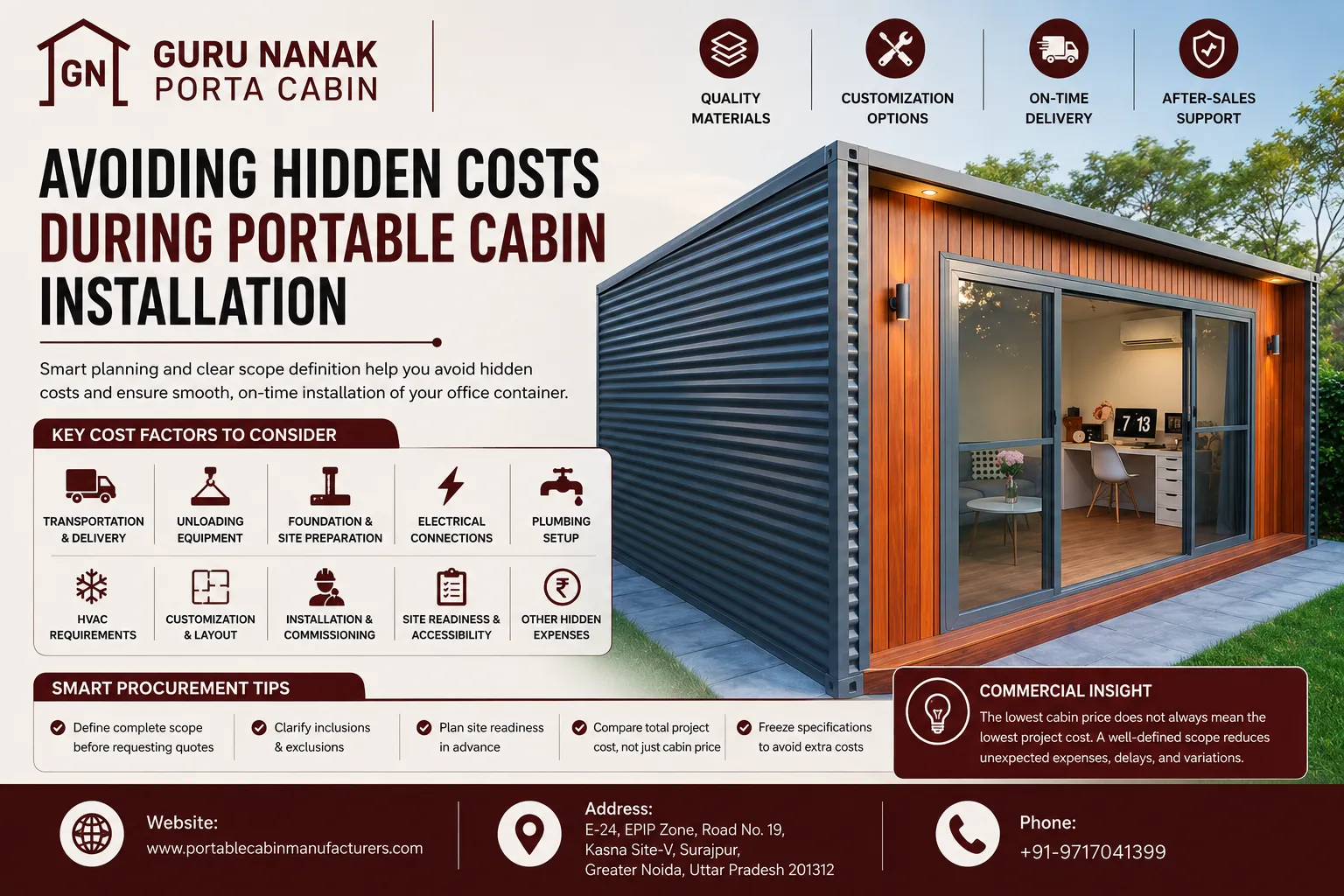
Avoiding Hidden Costs During Portable Cabin Installation
30 Jul, 2026
Most procurement teams begin evaluating a portable cabin by comparing the quoted purchase price. While this is a logical starting point, the manufacturing cost of an Office Container is only one part of the total project expenditure. Expenses related to transportation, unloading, foundation preparation, utility connections, customization, and site readiness often emerge only after a purchase order has been issued.
These additional expenses are frequently described as "hidden costs." In reality, many of them are not hidden at all—they arise because the installation scope was not fully defined during the quotation stage. A quotation that appears economical may ultimately become more expensive than another proposal that initially seemed higher but already included transportation coordination, installation assistance, or engineering provisions.
For project managers, EPC contractors, infrastructure developers, and procurement teams working under strict schedules, understanding these cost drivers before finalizing a supplier can prevent budget revisions, project delays, and unnecessary vendor coordination.
This guide explains the commercial and technical factors that influence the complete installation budget of a portable office container. Rather than focusing on fixed prices, it helps buyers evaluate quotations more accurately, define project scope clearly, and prepare realistic budgets for construction sites and industrial projects across Delhi NCR and Pan India.
The actual cost of installing a portable cabin extends beyond the manufacturing price. Transportation distance, unloading equipment, foundation requirements, electrical and plumbing connections, HVAC provisions, customization, site accessibility, and installation responsibilities all influence the final project budget. Buyers who define these requirements early through a detailed RFQ and transparent quotation are less likely to encounter unexpected expenses during execution.
Why the Cabin Price Is Not the Total Project Cost
Many buyers assume that the quoted office container price represents the complete investment required to make the cabin operational. In practice, the quoted manufacturing cost usually covers fabrication according to the agreed specifications, while several project-specific activities remain dependent on site conditions.
A portable cabin that is being installed inside an urban construction project in Noida presents a different commercial scenario than one being delivered to a remote renewable energy site hundreds of kilometers away. Even when the cabin specifications remain identical, the supporting activities required for successful installation may differ significantly.
Typical project cost components include:
| Cost Component | Depends On |
|---|---|
| Manufacturing | Cabin size, steel structure, insulation, layout |
| Transportation | Distance, route restrictions, permits, vehicle size |
| Unloading | Crane capacity, lifting access, manpower |
| Foundation | Soil condition, support arrangement, site preparation |
| Electrical | Connected load, cable routing, distribution boards |
| Plumbing | Washroom, pantry, drainage requirements |
| HVAC | Equipment capacity, installation provisions |
| Installation | Positioning, anchoring, alignment |
| Commissioning | Testing utilities and operational readiness |
Each of these activities contributes to the total project investment. Understanding their relationship enables procurement teams to compare quotations based on complete project scope instead of manufacturing cost alone.
Commercial Insight
The lowest manufacturing quotation does not necessarily represent the lowest overall project cost. A quotation with broader installation scope may reduce coordination expenses, execution delays, and unforeseen variation orders.
Hidden Costs Are Usually Scope Definition Gaps
One of the biggest misconceptions in industrial procurement is that suppliers intentionally hide installation expenses. In many projects, the additional costs arise because responsibilities were never clearly allocated.
For example:
- Who provides the crane?
- Who prepares the foundation?
- Who connects electrical power?
- Who supplies incoming cables?
- Who installs air-conditioning equipment?
- Who arranges local unloading manpower?
If these responsibilities remain undefined during quotation, they often become change requests after manufacturing has begun.
Instead of asking,-"What hidden costs should I expect?"
a better procurement question is,-"Which installation activities are included, excluded, or client-supplied?"
That single clarification often eliminates a large portion of budget uncertainty.
Decision Checkpoint
Before requesting commercial quotations, prepare a preliminary installation responsibility matrix.
Clearly define:
- Supplier scope
- Client scope
- Third-party contractor scope
This improves quotation accuracy while reducing commercial disputes during execution.
Transportation Is Often the First Major Variable Cost
Transportation is rarely a standard charge because every project location presents different logistical requirements.
A portable office container delivered within Greater Noida may follow a straightforward transport route, whereas delivery to a mining project or infrastructure site could involve multiple transport restrictions, road permits, or difficult terrain.
Transportation costs commonly depend upon:
- Delivery distance
- Overall cabin dimensions
- Gross weight
- Number of modules
- Oversized cargo requirements
- State transportation regulations
- Road accessibility
- Multiple unloading locations
- Waiting time at site
- Escort vehicle requirements (where applicable)
Some buyers compare quotations without checking whether transportation is included or billed separately.
This creates inaccurate cost comparisons.
Procurement Example
Consider two suppliers quoting identical office containers.
Supplier A
- Manufacturing cost appears lower.
- Transportation excluded.
- Unloading excluded.
- Installation guidance excluded.
Supplier B
- Manufacturing quotation is slightly higher.
- Transportation coordinated.
- Delivery scheduling included.
- Site unloading guidance included.
- Basic installation support included.
Although Supplier B's initial quotation may appear more expensive, the total project expenditure after logistics could actually be lower.
Decision Summary
Always compare complete delivered project cost—not factory price alone.
Site Preparation Can Influence Both Budget and Timeline
A portable cabin may be manufactured perfectly, yet installation can still be delayed if the site is not ready.
Many project schedules assume the cabin will simply arrive and be placed immediately. In reality, installation depends heavily on site preparation.
Typical site readiness activities include:
- Level ground preparation
- Soil stabilization where required
- Concrete blocks or foundation supports
- Drainage planning
- Vehicle movement access
- Crane operating space
- Utility routing
- Safe unloading area
- Temporary storage (if immediate installation is not possible)
Each activity influences both execution cost and project timeline.
For infrastructure and EPC projects running multiple contractors simultaneously, delayed site preparation can also generate idle transportation charges or rescheduling costs.
Commercial Insight
A delayed site can increase project expenses even when manufacturing is completed on time. Installation planning should therefore begin alongside production rather than after dispatch.
Foundation Costs Depend on Site Conditions
Portable cabins generally require stable support rather than elaborate civil construction. However, the type of support arrangement depends entirely on project conditions.
Common support solutions include:
- PCC blocks
- RCC pedestals
- Steel supports
- Structural beams
- Existing concrete slabs
- Elevated platforms
The correct option depends on:
- Ground bearing capacity
- Cabin dimensions
- Occupancy load
- Future relocation plans
- Drainage conditions
- Wind exposure
- Local engineering requirements
Attempting to reduce foundation costs without considering these factors can affect installation quality and long-term structural stability.
Unloading Equipment Is Frequently Overlooked
Transportation delivers the cabin to the project location—but unloading is an entirely separate activity.
Depending on cabin dimensions and site accessibility, unloading may require:
- Mobile crane
- Hydra crane
- Forklift
- Telehandler
- Spreader beam
- Lifting slings
- Certified rigging personnel
Several factors influence unloading cost:
- Crane capacity
- Reach distance
- Ground condition
- Lifting duration
- Multiple lifts
- Restricted access
- Night unloading requirements
- Weather conditions
Many procurement teams assume unloading is automatically included because transportation has already been quoted.
That assumption should always be verified.
Buyer Checklist: Transportation & Installation Clarifications
Before approving an office container quotation, confirm the following:
- Is transportation included or billed separately?
- Is unloading included?
- Who arranges the crane?
- Is lifting equipment specified?
- Are waiting charges applicable?
- Are route permissions required?
- Are multiple unloading locations covered?
- Is installation supervision included?
- Are anchoring materials included?
- Who bears costs arising from site delays?
A simple clarification of these points can prevent unexpected commercial adjustments after dispatch.
Electrical Connections Can Create Unexpected Project Costs
An Office Container is generally supplied with internal electrical wiring based on the approved specifications. However, making the cabin operational usually requires additional site-side electrical work, which is often outside the manufacturing scope.
These costs depend on the project's electrical infrastructure rather than the cabin itself.
Common electrical cost factors include:
- Incoming power cable length
- Electrical connected load
- Main distribution board location
- Earthing arrangement
- Cable trenching
- Cable trays
- External lighting
- Generator synchronization
- UPS integration
- Temporary construction power
For example, a portable office located close to the site's electrical distribution point will require considerably less external cabling than a cabin positioned hundreds of meters away.
HVAC Requirements Influence More Than Equipment Cost
Many buyers consider air-conditioning as an optional accessory. In reality, HVAC requirements influence both manufacturing specifications and installation planning.
The following factors affect HVAC-related costs:
| HVAC Factor | Budget Impact |
|---|---|
| Cabin size | Equipment capacity |
| Occupancy | Cooling requirement |
| Wall insulation | Energy efficiency |
| Roof insulation | Heat reduction |
| Glass area | Cooling load |
| Geographic climate | System sizing |
| Electrical capacity | Distribution upgrades |
| Outdoor unit location | Installation complexity |
An under-designed HVAC system may reduce the initial quotation but increase operational costs throughout the project's life.
Decision Checkpoint
Before approving HVAC specifications, consider operational efficiency rather than equipment price alone.
Higher insulation standards often reduce long-term electricity consumption.
Plumbing Scope Should Be Clearly Defined
If the portable cabin includes washrooms, pantries, or utility areas, plumbing becomes another important cost component.
Procurement teams should clarify whether the quotation includes:
- Internal plumbing
- External water supply connection
- Drainage connection
- Septic arrangement
- Water storage tanks
- Pumps
- Fixtures
- Testing
Site plumbing responsibilities frequently vary between projects, making detailed scope clarification essential.
Customization Can Increase Installation Complexity
Customization improves operational efficiency but may also influence installation cost.
Common customization requests include:
- Multi-room office layouts
- Conference rooms
- Glass cabins
- False ceilings
- Premium flooring
- Additional doors
- Large windows
- Branding
- Acoustic insulation
- Fire-rated partitions
- Pantry integration
- Washroom modules
Each modification can affect:
- Structural fabrication
- Electrical routing
- HVAC design
- Transportation dimensions
- Installation sequence
- Commissioning activities
Rather than avoiding customization, buyers should evaluate whether it improves productivity enough to justify the additional investment.
Procurement Scenario
An EPC contractor initially orders an open office layout.
Two weeks before dispatch, the project team requests:
- One conference room
- Two manager cabins
- Glass partitions
- Additional electrical sockets
- False ceiling
- Separate HVAC zones
Although each revision appears minor, together they require engineering changes, revised fabrication, additional materials, updated electrical routing, and potentially modified transportation arrangements.
Many "unexpected costs" arise from late design revisions rather than supplier pricing.
Commercial Summary
Freezing the cabin layout before production begins is one of the most effective ways to control project costs.
Scope Changes After Production Begins Are Usually Expensive
Portable cabins are engineered products.
Once fabrication has started, even small specification changes may require:
- Structural modifications
- Material replacement
- Re-engineering
- Additional welding
- Revised electrical layouts
- Updated drawings
- Re-inspection
- Delivery rescheduling
Procurement teams can reduce these costs by ensuring all stakeholders approve:
- Floor plan
- Utility requirements
- Occupancy
- Future expansion
- Furniture layout
- Mechanical requirements
before manufacturing begins.
Hidden Costs During Installation: A Practical Checklist
The following checklist helps procurement teams evaluate whether a quotation addresses the complete installation scope.
| Installation Item | Verify Before Ordering |
|---|---|
| Manufacturing scope | Yes |
| Transportation included | Yes |
| Delivery destination confirmed | Yes |
| Crane responsibility defined | Yes |
| Unloading scope | Yes |
| Foundation responsibility | Yes |
| Anchoring method | Yes |
| Electrical connection | Yes |
| Plumbing connection | Yes |
| HVAC installation | Yes |
| Utility testing | Yes |
| Commissioning support | Yes |
| Documentation | Yes |
| Warranty scope | Yes |
| Change-order procedure | Yes |
A checklist like this can significantly reduce procurement ambiguity during execution.
How to Compare Office Container Quotations Correctly
Instead of selecting the lowest commercial offer, compare quotations using the following framework.
| Evaluation Parameter | Supplier A | Supplier B |
|---|---|---|
| Manufacturing Scope | Yes | Yes |
| Transportation Included | No | Yes |
| Site Installation Support | Limited | Included |
| Foundation Guidance | No | Yes |
| Electrical Provisions | Basic | Detailed |
| HVAC Readiness | Optional | Included |
| Utility Coordination | Client Scope | Discussed |
| Layout Engineering | Standard | Customized |
| Commercial Exclusions Clearly Listed | Partial | Detailed |
| Engineering Consultation | Limited | Available |
The quotation with the higher manufacturing value may provide better commercial certainty if it minimizes additional project coordination.
Supplier Evaluation Questions
Before finalizing an office container supplier, ask:
- What activities are excluded from the quotation?
- Which installation responsibilities remain with the client?
- Is unloading included?
- Who provides lifting equipment?
- Is commissioning included?
- What documentation accompanies delivery?
- How are future modifications handled?
- Can expansion be planned now to reduce future costs?
- How are commercial deviations documented?
- What engineering discussions take place before production?
These questions often reveal differences that are not immediately visible in the quoted price.
Practical Buying Tips for Procurement Teams
Before requesting an office container quotation, consider the following recommendations:
- Define the cabin layout before requesting prices.
- Share the exact installation location.
- Provide site access details.
- Specify utility requirements.
- Mention lifting restrictions.
- Clarify foundation availability.
- Estimate future expansion needs.
- Include occupancy information.
- Discuss delivery timelines early.
- Request a complete list of commercial inclusions and exclusions.
Well-prepared RFQs generally receive more accurate quotations and reduce variation orders later.
Frequently Asked Questions
1. Why do portable cabin installation costs vary between projects?
Installation costs depend on transportation distance, site conditions, unloading equipment, foundation requirements, utilities, customization, and project-specific engineering rather than cabin size alone.
2. Does the cabin price usually include transportation?
Not always. Some quotations include transportation, while others treat it as a separate commercial item. Buyers should verify this before comparing suppliers.
3. Who usually arranges the crane for unloading?
This depends on the agreed commercial scope. The responsibility should be clearly stated in the quotation to avoid confusion at the delivery stage.
4. Can site conditions increase project costs?
Yes. Uneven ground, restricted access, poor soil conditions, or delayed site readiness can increase installation complexity and related expenses.
5. Does customization affect installation costs?
Yes. Additional partitions, washrooms, HVAC systems, electrical modifications, and premium interiors can influence fabrication, transportation, and installation requirements.
6. Is foundation work included in every quotation?
No. Foundation scope varies between projects and should be discussed separately during engineering and commercial planning.
7. Why should electrical load be finalized early?
Electrical load affects wiring, distribution systems, HVAC sizing, and utility planning. Late changes can require design revisions.
8. Can layout changes after manufacturing begins increase costs?
Yes. Design changes during production often require re-engineering, material replacement, and revised fabrication.
9. What documents should accompany delivery?
Typical documentation may include approved drawings, inspection records (where applicable), installation guidance, and warranty information, depending on the agreed scope.
10. How can buyers reduce hidden installation expenses?
Develop a detailed RFQ, define responsibilities, verify inclusions and exclusions, freeze specifications before production, and compare quotations based on total project scope rather than manufacturing price alone.
11. Should future expansion be considered during the initial purchase?
Yes. Planning for modular expansion during the design stage can reduce future modification costs and minimize operational disruption.
12. How do transportation restrictions affect project budgets?
Bridge limits, route permissions, oversized cargo regulations, and remote project locations can increase logistics costs and delivery planning complexity.
13. Are HVAC-ready cabins more cost-effective over time?
In many cases, yes. Proper insulation and HVAC-ready provisions can improve energy efficiency and reduce future retrofit expenses.
14. Why are detailed exclusions important in a quotation?
Clearly documented exclusions prevent misunderstandings, reduce change-order disputes, and help procurement teams prepare accurate budgets.
15. What is the best way to compare multiple portable cabin suppliers?
Evaluate engineering support, installation scope, commercial transparency, delivery coordination, and technical capability—not just the quoted manufacturing price.
Making the Final Commercial Decision
A portable cabin project succeeds when the complete installation scope is understood before production begins. Manufacturing cost, transportation, unloading, foundation preparation, utilities, customization, and commissioning should be viewed as interconnected parts of a single project budget rather than separate expenses.
If your project requires a customized office container with installation planning tailored to site conditions, discuss your layout, foundation details, utility availability, and execution schedule with the engineering team at Guru Nanak Porta Cabin. Their team can review project-specific requirements and provide technical guidance along with a customized quotation for office container solutions.
Contact Guru Nanak Porta Cabin through the company's Contact Us page.


