

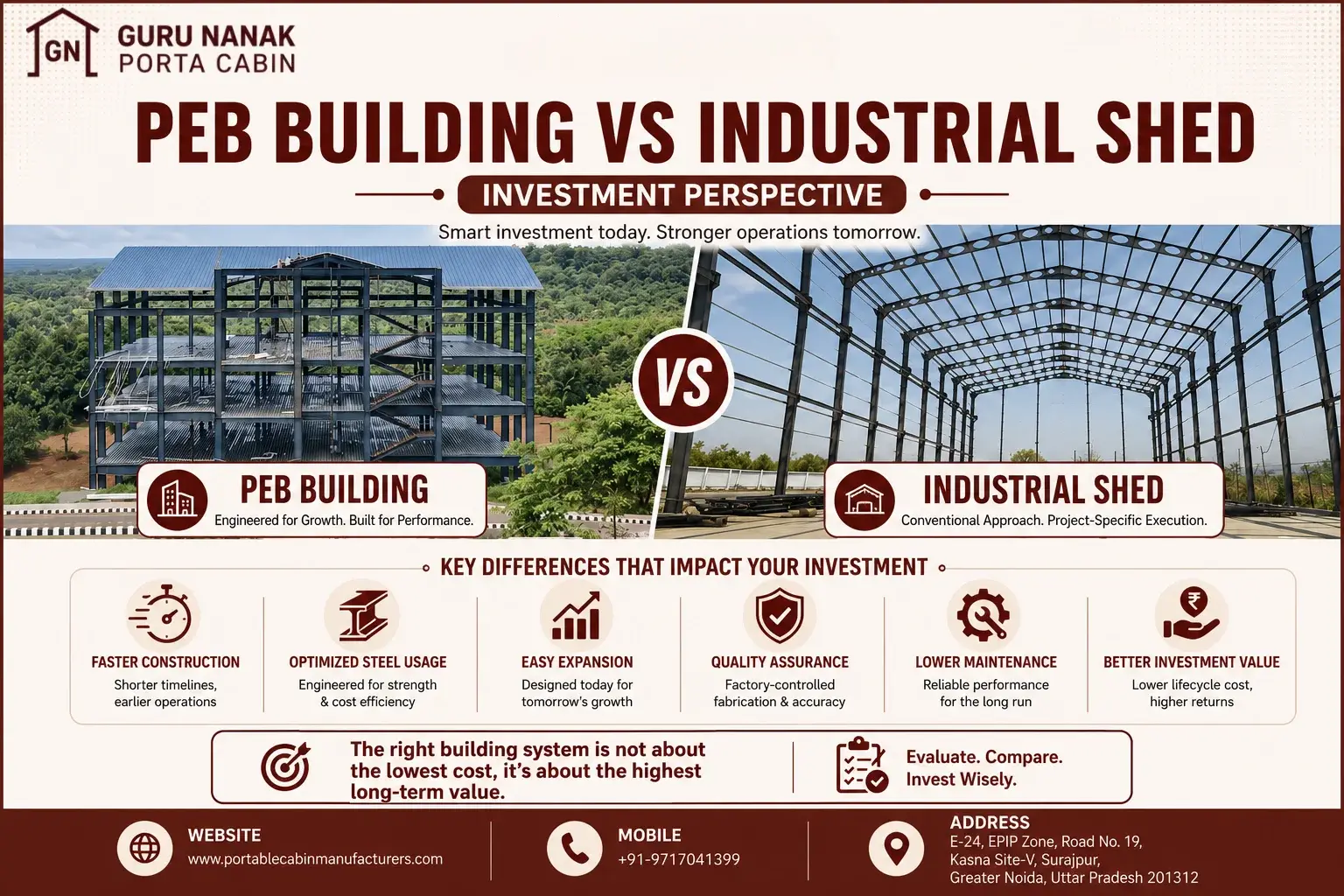
PEB Building vs Industrial Shed - Investment Perspective
31 Aug, 2026
For an industrial buyer, the cheaper construction quotation is not always the better investment.
A factory or warehouse is an operating asset. Its value depends not only on what it costs to build, but also on how quickly it becomes operational, how efficiently the structural system uses material, how easily production can expand, how predictable maintenance remains and how much disruption future modifications create.
That makes the PEB building vs industrial shed decision more than a construction-method comparison.
There is also an important terminology point. “Industrial shed” is a broad term and can itself be built using a pre-engineered system. In this comparison, PEB Building refers to a pre-engineered, factory-fabricated steel building system, while Industrial Shed refers to a more conventionally engineered/fabricated steel-shed approach with greater project-specific fabrication and site dependence.
Guru Nanak Porta Cabin, established in 2009, provides factory-direct PEB manufacturing, in-house steel fabrication, structural engineering, CNC cutting, roofing and wall-cladding integration, and Pan-India project execution. For buyers evaluating a new facility, however, the correct choice should still come from project requirements rather than from a predetermined preference.
A PEB building is generally more suitable when speed, controlled fabrication, clear spans, future expansion and long-term operational planning are important. A conventional industrial shed may remain appropriate for straightforward projects with strong local fabrication capability or highly site-specific detailing. The better investment depends on total lifecycle value, not initial quotation alone.
PEB Building vs Industrial Shed
| Investment Factor | PEB Building | Conventional Industrial Shed |
|---|---|---|
| Engineering approach | Systemized, project-engineered | More conventional/project-specific |
| Fabrication | Primarily factory-controlled | Often greater workshop/site dependence |
| Construction speed | Generally more schedule-efficient | Can involve longer fabrication/site coordination |
| Steel optimization | Designed around calculated requirements | Depends strongly on engineering/fabrication approach |
| Site labour | Typically lower fabrication dependence at site | Usually greater site/workshop labour involvement |
| Quality consistency | Strong factory-control potential | More dependent on contractor/fabricator controls |
| Future expansion | Can be planned from initial design | Possible, but may require more intervention |
| Modification flexibility | Good when planned in advance | Can suit highly custom site modifications |
| Maintenance | Specification and execution dependent | Specification and execution dependent |
| Investment value | Strong where time, repeatability and expansion matter | Strong where conventional execution suits project conditions |
The Investment Question Is Bigger Than Initial Cost
Initial capital cost matters. It should not be ignored. But industrial investment decisions become distorted when buyers compare only:
Quotation A vs Quotation B
A more useful equation is:
Long-Term Industrial Investment Value = Initial CAPEX + Time to Operation + Maintenance + Expansion Cost + Modification Risk + Operational Disruption − Residual Value
This is not a formal accounting formula. It is a procurement framework.
Suppose one building option costs less initially but takes longer to complete. If the factory cannot begin production during that additional period, the project may carry a commercial cost that never appears in the construction quotation. Likewise, a structure that is cheaper today but difficult to expand may become expensive when production capacity grows.
The correct comparison therefore asks: What does each building system do to the economics of the industrial project over its intended ownership period?
Structural Engineering: Where the Investment Logic Starts
A PEB building is typically developed as an engineered structural system in which primary framing, secondary members, connections, roof and wall systems are coordinated around project requirements.
A conventional industrial shed can also be properly engineered. The difference is often in the workflow and degree of systemization rather than in whether engineering exists at all.
For investment evaluation, buyers should verify:
- Building Span
- Eave Height
- Bay Spacing
- Crane Requirements
- Equipment Loads
- Future Expansion
- Roof Loads
- Local Site Conditions And
- Applicable Project Specifications.
Where PEB Often Gains an Advantage
A properly engineered PEB system can allow structural members to be optimized around actual load demand instead of relying on generalized or repetitive member sizes.
That can potentially improve steel efficiency.
However, buyers should avoid simplistic claims such as “PEB always uses less steel.” Actual steel quantity depends on design loads, span, height, crane requirements, configuration and engineering assumptions.
Where a Conventional Industrial Shed Can Make Sense
A conventional approach may be commercially appropriate where the project has unusual structural detailing, established local fabrication resources or significant site-specific work that does not fit a standardized engineering workflow efficiently.
Construction Timeline Has an Investment Value
For many factories and warehouses, construction time is connected directly to revenue.
A PEB system shifts substantial fabrication activity into a controlled manufacturing environment while site work and foundations can progress separately where project sequencing permits.
This can reduce dependence on extensive site fabrication. The commercial advantage is not simply “faster construction.”
The real advantage can be:
Earlier building readiness → Earlier equipment installation → Earlier commissioning → Earlier operations
For a warehouse, earlier readiness may mean earlier inventory handling. For a manufacturing plant, it may mean earlier production. For an expansion project, it can reduce the period during which existing operations remain constrained.
A conventional industrial shed may still meet the required schedule, particularly where a capable local fabrication team and established workflow are already available. Buyers should therefore compare realistic project schedules rather than generic claims.
Foundation Cost Should Be Evaluated With the Structural System
Foundation cost is sometimes treated as a completely separate civil-work issue. From an investment perspective, that is incomplete.
The structural building and foundation interact.
Foundation requirements can be influenced by:
- Column Reactions
- Building Geometry
- Crane Loads
- Soil Conditions
- Wind And Other Project Loads
- Base Details
- Structural Configuration
A structurally optimized superstructure may influence foundation requirements, but no universal statement should be made that one system always produces cheaper foundations.
The practical procurement step is to compare both options using coordinated structural and foundation assumptions.
If one supplier quotation excludes civil works while another includes interface design or foundation inputs, the quotations should be normalized before comparison.
Factory Fabrication vs Greater Site Dependence
One of the biggest differences from a procurement perspective is where production quality is controlled.
PEB manufacturing typically allows a greater proportion of cutting, welding, fabrication and assembly preparation to occur in a factory environment.
Guru Nanak Porta Cabin lists in-house steel fabrication, CNC cutting, structural welding, surface treatment, roof and wall-cladding integration, quality inspection and factory testing among its capabilities.
A conventional industrial shed may rely more heavily on workshop and site fabrication, depending on the execution model.
Neither method guarantees quality automatically.
The buyer should evaluate:
- Approved Drawings
- Material Control
- Fabrication Accuracy
- Welding Procedures
- Dimensional Checks
- Coating Or Surface Treatment
- Erection Controls And
- Inspection Records.
Procurement Warning
Do not compare “factory fabricated” with “site fabricated” as marketing labels. Compare the actual quality-control system behind each project proposal.
Clear-Span Utilization and Industrial Operations
Industrial buildings are not valuable because of their external dimensions. They are valuable because of how effectively the internal space supports production, storage and movement.
Clear-span requirements can affect:
- Production-Line Planning
- Racking
- Forklift Circulation
- Equipment Placement
- Crane Movement And
- Future Rearrangement.
PEB buildings are commonly considered for industrial applications where wide usable spans are important. A conventional shed may also provide substantial spans if engineered accordingly.
The investment decision should focus on the internal operational requirement rather than on selecting a structural system first.
For example, a warehouse developer should ask: Which option gives the required column-free storage and racking environment without creating unnecessary structural cost?
A manufacturer should ask: Which structural grid supports equipment, movement and future production changes most effectively?
Crane Compatibility Is a Design Requirement, Not a Product Feature
Both PEB buildings and conventional industrial sheds can potentially be designed around industrial crane requirements. The buyer should not choose between the two based on a generic claim that one “supports cranes better.”
Instead, define:
- Crane Type
- Capacity
- Runway Arrangement
- Operating Requirements
- Building Span
- Clear Height
- Future Crane Requirements
Crane loads can materially influence structural design and cost.
Adding crane requirements after the main structural system has already been designed can create expensive modifications regardless of construction method.
Roofing, Cladding and Insulation Affect Ownership Cost
The steel frame attracts most attention during procurement, but the building envelope strongly influences daily operating conditions.
Buyers should compare:
- Roofing Specification
- Wall Cladding
- Insulation
- Ventilation
- Daylighting Where Relevant
- Drainage
- Weather Sealing
- Corrosion-Protection System.
A low initial price can become less attractive if the envelope does not match the actual operating environment.
A food-processing facility may have different thermal and moisture considerations from a logistics warehouse.
A hot manufacturing plant may need ventilation or insulation decisions that are less important for a basic storage shed.
PEB and conventional industrial sheds can both use suitable roof and cladding systems. The investment difference comes from how well the envelope is specified and coordinated with the intended use.
Maintenance: Do Not Assume One System Is Maintenance-Free
Neither PEB buildings nor industrial sheds should be treated as maintenance-free assets.
Long-term maintenance can involve:
- Roof Inspections
- Fastener Checks
- Sealant Replacement
- Drainage Cleaning
- Coating Inspection
- Corrosion Treatment
- Cladding Repairs
- Connection Inspection
- Damage Caused By Operations Or Later Modifications.
A factory-controlled PEB can provide consistency advantages when materials and fabrication are properly managed, but maintenance performance still depends on environment, coating system, detailing, erection quality and maintenance discipline.
The useful investment question is:
Which option gives us the most predictable inspection and repair strategy over the expected ownership period?
Expansion Is Where the Original Investment Decision Can Reappear
A factory that operates successfully often needs more space later.
Expansion may involve:
- Additional Production Bays
- Warehouse Extension
- Higher Storage Capacity
- Additional Equipment
- New Crane Systems
- Revised Internal Circulation
If expansion is expected, it should influence the initial structural strategy.
PEB Building
A PEB can be designed with future extension in mind. Expansion planning can consider end-wall configuration, structural interfaces, bay repetition and future utility requirements.
Industrial Shed
A conventional industrial shed can also be expanded, but the ease and cost depend heavily on how the original structure was designed and documented.
Investment Perspective
The important issue is not whether expansion is technically possible.
It is:
How much structural intervention, operational disruption and new construction will expansion require?
A lower initial investment can lose value if future capacity growth requires extensive demolition or structural rework.
Future Modifications and Operational Downtime
Industrial facilities change.
Equipment moves. Production lines change. New openings are required. Mezzanine requirements emerge. Utility loads increase.
Modification cost should therefore be considered separately from basic maintenance.
An engineered building with accurate drawings and clearly defined structural systems can make future assessment easier. However, modifications should still be reviewed technically rather than carried out informally.
For conventional industrial sheds, modification flexibility may be an advantage where site-specific fabrication expertise is readily available.
The buyer should compare not only modification capability but also the likely downtime associated with modification.
For an operating factory, disruption can be more expensive than the steelwork itself.
Lifecycle Cost: Compare the Whole Ownership Period
A useful lifecycle comparison includes:
Initial Stage
- Engineering
- Fabrication
- Structural Materials
- Foundations
- Roofing And Cladding
- Transport
- Erection.
Operational Stage
- Inspection
- Maintenance
- Corrosion Protection
- Roof And Cladding Repair
- Operational Modifications.
Growth Stage
- Expansion
- Crane Upgrades
- Utility Changes
- New Openings
- Additional Structural Requirements.
End-of-Use Stage
- Dismantling Or Demolition
- Steel Recovery
- Disposal
- Residual Or Salvage Value.
The lower first-year cost does not automatically produce the lower lifecycle cost.
Likewise, buyers should not assume that PEB always produces the lower total ownership cost. Lifecycle economics depend on specification quality, environment, ownership period and future project requirements.
PEB Building vs Industrial Shed: Investment Decision Matrix
| Buyer Priority | More Likely Fit |
|---|---|
| Compressed project schedule | PEB Building |
| Factory-controlled fabrication | PEB Building |
| Planned future expansion | PEB Building |
| Large repeatable industrial layout | PEB Building |
| Reduced site fabrication dependency | PEB Building |
| Highly site-specific conventional workflow | Industrial Shed |
| Strong existing local fabrication resources | Industrial Shed |
| Extensive custom site modifications | Industrial Shed may fit |
| Long-term facility with planned growth | PEB Building often deserves stronger evaluation |
| Very simple building requirement | Compare both commercially |
This matrix is directional, not universal.
When a PEB Building Is the Better Investment
A PEB building is often more appropriate when:
- Project Completion Speed Has Measurable Financial Value
- Factory-Controlled Fabrication Is Preferred
- Large Clear Spans Are Required
- Structural Optimization Matters
- Site Labour Dependency Needs To Be Reduced
- Quality Consistency Is A Major Procurement Requirement
- Future Expansion Is Expected
- The Owner Intends To Operate The Building For Many Years
- Earlier Commissioning Improves Project Economics
For a manufacturing facility or large warehouse, these advantages can make the PEB building attractive even when the initial quotation is not the lowest.
When an Industrial Shed Can Be the Better Choice
A conventional industrial shed may be more appropriate when:
- The Building Requirement Is Relatively Straightforward
- Reliable Local Engineering And Fabrication Capability Is Already Available
- The Project Requires Substantial Site-Specific Fabrication
- The Owner Already Has An Established Conventional Construction Process
- Speed Provides Little Commercial Advantage
- Future Expansion Is Unlikely
- Unusual Detailing Makes Conventional Execution More Practical.
The important point is that “conventional” should not be confused with “inferior.”
A well-engineered and well-executed industrial shed can be a sound investment when it matches the project.
What Should Procurement Compare Before Approving the Investment?
Before selecting either option, obtain comparable proposals covering:
- Structural Design Basis
- Building Dimensions
- Span And Bay Spacing
- Crane Requirements
- Structural Steel Scope
- Roofing And Cladding
- Insulation Where Required
- Coating Or Corrosion Protection
- Foundation Assumptions
- Transport
- Erection
- Project Schedule
- Exclusions
- Expansion Provisions
- Warranty Or Maintenance Terms Where Offered.
Procurement Checkpoint
If Supplier A includes engineering, transport and erection while Supplier B quotes only fabricated structural steel, their total prices should not be compared directly.
Normalize the scope first.
Common Investment Mistakes
Comparing Only Cost Per Square Foot
Two buildings with the same floor area can have completely different structural, envelope and operating requirements.
Ignoring Time to Operation
Construction schedule can affect revenue, production and project financing.
Assuming More Steel Means More Value
Structural efficiency should come from engineering requirements, not simply heavier members.
Ignoring Expansion During Initial Design
Future expansion becomes more expensive when the original building was never planned to grow.
Treating Maintenance as a Future Problem
Roofing, cladding, corrosion protection and access for inspection affect lifecycle economics.
Choosing a System Before Defining the Factory
The industrial process should influence the building. The building system should not dictate the process unnecessarily.
Frequently Asked Questions
What is the main difference between a PEB building and an industrial shed?
A PEB building is generally developed as an integrated pre-engineered steel-building system with significant factory fabrication. “Industrial shed” is broader in this comparison it refers to a more conventional fabricated steel-shed approach.
Is a PEB building always more expensive initially?
Not necessarily. Initial cost depends on dimensions, loads, steel quantity, envelope, foundations, cranes, location and project scope.
Which option is faster to construct?
PEB buildings often provide schedule advantages because significant fabrication occurs in a controlled factory environment, but actual project duration depends on design approvals, foundations, manufacturing, logistics and erection.
Which is better for a permanent factory?
Either can be suitable if properly engineered. Long-term factories should compare structural requirements, future expansion, maintenance, envelope performance and lifecycle expenditure.
Which option provides better structural efficiency?
A PEB system can provide strong opportunities for optimized structural design. However, actual efficiency depends on engineering inputs and project configuration.
Can both support industrial cranes?
Potentially, yes. Crane loads and operating requirements must be incorporated into the structural design.
Which is better for warehouses?
PEB buildings are often attractive where clear spans, construction speed and repeatable layouts are valuable. The final decision should follow warehouse layout, racking, height and expansion requirements.
Which option is easier to expand?
PEB buildings can be highly expansion-friendly when future extension is included in the original engineering strategy. Conventional industrial sheds can also be expanded if designed appropriately.
Which requires less maintenance?
There is no universal answer. Maintenance depends on materials, coatings, environment, roof and cladding quality, detailing and inspection practices.
Does a PEB building offer better corrosion resistance?
Corrosion resistance depends primarily on the selected protection system, exposure conditions, fabrication quality and maintenance rather than the PEB label itself.
Is PEB better for long-term ownership?
PEB can provide strong long-term value where controlled engineering, schedule, expansion and predictable fabrication are important. Long-term value remains project-specific.
How should buyers compare lifecycle cost?
Include initial construction, maintenance, repair, expansion, modification, downtime, dismantling and residual value rather than comparing only purchase price.
Does construction speed affect ROI?
It can. Earlier building completion may allow earlier equipment installation, commissioning, warehousing or production, depending on the project.
Which system has better salvage value?
Both primarily use recoverable steel components, but actual salvage value depends on condition, configuration, dismantling feasibility and market conditions at the end of use.
Should the lowest quotation win?
Not automatically. Procurement should compare equivalent technical and commercial scope, construction timeline, lifecycle implications and operational fit.
Is an industrial shed suitable for future expansion?
It can be, provided expansion is considered during the original structural planning.
What should factory owners prioritize?
Factory owners should prioritize process layout, clear spans, equipment loads, crane requirements, completion schedule, expansion and lifecycle value.
What should warehouse developers prioritize?
Warehouse developers should review clear height, column spacing, racking, material movement, construction schedule, envelope performance and future capacity needs.
Which Option Creates Better Investment Value?
There is no universal winner in a PEB building vs industrial shed comparison.
A conventional industrial shed can be commercially sensible for straightforward projects with strong local fabrication resources, limited expansion requirements or unusually site-specific construction.
A PEB building deserves stronger consideration when project speed, factory-controlled fabrication, structural optimization, large clear spans, future expansion and long-term operational planning have measurable value.
For industrial buyers, the decision should therefore move through five questions:
- What does the facility need structurally?
- How quickly must it become operational?
- How likely is future expansion?
- What maintenance and modification burden is acceptable?
- Which option creates the stronger lifecycle return after all project costs are considered?
That is a more reliable investment framework than choosing whichever quotation appears lowest on day one.
Guru Nanak Porta Cabin provides PEB Building solutions from its Greater Noida manufacturing facility with in-house fabrication, structural engineering, CNC cutting, project-specific manufacturing, roofing and cladding integration, and Pan-India execution capability.
For buyers already evaluating a factory, warehouse or industrial facility, the next practical step is to compare the proposed building against the real operational layout rather than against generic building rates.
Request a PEB Building Investment Evaluation
Share your proposed factory or warehouse dimensions, clear-span requirement, building height, crane requirements, project location and future expansion plans for a project-specific discussion.


