

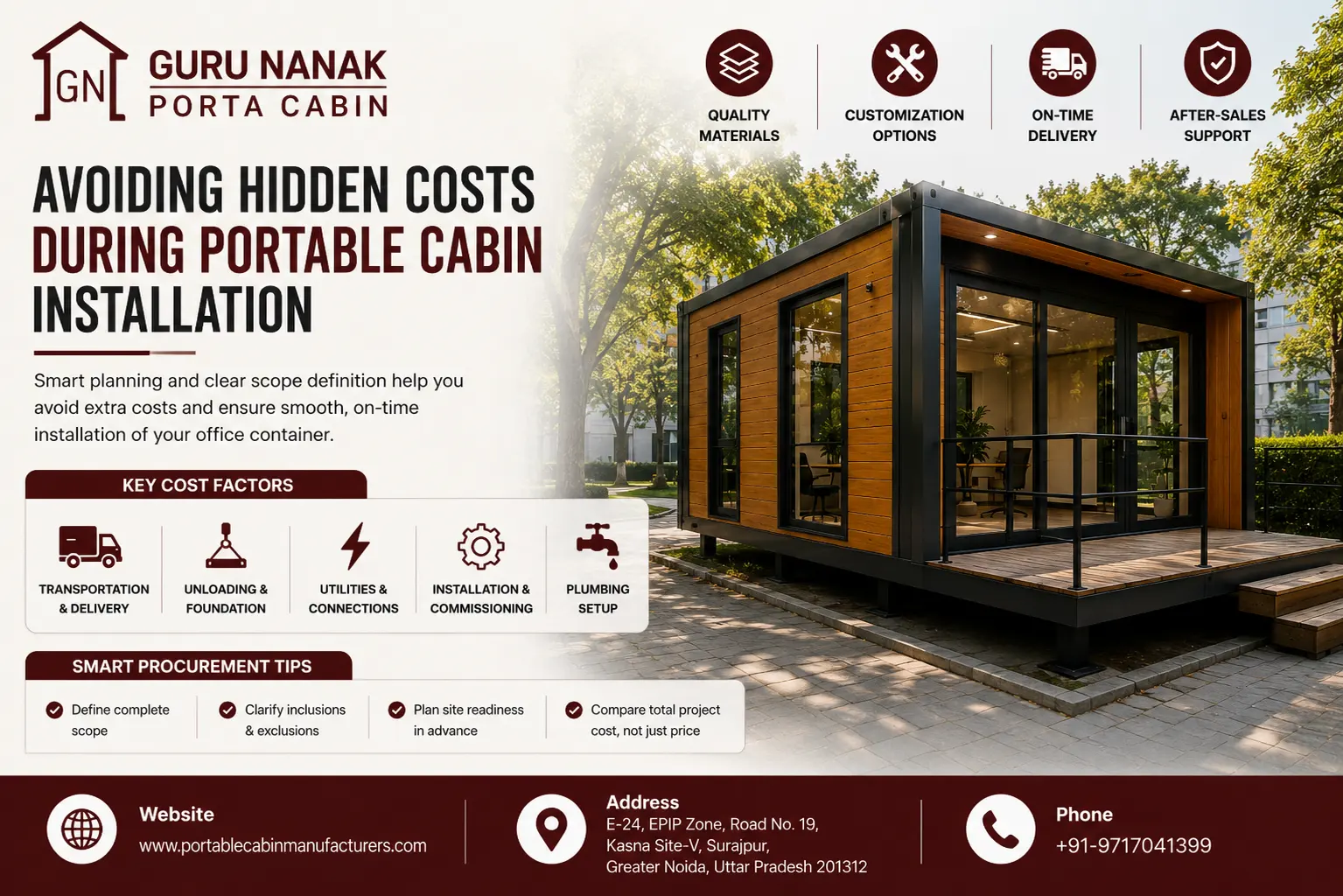
Hidden Budget Factors in Office Container Projects
31 Jul, 2026
The quoted price of an office container may not represent the complete amount required to make the unit operational at site. Transportation, unloading, foundations or supports, electrical requirements, HVAC, plumbing, site access, installation, utility connections and late customization can all affect the final project budget.
These should not automatically be treated as “hidden charges.” In many projects, they become unexpected because responsibility for them was not clearly defined during RFQ preparation and quotation comparison.
For procurement teams, the better question is therefore not simply:
“What is the office container price?”
It is:
“What will it cost to deliver, place, connect and make this office container ready for its intended use?”
Why the Quoted Office Container Price Is Not Always the Project Budget
An office container quotation generally reflects a defined technical and commercial scope. The final project cost can become higher when requirements outside that scope—such as transportation, unloading, civil supports, final utility connections or site-specific installation work—are added later.
Consider a construction project that requests quotations for a standard site office.
Supplier A quotes the fabricated office container.
Supplier B quotes the office container along with transportation and placement.
Supplier C includes additional electrical provisions and installation coordination.
Looking only at the headline quotation value can make Supplier A appear less expensive even though the three quotations are not commercially comparable.
This is one reason procurement teams should distinguish between:
Container price → Delivered cost → Installed cost → Operationally ready project cost
That distinction creates a much more useful basis for budgeting.
Commercial Insight
A lower quotation is not necessarily a lower project cost when the quotation scopes are different.
The first task during cost evaluation should therefore be identifying exactly where each supplier's responsibility ends.
1. Start With the Total Office Container Project Cost
Office container budget planning should include the fabricated unit as well as the project-specific expenditure required to deliver and commission it for practical site use.
A useful conceptual model is:
Total Project Budget = Base Container + Customization + Building Services + Logistics + Site Preparation + Installation + Third-Party Work + Lifecycle Requirements
Not every project will contain every component.
For example, a basic supervisory cabin with existing site power may have limited external work. A multi-room EPC project office with air-conditioning, toilets, multiple modules and a remote installation location can have a considerably broader commercial scope.
That is why fixed price assumptions are unreliable without specifications.
Guru Nanak Porta Cabin follows a project-specific quotation approach based on requirements such as dimensions, structural specification, layout, insulation, electrical scope, HVAC/plumbing provisions, customization, transportation and installation requirements.
Budget checkpoint: Before seeking approval, determine whether the amount being approved represents the manufactured unit or the complete operational requirement.
2. Structural Specifications Influence the Starting Cost
The physical size of an office container is only one part of its manufacturing cost. Structural steel requirements, wall and roof construction, insulation, flooring and opening configurations also influence the fabrication scope.
Two office containers with similar external dimensions may therefore have different costs.
Key structural factors include:
- external dimensions
- structural steel specification
- frame configuration
- wall construction
- roof construction
- insulation type and thickness
- flooring specification
- number and type of doors
- number and size of windows
- protective coating requirements
- application-specific structural provisions
This becomes particularly important when procurement teams compare quotations using only dimensions.
A 20-foot or similarly sized unit from two suppliers should not automatically be considered technically equivalent.
Before Comparing Base Prices
Ask both suppliers to identify the specification behind the price.
The comparison should ideally cover frame construction, wall and roof system, insulation, flooring, openings, coating and included services.
Otherwise, procurement may be comparing different products under the same general description of “office container.”
3. Internal Layout Can Change More Than the Interior Cost
A customized office container layout affects partitions, doors, electrical distribution, lighting, HVAC planning and potentially plumbing. Layout changes therefore influence multiple cost centres rather than only interior finishing.
A simple open-plan portable office container generally requires fewer internal components than a configuration containing:
- manager cabin
- meeting room
- reception
- workstations
- storage room
- pantry
- toilet
- multiple internal partitions
Every partition potentially changes material quantity, labour, doors, switches, lighting positions, AC distribution and usable circulation space.
This creates an important procurement lesson:
Freeze the functional layout before commercial comparison whenever possible.
If the layout is still evolving while quotations are being evaluated, suppliers may be pricing different assumptions.
A Common Budget Problem
A project initially requests an open office.
After fabrication planning begins, the project team asks for a manager cabin and meeting room. Additional partitions are required, electrical points move, lighting changes and AC requirements may need review.
The issue is not simply “customization costs more.”
The real issue is that late customization can create rework.
Early layout planning therefore protects both the budget and the delivery programme.
4. Electrical Connected Load Is an Important Cost Driver
Office container electrical cost depends on what the office is expected to operate, not simply how many lights and sockets appear on a drawing.
The electrical scope may include:
- internal wiring
- lighting
- switches and sockets
- distribution provisions
- protection devices
- AC points
- workstation power
- equipment points
- data/network provisions
- external connection provisions
A small administrative cabin and a project office supporting multiple computers, printers, AC units and meeting-room equipment have very different electrical requirements.
Why This Gets Missed
Procurement documents sometimes state only “electrical included.”
That phrase is commercially incomplete.
A stronger RFQ defines:
- anticipated connected load
- number and type of outlets
- lighting requirement
- AC points
- equipment loads
- distribution requirement
- data points
- interface with site power
This allows suppliers to price the same requirement.
Commercial checkpoint: Do not compare electrical inclusions by point count alone. Compare the electrical specification and expected load.
5. HVAC Can Change Both Capital and Operating Requirements
HVAC-related office container cost depends on internal volume, occupancy, insulation, heat exposure, equipment loads, layout and the cooling configuration required for the application.
Simply asking for “AC provision” leaves considerable room for interpretation.
The commercial scope should distinguish between:
- HVAC-ready: structural/electrical provisions are prepared for later equipment installation.
- HVAC supplied: equipment is included in the supplier's scope.
- HVAC installed: equipment, mounting and associated installation are included.
- HVAC commissioned: the scope extends to making the system operational where applicable.
These are not equivalent commercial offers.
Adding AC requirements after fabrication has started can also require changes to electrical load, openings, drainage and equipment positioning.
For projects in Delhi NCR and other regions experiencing demanding summer conditions, insulation and HVAC should therefore be considered together rather than treated as unrelated purchasing items.
6. Plumbing Requirements Should Be Defined Before Fabrication
Adding a toilet, pantry or wash area can introduce plumbing lines, fixtures, drainage interfaces, water supply requirements and additional internal finishing.
The supplier may prepare internal plumbing provisions, while the site team or another contractor handles final water and drainage connections.
If nobody defines that boundary, the project can arrive at installation with a technically complete cabin that still cannot be used as intended.
Procurement Questions to Ask
Before finalizing the quotation, confirm:
- Are sanitary fixtures included?
- Is internal piping included?
- Where are inlet and outlet points terminated?
- Who connects the unit to site water?
- Who provides external drainage?
- Are tanks, pumps or other external systems required?
- Who tests final site connections?
The answers determine whether the quoted plumbing scope represents a provision, an internal system or a complete site connection.
7. Transportation Can Become a Significant Budget Variable
Office container transportation cost depends on more than the distance between the manufacturing facility and project site.
Commercial factors may include:
- transport distance
- container dimensions
- number of modules
- vehicle requirement
- road accessibility
- route restrictions
- oversized-load considerations
- entry restrictions
- remote location
- scheduling requirements
A project near a manufacturing facility and a remote infrastructure project may require very different logistics planning even when the office containers themselves are identical.
Guru Nanak Porta Cabin operates from Greater Noida and supports Pan-India project requirements, making destination-specific transport planning an important part of quotation preparation.
Why Freight Should Be Separated Clearly
Transportation does not necessarily need to be embedded invisibly in the container price.
For procurement purposes, transparency is often more useful.
A quotation that identifies freight separately allows the buyer to understand:
- manufacturing cost
- logistics cost
- destination impact
- changes if the site location changes
This creates a cleaner commercial comparison.
8. Crane, Unloading and Placement May Be Separate Costs
Delivery to the project gate does not automatically mean placement at the final installation position.
Depending on the container configuration and site conditions, unloading may require suitable lifting equipment.
Potential responsibilities include:
- crane arrangement
- lifting equipment
- operators
- rigging
- unloading zone preparation
- lifting permissions
- placement coordination
- site safety supervision
This is one of the most frequently misunderstood scope boundaries in modular projects.
Before Dispatch
Confirm in writing:
- Who provides the crane?
- Who bears unloading charges?
- Is placement included?
- Can the truck reach the installation point?
- Are lifting clearances available?
A crane booked after the vehicle arrives can create waiting time, coordination problems and avoidable expense.
9. Foundations and Supports Sit Outside the Container Price in Many Projects
An office container requires a level and stable installation area. Depending on the project and design, foundation blocks, supports, pads or other civil preparation may be required.
These works can involve:
- ground preparation
- levelling
- support blocks
- concrete works
- drainage planning
- anchoring provisions
- access preparation
The important commercial distinction is that container manufacturing and site civil preparation are separate scopes unless the quotation specifically combines them.
A supplier may provide foundation or support guidance while the buyer's civil contractor performs the actual work.
Why Early Coordination Matters
If the office container reaches site before supports are ready, the problem is not merely a civil delay.
It can affect:
- unloading
- crane scheduling
- vehicle waiting
- installation manpower
- project sequencing
Foundation readiness is therefore both a technical requirement and a budget-control measure.
10. Installation Cost Depends on What “Installation” Actually Means
Office container installation cost can vary because installation may describe anything from simple placement to joining multiple modules and coordinating electrical or plumbing interfaces.
A single cabin placed on prepared supports is different from a modular office comprising several connected units.
Installation scope may involve:
- placement
- levelling
- alignment
- module joining
- sealing
- anchoring
- internal finishing at joints
- electrical interconnections
- plumbing interconnections
- final checks
The project should therefore avoid accepting a single line reading “installation included” without understanding its boundaries.
A better commercial document defines the tasks included in installation and identifies buyer responsibilities separately.
11. Utility Connections Are a Common Scope Gap
A supplier can provide an electrically wired office container without supplying the external cable from the project's power source. Likewise, internal plumbing can be complete while external water and drainage connections remain the buyer's responsibility.
These interfaces are easy to overlook because both parties may assume the other owns them.
A simple scope matrix can prevent that.
| Requirement | Supplier Scope | Buyer/Site Scope | Third-Party Scope |
|---|---|---|---|
| Internal electrical wiring | Define in quotation | — | — |
| Main site power source | — | Typically site responsibility | Electrical contractor if applicable |
| External power connection | Define | Define | May involve MEP contractor |
| Internal plumbing | Define | — | — |
| External water supply | — | Define | Plumbing contractor if applicable |
| External drainage | — | Define | Civil/MEP contractor |
| Foundation/supports | Define | Define | Civil contractor where applicable |
| Crane/unloading | Define | Define | Crane agency where applicable |
| Placement/installation | Define | Define | Specialist contractor if required |
The purpose of this table is not to prescribe responsibility.
It is to ensure responsibility is assigned before purchase.
12. Site Accessibility Can Change Logistics and Installation Costs
A technically straightforward office container can become commercially complicated when the installation site is difficult to access.
Relevant conditions include:
- narrow approach roads
- restricted turning radius
- overhead obstructions
- limited crane positioning
- congested construction areas
- soft ground
- restricted working hours
- permit requirements
- remote project locations
These constraints can influence vehicle selection, crane planning, manpower and installation sequencing.
Procurement Scenario
An EPC team orders several modules for a project site.
The main road is suitable for transport, but the final approach has limited turning space. The planned delivery vehicle cannot reach the installation area.
The project may now require alternative handling arrangements.
The office container specification has not changed at all.
The project cost has.
This is why site logistics should be reviewed before dispatch—not after the vehicle reaches the site.
13. Last-Minute Specification Changes Can Be More Expensive Than Early Customization
Customized office containers do not create budget problems simply because they are customized. The larger risk is changing an approved specification after engineering, procurement or fabrication has progressed.
Late changes may involve:
- removing completed work
- adding material
- relocating doors
- changing windows
- moving electrical points
- revising partitions
- adding AC provisions
- adding plumbing
- repainting or refinishing
The resulting commercial impact can include material, labour, engineering and schedule consequences.
Better Budget Control
Establish a design freeze point.
Before that point, stakeholders should validate:
- dimensions
- room layout
- occupancy
- doors/windows
- electrical requirements
- HVAC
- plumbing
- furniture interfaces
- utility interfaces
After approval, changes should be treated through a controlled variation process.
That makes cost ownership visible.
14. Accelerated Delivery Can Affect the Commercial Scope
Project schedules influence manufacturing and logistics planning.
If an office container is required under a compressed programme, the supplier may need to evaluate production capacity, material availability, fabrication sequencing, labour allocation, transport scheduling and installation coordination.
Buyers should therefore communicate the required-on-site date during RFQ preparation.
A vague instruction such as “urgent delivery required” provides little commercial clarity.
Instead specify:
- quotation deadline
- drawing approval target
- expected order date
- required dispatch date
- required site delivery date
- installation readiness date
The supplier can then assess feasibility against an actual project schedule.
15. Multi-Module Offices Create Interface Costs
Larger site offices may use several modules rather than one container.
That can introduce additional work involving:
- module alignment
- joining
- weather sealing
- internal transitions
- electrical interconnection
- plumbing interconnection
- roof interfaces
- circulation planning
A procurement team comparing a single large concept against a multi-module arrangement should therefore compare the complete installed configuration—not simply the unit rate of each module.
Commercial insight: As modular complexity increases, interfaces become part of the project scope.
Ignoring those interfaces can make an early budget appear more attractive than the final execution cost.
16. Relocation and Reuse Should Be Considered at the First Purchase
Portable office infrastructure can potentially support projects where facilities need to be moved or reused, but relocation itself creates a new commercial event.
Future costs can include:
- disconnection
- inspection
- lifting
- loading
- transportation
- unloading
- new foundations/supports
- reconnection
- repairs
- coating touch-ups
- sealant replacement
A buyer expecting future relocation should discuss that requirement during initial planning.
Door positions, module configuration, connection details and site services can all influence how practical future relocation becomes.
The relevant question is not simply whether the office container is portable.
It is:
How efficiently can this specific configuration be disconnected, transported and recommissioned?
17. Maintenance Belongs in Lifecycle Budget Planning
Initial procurement cost is only one part of commercial planning for office infrastructure expected to remain in service for an extended period or move between projects.
Periodic requirements may include:
- coating inspection
- corrosion monitoring
- roof checks
- waterproofing inspection
- sealant checks
- door/window hardware maintenance
- electrical inspection
- HVAC servicing
- plumbing inspection
- flooring inspection
- touch-up painting
These are normal asset-management considerations rather than hidden costs.
The objective is to preserve usability and identify deterioration before it develops into larger repair work.
Before relocating a used site office container, an inspection can also help determine whether structural, electrical, coating or sealing work is required before the next deployment.
18. The Best Budget Separates Supplier, Buyer and Third-Party Costs
One of the strongest ways to control office container procurement cost is to create a responsibility matrix before issuing the purchase order.
A practical budget can be divided into three ownership groups.
Supplier Scope
Potentially:
- engineering/fabrication
- structural construction
- walls and roof
- insulation
- flooring
- doors/windows
- internal electrical work
- HVAC provisions
- plumbing provisions
- finishing
- inspection
- transport coordination
- installation support
Actual inclusions must follow the quotation.
Buyer Scope
Potentially:
- site access
- civil preparation
- foundation/supports
- power availability
- water availability
- drainage
- site permissions
- safety clearances
- installation area readiness
Third-Party Scope
Potentially:
- transportation
- crane
- civil contractor
- external electrical contractor
- plumbing contractor
- HVAC specialist
Again, these are not fixed allocations.
They are categories that should be assigned explicitly.
That distinction prevents the dangerous assumption that “someone else has included it.”
19. How Procurement Teams Should Compare Office Container Quotations
Office container quotations should be normalized against the same technical scope before their commercial values are compared.
Use a comparison sheet such as this:
| Comparison Parameter | Supplier A | Supplier B | Supplier C |
|---|---|---|---|
| External dimensions | Verify | Verify | Verify |
| Structural specification | Verify | Verify | Verify |
| Wall/roof construction | Verify | Verify | Verify |
| Insulation | Verify | Verify | Verify |
| Flooring | Verify | Verify | Verify |
| Layout | Verify | Verify | Verify |
| Doors/windows | Verify | Verify | Verify |
| Electrical load/scope | Verify | Verify | Verify |
| HVAC | Verify | Verify | Verify |
| Plumbing | Verify | Verify | Verify |
| Coating | Verify | Verify | Verify |
| Transportation | Included/Excluded | Included/Excluded | Included/Excluded |
| Unloading/crane | Included/Excluded | Included/Excluded | Included/Excluded |
| Foundation | Included/Excluded | Included/Excluded | Included/Excluded |
| Installation | Included/Excluded | Included/Excluded | Included/Excluded |
| Utility connections | Included/Excluded | Included/Excluded | Included/Excluded |
| Technical deviations | Record | Record | Record |
| Commercial exclusions | Record | Record | Record |
This process turns a quotation comparison into a scope comparison.
Only after scope normalization does price comparison become commercially meaningful.
20. The “Lowest Quote” Test
Before approving the lowest office container quotation, procurement teams should ask four questions:
- Are the technical specifications equivalent?
- Are the commercial inclusions equivalent?
- Are site and logistics responsibilities equivalent?
- Are exclusions clearly identified?
If the answer to any one is no, the quotations are not yet directly comparable.
This does not mean the higher quotation is automatically better.
It means the buyer needs enough information to understand the difference.
A technically compliant lower quotation with clearly defined exclusions can still be commercially attractive. Likewise, a higher quotation containing broader scope may reduce third-party coordination.
The procurement decision should be based on the project requirement rather than the headline number alone.
21. Office Container Budget Planning Checklist
Before requesting or approving an office container quotation, confirm the following:
Technical
- Dimensions finalized
- Number of modules confirmed
- Structural specification defined
- Wall/roof construction defined
- Insulation requirement confirmed
- Flooring requirement confirmed
- Layout approved
- Doors/windows finalized
MEP
- Connected electrical load identified
- Socket requirements defined
- Lighting requirement defined
- Data/network points identified
- HVAC scope defined
- Plumbing scope defined
- Water/drainage interfaces defined
Logistics
- Delivery address confirmed
- Truck access verified
- Turning radius checked
- Route constraints reviewed
- Unloading responsibility assigned
- Crane requirement confirmed
- Placement area accessible
Site Preparation
- Ground level confirmed
- Foundations/supports ready
- Drainage considered
- Installation clearance available
- Anchoring requirements confirmed
- Site permissions available
Commercial
- Freight inclusion confirmed
- Unloading inclusion confirmed
- Installation inclusion confirmed
- Utility connection responsibility confirmed
- Exclusions recorded
- Technical deviations recorded
- Change-control procedure understood
- Required delivery date communicated
A procurement team that completes this checklist before quotation comparison is far less likely to discover major scope gaps after purchase.
22. What Information Should Be Sent to an Office Container Manufacturer?
A detailed RFQ allows an office container manufacturer to develop a more relevant technical-commercial quotation.
At minimum, provide:
- project location
- intended application
- required quantity
- external dimensions
- internal layout
- expected occupancy
- structural requirements where specified
- insulation requirement
- flooring requirement
- electrical load
- lighting and socket requirements
- HVAC requirement
- plumbing requirement
- door/window schedule
- transport/access information
- installation expectations
- required delivery schedule
For a customized office container, drawings, layout sketches or project-specific specifications can further reduce assumptions.
The more clearly the RFQ defines the requirement, the less commercial interpretation is required later.
23. Budgeting for Delhi NCR Projects vs Remote Locations
The manufactured office container may have the same specification regardless of destination, but the delivered project cost can change because logistics and site conditions are location-dependent.
Projects in Greater Noida, Noida, Ghaziabad or Delhi NCR may involve one set of transportation and access conditions.
A remote mining, renewable-energy, power or infrastructure project elsewhere in India may involve:
- longer transportation
- route planning
- limited crane availability
- difficult access
- remote workforce coordination
- restricted utility availability
For Pan-India procurement, logistics should therefore be treated as a project variable rather than assumed to be a fixed percentage of manufacturing cost.
This is particularly relevant when a central procurement team is budgeting identical office units for several geographically dispersed projects.
24. What Can Buyers Do to Control Office Container Costs?
Cost control does not necessarily mean reducing the specification.
It means eliminating unnecessary scope, preventing rework and defining commercial responsibilities early.
Practical steps include:
- finalize layout before fabrication
- define essential versus optional features
- calculate electrical requirements early
- coordinate HVAC with insulation
- define plumbing before manufacturing
- verify transport access
- prepare foundations before dispatch
- assign crane responsibility
- establish utility connection ownership
- compare quotations on equal specifications
- control post-approval variations
- communicate realistic project dates
A lower specification can reduce initial cost, but it should not compromise the functional requirement simply to achieve a budget target.
For example, removing insulation from a climate-sensitive site office may reduce one procurement component while increasing comfort or HVAC challenges later.
Good cost optimization removes waste. Poor cost cutting removes necessary performance.
25. When Should Procurement Request a Revised Quotation?
A revised commercial quotation should be considered whenever a material project requirement changes after the original quote.
Examples include:
- dimensions change
- quantity changes
- layout changes
- additional partitions
- more doors/windows
- revised electrical load
- additional AC units
- plumbing added
- destination changes
- installation scope changes
- delivery schedule changes
Relying on an earlier quotation after the technical scope has changed can create budget discrepancies at purchase-order stage.
A controlled revision also creates an audit trail showing why the project value changed.
That can be useful for internal approvals and commercial justification.
26. A Better Definition of “Hidden Costs”
The phrase office container hidden costs can be misleading.
Transportation, crane hire, civil foundations and utility connections are not inherently hidden. They are legitimate project activities.
They become unexpected when:
- the RFQ does not mention them
- the quotation does not clarify them
- procurement assumes they are included
- the supplier assumes they are excluded
- another contractor's scope is undefined
The solution is therefore not simply demanding an “all-inclusive price.”
For complex projects, even an all-inclusive quotation requires a clear definition of what “all-inclusive” covers.
The better objective is scope transparency.
27. From Quoted Price to Operationally Ready Cost
For serious procurement decisions, office container cost can be evaluated in four stages:
| Cost Stage | What It Represents |
|---|---|
| Manufactured Cost | Office container according to defined factory specification |
| Delivered Cost | Manufactured unit plus agreed logistics to site |
| Installed Cost | Delivered unit plus agreed unloading, placement and installation |
| Operationally Ready Cost | Installed unit plus required utility interfaces and site works needed for intended use |
This framework is particularly useful when presenting the budget internally.
Instead of management asking why the project exceeded the “container price,” procurement can show the commercial layers required to create a usable facility.
That creates better budget expectations from the beginning.
28. Commercial Guidance Before Final Approval
Before approving an office container purchase, procurement and project teams should jointly review three documents:
1. Technical Specification
Defines what is being manufactured.
2. Scope Responsibility Matrix
Defines who handles logistics, civil work, utilities, installation and third-party services.
3. Commercial Comparison Sheet
Shows quotation inclusions, exclusions, deviations and project-specific costs.
Together, these documents answer the three questions that matter most:
- What are we buying?
- Who is responsible for making it operational?
- What is the total expected project budget?
If those questions are answered clearly, most so-called hidden cost problems become manageable before the purchase order is released.
Frequently Asked Questions
1. What are the main hidden budget factors in an office container project?
Commonly overlooked budget factors include transportation, crane/unloading, site preparation, foundation supports, utility connections, installation, electrical load requirements, HVAC, plumbing and late specification changes. Their applicability depends on project scope and should be clarified during RFQ preparation.
2. Is transportation normally included in the office container price?
It depends on the supplier's quotation. Buyers should confirm whether freight is included, excluded or quoted separately and whether the price covers delivery only to the project site or any additional placement activity.
3. Why can the same-size office container have different project costs?
Dimensions alone do not define the product. Structural specification, insulation, flooring, layout, electrical scope, HVAC, plumbing, openings, coating, customization and delivery requirements can differ substantially.
4. How should procurement calculate the total office container budget?
Evaluate the manufactured unit, customization, building services, transportation, unloading, site preparation, foundations, installation, utility interfaces and applicable third-party work rather than relying only on the base quotation.
5. Does customization always make an office container expensive?
Not necessarily. Customization affects cost according to what is changed and how complex the requirement becomes. Early, purposeful customization can also prevent later modifications and improve the container's suitability for its intended operation.
6. Why does electrical load affect office container cost?
Higher or more complex electrical requirements can influence wiring, distribution, protection, outlets, AC provisions and associated components. The supplier needs the expected connected load and equipment requirements to define an appropriate scope.
7. Should HVAC be included in the original RFQ?
If air-conditioning is required, it should ideally be defined early. HVAC requirements interact with insulation, electrical load, equipment positioning and drainage, making late additions potentially disruptive.
8. Who normally pays for crane unloading?
Responsibility varies by quotation and project arrangement. Crane/unloading should be assigned explicitly to the supplier, buyer or third-party contractor before dispatch.
9. Are foundations included in office container installation?
Not automatically. Civil supports or foundations may remain the buyer's or civil contractor's responsibility. The quotation should distinguish site preparation from container placement and installation.
10. Why does office container installation cost vary between projects?
Installation complexity depends on site accessibility, number of modules, lifting requirements, alignment, joining, anchoring, sealing and service connections. A single cabin on a prepared site is commercially different from a multi-module office.
11. Can plumbing be added after the office container is manufactured?
Modifications may be possible depending on the design, but adding plumbing later can require changes to internal finishes, drainage routing and service interfaces. Defining plumbing before fabrication generally provides better cost and coordination control.
12. How does a remote project location affect office container cost?
Remote locations can affect transportation distance, vehicle requirements, route planning, crane availability, installation coordination and access to third-party services. These factors should be evaluated separately from manufacturing cost.
13. What is the best way to compare office container suppliers?
Normalize quotations against the same technical specification and record inclusions, exclusions, deviations, logistics, installation and utility responsibilities. Compare commercial values only after confirming that the quoted scopes are equivalent.
14. Should the lowest office container quotation be selected?
Not solely because it is the lowest. First verify technical compliance and scope equivalence. A lower quotation may be commercially suitable, but only if the buyer understands what is included and what must be purchased separately.
15. How can project teams reduce office container budget overruns?
Finalize requirements early, issue a detailed RFQ, verify site access, prepare foundations before delivery, assign utility and unloading responsibilities, control design changes and compare supplier quotations using a standardized scope matrix.
16. Should relocation cost be considered during initial procurement?
Yes, if the container is expected to move between projects. Future lifting, transportation, inspection, reconnection, repair and new site preparation should form part of lifecycle planning.
17. What maintenance expenses should be considered?
Depending on configuration and use, maintenance can include coating checks, corrosion monitoring, waterproofing, sealants, door/window hardware, electrical inspection, HVAC servicing, plumbing inspection and flooring checks.
18. What information helps obtain a more accurate office container quotation?
Provide dimensions, quantity, layout, occupancy, structural requirements, insulation, flooring, electrical load, HVAC/plumbing requirements, project location, site access conditions, installation scope and required delivery schedule.
19. What does “operationally ready cost” mean for an office container?
It represents the cost required to move beyond manufacturing and make the office usable at its intended site, including applicable delivery, placement, installation, utility interfaces and site preparation.
20. When should an office container quotation be revised?
Request a revision when significant requirements change, such as dimensions, quantity, layout, electrical load, HVAC, plumbing, destination, installation scope or project schedule. This keeps commercial approval aligned with the actual technical requirement.
Request a Project-Specific Office Container Quotation
A reliable office container budget starts with a defined project scope rather than a generic unit price.
If your project requires a site office, EPC project office, engineering cabin, project management office or customized modular workspace, document the complete requirement before comparing commercial offers.
Guru Nanak Porta Cabin has operated since 2009, with in-house fabrication capabilities and experience across 350+ projects. The company supports project-specific office container planning, including structural configuration, layouts, electrical provisions, HVAC-ready and plumbing-ready requirements, transport coordination and installation support.
Review the Office Container solution page when defining your technical requirement:
For a project-specific commercial discussion, share the proposed dimensions, quantity, layout, location, MEP requirements and installation expectations with Guru Nanak Porta Cabin: Contact- US
The objective should be to receive a quotation that makes the scope—and not merely the headline price—clear enough for procurement approval.


