

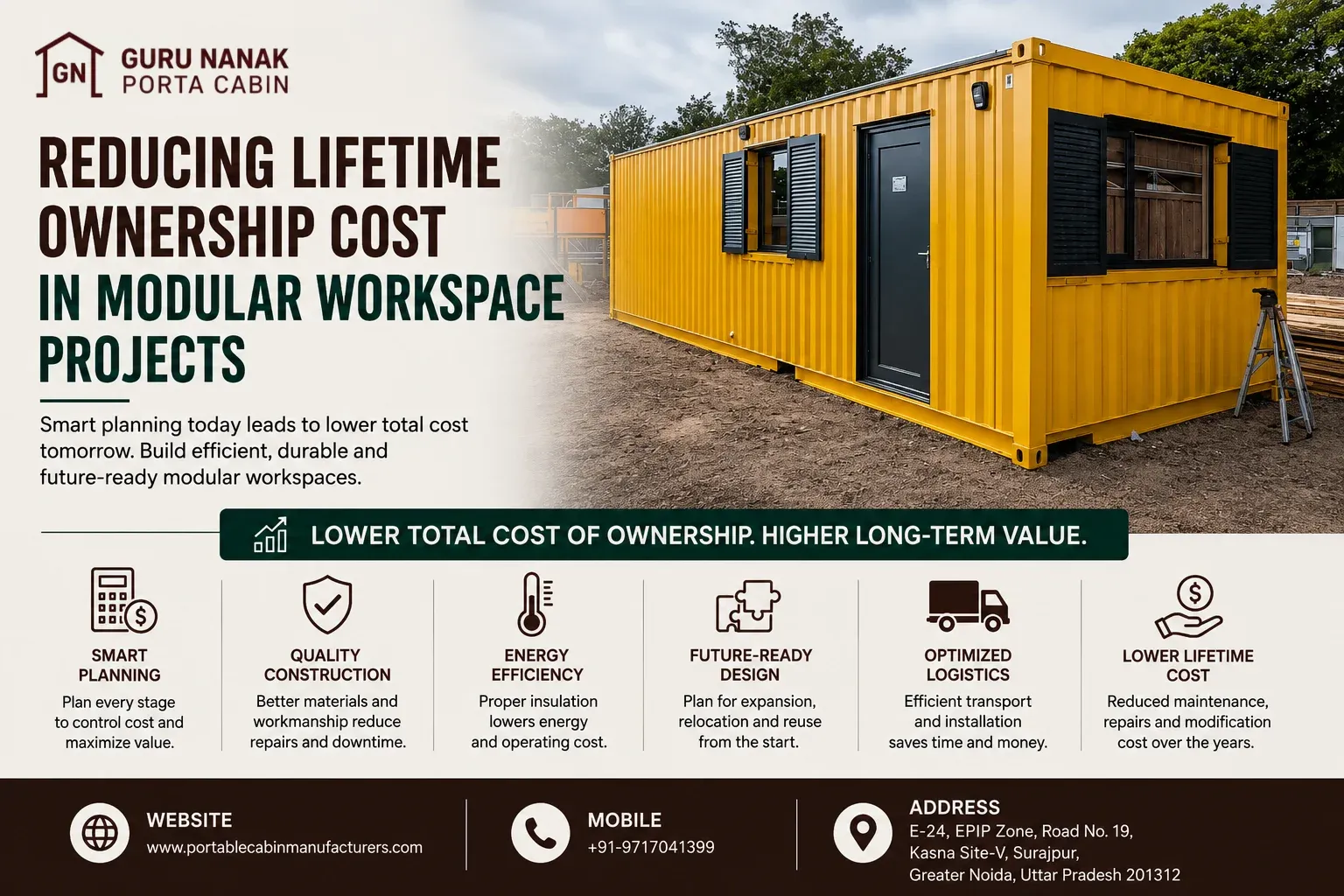
Reducing Lifetime Ownership Project Cost in Modular Workspace Projects
25 Aug, 2026
The lowest modular workspace quotation is not always the lowest-cost project.
A buyer may save money at the procurement stage and still spend more over the next several years because of poor insulation, weak maintenance planning, repeated modifications, relocation difficulty or unclear installation responsibilities. That is why modular workspace project cost should be evaluated across the complete ownership lifecycle rather than only at purchase.
For project offices, factory administration facilities, corporate expansion spaces, remote-site workspaces and multi-module office complexes, the commercial question is not simply:
“What does the workspace cost to buy?”
The better question is: “What will this workspace cost us to manufacture, deliver, install, operate, maintain, modify, relocate and eventually reuse?”
Guru Nanak Porta Cabin supports modular workspace projects through factory-direct manufacturing, in-house fabrication, customized layouts, insulation installation, electrical provisions, HVAC-ready provisions, pre-dispatch inspection, delivery coordination and installation coordination.
Those capabilities can influence project cost, but every buyer should still evaluate the complete technical and commercial scope before approving a budget.
Reducing modular workspace lifetime cost starts with right-sizing the workspace, freezing the layout early, selecting appropriate insulation and finishes, defining transport and installation scope, planning maintenance, and designing for future expansion or relocation. The objective is not the lowest opening price. It is the lowest practical total cost of ownership for the required performance and service life.
What Is the True Cost of a Modular Workspace?
The true cost of a modular workspace includes far more than factory manufacturing.
A useful commercial framework is: Total Lifetime Ownership Cost = Initial Manufacturing Cost + Transportation + Site Preparation + Installation + Operating Cost + Maintenance + Repairs + Refurbishment + Expansion/Modification + Relocation/Reinstallation − Reuse or Residual Value
This is a budgeting framework rather than a universal accounting formula, but it forces procurement teams to look beyond the initial quotation. A modular office that is inexpensive to purchase but expensive to cool, repair or modify may perform poorly commercially. Another option with a slightly higher initial specification may produce better long-term value if it lowers operating disruption and supports future reuse.
Commercial checkpoint
Before comparing supplier prices, decide how long the workspace is expected to remain in service and whether it may later be expanded, relocated or reused.
Without that information, lifecycle comparison remains incomplete.
Initial Project Cost vs Lifetime Ownership Cost
Initial cost measures what it takes to procure and deploy the workspace. Lifetime ownership cost measures what the project continues to spend after handover.
Initial project cost can include:
- Design And Layout Development
- Structural Frame
- Wall And Roof Systems
- Insulation
- Flooring
- Doors And Windows
- Electrical Provisions
- Hvac Provisions
- Plumbing Interfaces Where Required
- Interior Finishes
- Transport
- Unloading
- Installation
- Utility Connection Work.
Lifetime cost can include:
- Electricity
- Hvac Operation
- Routine Maintenance
- Minor Repairs
- Sealant Replacement
- Door And Window Repairs
- Finish Renewal
- Refurbishment
- Layout Changes
- Expansion
- Dismantling
- Relocation
- Reinstallation.
Procurement teams often focus heavily on the first list and underestimate the second. That is understandable because initial cost is visible before purchase while future cost is less certain.
However, long-term cost becomes easier to manage when the design and procurement process anticipates it.
What Determines Modular Workspace Pricing?
Modular workspace pricing varies because projects differ in size, layout, specification, services, logistics and installation requirements.
The main cost drivers include:
| Cost Driver | Why It Affects Cost |
|---|---|
| Number of modules | More units increase material, manufacturing and logistics scope |
| Workspace dimensions | Larger spaces require more structure, envelope and finishes |
| Structural configuration | Different layouts and configurations affect fabrication |
| Wall and roof system | Material and performance requirements affect cost |
| Insulation | Higher-performance specifications change initial cost and operating economics |
| Flooring | Finish level and durability influence purchase and replacement cost |
| Electrical scope | More outlets, lighting and connected loads increase scope |
| HVAC provisions | Equipment, openings, drainage and electrical needs vary |
| Plumbing | Washrooms, pantry and drainage interfaces add complexity |
| Interior finish | Corporate or long-term-use finishes may increase initial cost |
| Transportation | Distance and module size affect freight |
| Installation | Site conditions, lifting and interconnection influence deployment cost |
| Expected service life | Longer use may justify stronger specifications |
This is why generic “modular office price” comparisons can be misleading.
Two structures of similar size can have very different cost because their technical and operational scope is different.
Right-Sizing the Workspace Is One of the Best Cost Controls
Unused floor area creates cost at several stages of the project.
Extra space affects:
- Structural Material
- Wall And Roof Area
- Flooring;
- Lighting;
- Hvac Load;
- Transport;
- Installation;
- Cleaning; And
- Future Maintenance.
However, under-sizing can be equally expensive. A cramped workspace may require an additional module or major layout change soon after installation.
The better approach is to plan around:
- Current Occupancy
- Realistic Future Headcount
- Workstations
- Manager Cabins
- Meeting Requirements
- Storage
- Circulation And
- Future Expansion.
Procurement scenario
A project team needs space for 18 people today but expects to reach 28 within two years. Buying only for 18 may reduce initial cost but create a second procurement cycle quickly. Buying a much larger building immediately may create unnecessary capital and operating cost.
A phased layout with planned expansion may offer better lifecycle value.
Insulation Can Change Operating Cost Significantly
Insulation should be treated as a lifecycle-cost decision, not only a purchase-price line item. For full-day office use, roof and wall performance influence cooling and heating demand. A lower-cost specification may reduce initial modular workspace price but increase energy use over time.
The buyer should compare:
- Roof Build-Up
- Wall Build-Up
- Insulation Specification
- Window Area
- Door Sealing
- Ventilation
- Shading
- Hvac Requirement.
This is particularly relevant for workspaces used in Delhi NCR, industrial sites, renewable-energy projects, mining locations and other environments with high heat exposure. The objective is not to specify the maximum possible insulation. It is to select insulation appropriate to the actual occupancy pattern and climate.
Cost principle
Overspecification wastes capital. Underspecification increases operating cost. Good lifecycle planning sits between the two.
HVAC and Electrical Planning Can Prevent Expensive Rework
Electrical and HVAC modifications made after manufacturing or installation usually cost more than changes planned in advance.
Before production, define:
- Workstation Socket Locations
- Lighting
- Meeting-Room Loads
- Printer And Equipment Loads
- Ac Positions
- Drainage Points
- Distribution Requirements
- Backup-Power Interfaces
- Data Provisions.
If a project later adds higher AC capacity, additional workstations or server equipment, the existing electrical system may need modification. Similarly, poor AC placement can create comfort problems that lead to equipment changes later. These are not just technical issues. They are ownership-cost issues.
Early coordination reduces:
- Post-Installation Cutting
- Rewiring
- Finish Repair
- Downtime
- Duplicate Labour
- Operational Disruption.
Transportation and Site Access Can Change the Final Project Cost
Freight and installation economics depend heavily on where the workspace must go and how easily the site can receive it.
Cost can increase when projects involve:
- Long Transport Distances
- Remote Locations
- Narrow Access Roads
- Difficult Turns
- Restricted Gates
- Crane Requirements
- Limited Unloading Areas
- Poor Site Readiness
- Multi-Location Deployment.
Before requesting final pricing, procurement should verify:
- Delivery Location
- Route Access
- Unloading Responsibility
- Crane/Lifting Requirement
- Installation Area
- Support/Foundation Readiness
- Utility Readiness.
A low factory price can lose its advantage if logistics were not considered early.
For multi-site projects, location-wise freight and installation should be separated rather than blended into one unclear delivery figure.
Maintenance Cost Should Be Planned Before Purchase
Preventive maintenance is generally easier to budget than emergency repair.
A modular workspace maintenance plan may include periodic checks of:
- Roof Condition
- Wall Surfaces
- Sealants
- Fasteners
- Doors And Windows
- Flooring
- External Finishes
- Drainage
- Electrical Systems
- Hvac Equipment
- Plumbing Interfaces Where Applicable
- Water-Ingress Risks.
Many buyers treat maintenance as something to discuss after handover.
That increases uncertainty.
A better approach is to understand which components will need inspection and which finishes may require periodic renewal before the purchase decision is made.
Commercial insight
Minor deterioration that is addressed early may avoid larger repair scope later.
The cost-saving mechanism is not “no maintenance.” It is planned maintenance before failure becomes expensive.
Manufacturing Quality Influences Repair and Refurbishment Cost
Poor execution can create ownership cost even when the initial quotation looks competitive.
Examples include:
- Poorly Sealed Joints
- Inconsistent Finishes
- Incorrectly Positioned Openings
- Weak Door Alignment
- Incomplete Insulation
- Poor Drainage Detailing
- Service Provisions Requiring Later Correction.
These issues may not immediately affect purchase price.
They can affect:
- Repair Frequency
- Water Ingress
- Employee Comfort
- Downtime
- Maintenance Labour
- Refurbishment Frequency.
This is why procurement teams should evaluate factory inspection and pre-dispatch inspection as cost-control tools rather than administrative steps.
Guru Nanak Porta Cabin includes quality inspection and pre-dispatch inspection among its supplied project capabilities.
For larger requirements, buyers should still define what inspection is expected and how acceptance will be documented.
Refurbishment Should Be Included in Long-Term Budget Planning
Modular workspace refurbishment can extend useful service life when the structure remains technically suitable but finishes or layouts need updating.
Potential refurbishment items can include:
- Interior Lining
- Flooring
- Lighting
- Doors
- Windows
- Sealants
- External Coating
- Electrical Modifications
- Partitions
- Cosmetic Upgrades.
Refurbishment is particularly relevant when a workspace moves from one project to another.
Instead of replacing the asset completely, a buyer may be able to refurbish and redeploy it.
The commercial value depends on the original structure, maintenance history, condition and new project requirements.
Buyers should therefore avoid assuming either that refurbishment will always be economical or that replacement will always be necessary.
Expansion Planning Can Reduce Future Project Cost
Future expansion is usually cheaper to manage when it is anticipated before the initial workspace is manufactured.
A modular office may later need:
- More Workstations
- Another Manager Cabin
- A Meeting Room
- Storage
- Pantry Space
- An Additional Connected Module.
If expansion is expected, initial planning should consider:
- Physical Space
- Module Connection Points
- Circulation
- Electrical Capacity
- Hvac
- Plumbing
- Drainage
- Installation Access.
A workspace can be technically modular yet still be expensive to expand if phase-one positioning blocks future additions.
Before approving the initial layout
Ask whether the site plan still works if another module is added later.
That single question can prevent substantial future rework.
Relocation and Reuse Can Improve Lifecycle Value
Relocation can create significant value where project offices are needed at several sites over time.
A workspace used for an EPC project, infrastructure site or temporary industrial expansion may later serve another location.
Reuse can reduce the need for a completely new building, but relocation itself has cost.
Budget may need to include:
- Disconnection
- Dismantling Where Required
- Loading
- Transportation
- Unloading
- Positioning
- Reinstallation
- Utility Reconnection
- Refurbishment.
The best lifecycle outcome comes when relocation is considered during initial planning.
If a workspace may move frequently, design choices should reflect that expectation.
If relocation is unlikely, the buyer may prioritize other factors instead.
Operational Downtime Is a Cost Buyers Often Miss
Repairs and modifications affect more than maintenance budgets—they can interrupt work.
A workspace may need to be partially unavailable during:
- Electrical Modifications
- Hvac Replacement
- Water-Ingress Repair
- Flooring Repair
- Refurbishment
- Expansion
- Relocation.
For busy project teams, downtime can create indirect costs through:
- Reduced Productivity
- Temporary Accommodation
- Disrupted Meetings
- Delayed Site Coordination
- Employee Inconvenience.
These costs may never appear on the supplier quotation.
They still matter commercially.
A specification that is easier to maintain, repair or expand may therefore create more value even if the initial project price is not the lowest.
How to Compare Modular Workspace Quotations Correctly
Supplier quotations should be normalized before price is compared.
Check the following:
| Commercial Area | Supplier A | Supplier B | Supplier C |
|---|---|---|---|
| Dimensions | Verify | Verify | Verify |
| Structural scope | Verify | Verify | Verify |
| Wall/roof system | Verify | Verify | Verify |
| Insulation | Verify | Verify | Verify |
| Flooring | Verify | Verify | Verify |
| Doors/windows | Verify | Verify | Verify |
| Electrical | Verify | Verify | Verify |
| HVAC | Verify | Verify | Verify |
| Plumbing | Verify | Verify | Verify |
| Transport | Verify | Verify | Verify |
| Unloading | Verify | Verify | Verify |
| Installation | Verify | Verify | Verify |
| Inspection | Verify | Verify | Verify |
| Warranty | Verify | Verify | Verify |
| Exclusions | Verify | Verify | Verify |
A lower modular office quotation may simply contain fewer inclusions.
Before final approval, compare:
Initial Project Cost + Expected Ownership Cost + Future Flexibility
This produces a more useful commercial decision than unit price alone.
Hidden Costs Procurement Teams Should Check
Common ownership costs that are easy to overlook include:
- Site Preparation
- Lifting Or Unloading
- Utility Connection
- Additional Electrical Work
- Ac Equipment
- Data/Network Provisions
- Internal Furniture
- Repair Access
- Drainage Work
- Future Partition Changes
- Transport For Relocation
- Refurbishment After Relocation
- Expansion Utilities
- Maintenance Labour
- Downtime During Modifications.
Not every project will include every item.
The point is to identify responsibility before award.
A complete quotation should make major inclusions and exclusions visible.
Modular Workspace Lifetime Cost Reduction Checklist
Before approving a project budget, verify:
- Is the workspace correctly sized?
- Is future occupancy considered?
- Is the layout frozen?
- Are module sizes standardized where possible?
- Is insulation appropriate to usage?
- Are HVAC requirements coordinated?
- Is electrical capacity sufficient?
- Are plumbing interfaces clear?
- Are finishes maintainable?
- Is drainage considered?
- Is transport included?
- Is unloading defined?
- Is installation scope clear?
- Is preventive maintenance planned?
- Is future expansion considered?
- Is relocation likely?
- Can the workspace be reused?
- Have quotations been normalized?
- Are commercial exclusions visible?
- Has total ownership cost been reviewed before purchase?
Buyer FAQs
1. How much does a modular workspace cost?
There is no universal fixed price. Cost depends on dimensions, quantity, structural configuration, insulation, finishes, utilities, transport, site conditions and installation scope.
2. Why do modular office quotations vary so much?
Different suppliers may quote different specifications, inclusions, logistics and installation responsibilities. Prices should be compared only after technical and commercial scope is normalized.
3. What should be included in modular workspace project cost?
Depending on scope, project cost may include manufacturing, insulation, interiors, services, transportation, unloading, installation and utility interfaces.
4. What is modular workspace lifecycle cost?
Lifecycle cost is the total cost of purchasing, deploying, operating, maintaining, repairing, modifying, relocating and eventually reusing or replacing the workspace.
5. Can a cheaper modular workspace cost more over time?
Yes. Lower initial cost may be offset by higher maintenance, energy use, repair, modification or operational disruption.
6. How does insulation affect ownership cost?
Appropriate insulation may reduce HVAC demand and improve comfort. The correct specification depends on climate, occupancy and intended use.
7. Does transport significantly affect modular workspace pricing?
It can, particularly for remote sites, multiple locations or difficult delivery routes.
8. What affects installation cost?
Site readiness, unloading, lifting, access, module configuration, utility connections and installation scope can all influence cost.
9. How can maintenance costs be reduced?
Use suitable specifications, conduct preventive inspections and address minor defects before they develop into larger repairs.
10. Should refurbishment be included in lifecycle budgeting?
Yes, especially for longer-use projects or workspaces expected to be relocated and reused.
11. Can modular offices be relocated?
Many can be relocated depending on their configuration and condition. Relocation costs should still be evaluated before assuming reuse will be economical.
12. How does future expansion affect cost?
Expansion can be more economical when space, utilities and module connections are planned during the original project.
13. What hidden costs should procurement check?
Common hidden items include transport, unloading, lifting, utility connections, additional electrical work, refurbishment and future modifications.
14. How should supplier quotations be compared?
Compare equivalent dimensions, specifications, utilities, logistics, installation, warranty and exclusions before reviewing total price.
15. What affects modular workspace ROI?
ROI depends on acquisition cost, useful life, operating cost, maintenance, productivity, reuse, relocation and residual value.
16. Can standardizing module sizes reduce cost?
It can improve manufacturing consistency and simplify future expansion or replacement, depending on project requirements.
17. Should the lowest quotation be rejected?
Not automatically. A low quotation may still offer good value if its specification and scope meet the project requirement. The key is to compare equivalent scope.
18. How can buyers estimate lifetime ownership cost before purchase?
Start with initial project cost, then estimate likely operating, maintenance, repair, refurbishment, expansion and relocation requirements based on the expected service life.
Optimize the Ownership Lifecycle, Not Just the Purchase Order
The strongest cost-saving decisions usually happen before manufacturing begins.
Right-sizing the workspace, coordinating utilities, selecting suitable insulation, defining logistics, planning maintenance and considering future expansion can reduce repeated expenditure later.
The goal is not to spend more upfront.
It is to avoid saving in one area only to create higher cost somewhere else.
For procurement teams, the practical decision is:
Compare modular workspace suppliers on total project responsibility and lifecycle value—not on headline quotation alone.
Request a Modular Workspace Lifetime Cost Assessment
Guru Nanak Porta Cabin supports modular workspace projects from its Greater Noida manufacturing base with customized layout development, in-house fabrication, insulation installation, electrical provisions, HVAC-ready provisions, quality inspection, delivery coordination and installation coordination.
If you are preparing a modular workspace budget, share your number of users, approximate dimensions, project location, expected service period, technical requirements and any future expansion or relocation plans for a project-specific cost discussion.
Review the Office Container commercial page for detailed workspace options, or use the Contact Us page to request a customized quotation.


